Lorawan
LoRaWAN Environmental Monitoring: How Smart Sensors Track Air, Water, and Climate Parameters
UniConverge Technologies · 24 Nov 2025 · 4 min read
Environmental monitoring is now a core part of protecting our planet. Rising pollution, climate change, and pressure on natural resources demand continuous, accurate tracking of environmental parameters.
LoRaWAN environmental monitoring brings together low-power connectivity, long-range communication, and smart sensors to build scalable, cost-effective eco-monitoring systems. From air and water quality to climate and soil conditions, LoRaWAN-powered environmental sensing networks help governments, industries, and smart cities make data-driven decisions for smart sustainability.
What is LoRaWAN and Why is it Ideal for Environmental Monitoring?
LoRaWAN (Long Range Wide Area Network) is a communication protocol designed specifically for IoT environmental data transmission from low-power devices like sensors.
Key advantages for environmental monitoring:
- Long-range coverage: Up to ~15 km in rural areas and 1–5 km in cities.
- Low power consumption: Sensors can run on small batteries for several years.
- Highly scalable: Thousands of sensors can connect to a single network.
- Secure communication: End-to-end encryption and device authentication.
These strengths make LoRaWAN perfect for remote, large-scale green IoT deployments where wired power and dense infrastructure are not feasible.
Core Applications of LoRaWAN Environmental Monitoring
1. Air Quality & Pollution Detection
Smart LoRaWAN sensors monitor:
- PM2.5 & PM10
- CO, NO₂
- VOCs and other gases
This real-time pollution detection enables:
- Identification of pollution hotspots
- Health and safety alerts
- Compliance with air quality regulations
- Better urban planning and traffic policies
2. Water Quality & Resource Protection
LoRaWAN-based water monitoring systems track parameters like:
- pH and turbidity
- Dissolved oxygen
- Temperature and conductivity
This helps:
- Detect contamination early
- Protect drinking water sources
- Maintain aquatic ecosystem health
- Support sustainable water resource management
3. Climate, Weather & Soil Monitoring
Environmental sensors connected via LoRaWAN collect:
- Rainfall and humidity
- Wind speed and direction
- Solar radiation
- Soil moisture and temperature
These insights are essential for:
- Precision agriculture
- Smart city infrastructure planning
- Local climate research and modeling
- Drought and flood risk management
4. Emerging Green IoT Use Cases
Beyond air, water, and climate, eco-monitoring systems using LoRaWAN are expanding into:
- Noise pollution mapping
- Forest fire and smoke detection
- Biodiversity and habitat monitoring
- Pest and crop health detection
- Waste bin level monitoring for smart waste management
How LoRaWAN Environmental Sensing Networks Work
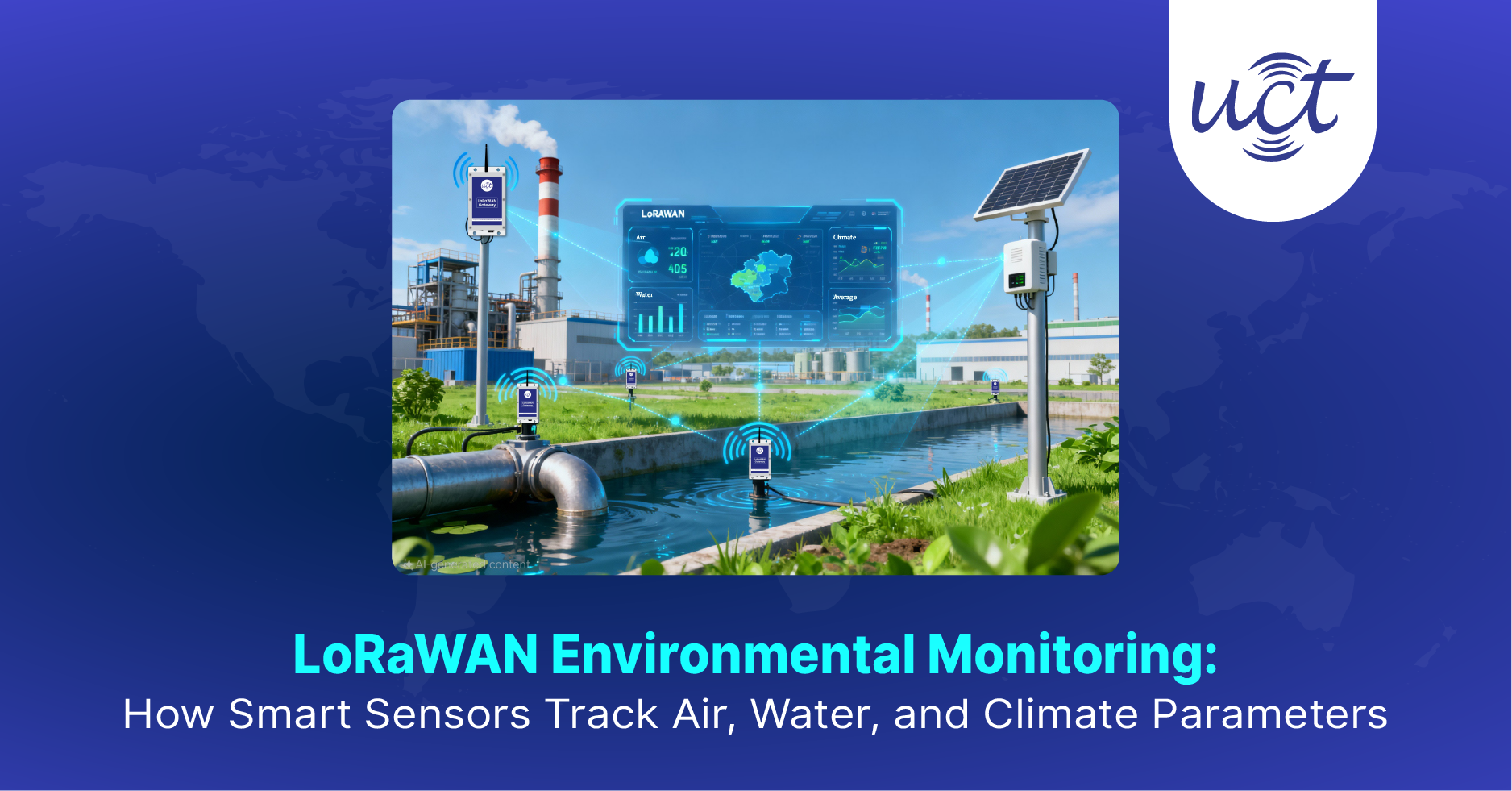
A typical LoRaWAN environmental monitoring setup includes:
- Sensor Nodes: Collect air, water, climate, or soil data and transmit via LoRa.
- Gateways: Receive sensor data and forward it to the internet.
- Network Servers: Manage devices, security, and routing.
- Cloud Platforms: Store, analyze, and visualize IoT environmental data via dashboards, reports, and alerts.
This architecture supports reliable, low-bandwidth, low-power communication across wide geographic areas, ideal for long-term environmental projects.
Turning Data into Insights: Analytics & AI
Modern LoRaWAN solutions go beyond raw measurement. They combine environmental sensing networks with analytics and AI to deliver:
- Predictive alerts: Early warnings for pollution spikes, weather events, or water contamination.
- Anomaly detection: Identifying sensor faults or unusual environmental patterns.
- Automated reporting: Simplified ESG and regulatory reporting.
- Smart sustainability dashboards: Visual tools for decision-makers in cities, industries, and environmental agencies.
This transforms monitoring from reactive to proactive environmental management.
Deployment Best Practices & Challenges
For successful LoRaWAN environmental projects, consider:
- Network design: Optimal gateway placement to ensure coverage in urban canyons, industrial areas, or remote sites.
- Sensor calibration: Regular calibration and maintenance for accurate data.
- Interoperability: Integration with existing SCADA, GIS, or legacy monitoring tools.
- Compliance: Adherence to local radio frequency regulations and data privacy laws.
Addressing these factors ensures reliable, scalable, and long-lasting deployments.
Measuring Sustainability Impact
LoRaWAN green IoT projects directly support sustainability and ESG goals by making impact measurable:
- Air quality: Reduced PM2.5/PM10 after interventions → improved public health.
- Water quality: Early detection of pollutants → safer drinking water and healthier ecosystems.
- Energy use: Battery-operated sensors and low-power networks → reduced energy footprint.
- Biodiversity: Habitat condition monitoring → better conservation planning.
Quantifiable outcomes help justify investments and build stakeholder confidence.
Security, Privacy & Trust in IoT Environmental Data
LoRaWAN ensures secure handling of IoT environmental data through:
- End-to-end encryption with unique keys
- Strong device authentication
- Integrity checks to prevent data tampering
Combined with certified network infrastructure and compliance with regional regulations, this builds trust in the data driving environmental decisions.
Customization & Scalability
LoRaWAN environmental monitoring solutions can be tailored to each project:
- Choosing sensors based on local climate, industry, or risk factors
- Tuning sampling rates and thresholds
- Starting with small pilots and scaling to city-wide or regional deployments
- Integrating with custom analytics platforms and reporting tools
This flexibility makes LoRaWAN suitable for governments, industries, campuses, smart cities, and conservation projects alike.
Conclusion: LoRaWAN as a Backbone of Smart Sustainability
LoRaWAN Environmental Monitoring brings together long-range wireless connectivity, low power usage, and intelligent analytics to create powerful eco-monitoring systems. By continuously tracking air, water, and climate parameters, it supports early pollution detection, better resource management, and data-driven climate strategies.