Introduction: Why IoT Needs the Right Protocols
Imagine millions of small devices spread across fields, cities, and factories, all trying to talk to the internet with tiny batteries and very limited power. That is the reality of the Internet of Things (IoT). The way these devices “talk” is defined by IoT communication protocols. Choosing the wrong protocol can mean dead batteries, lost data, and failed projects. Choosing the right one can mean reliable connectivity for years with almost no maintenance.
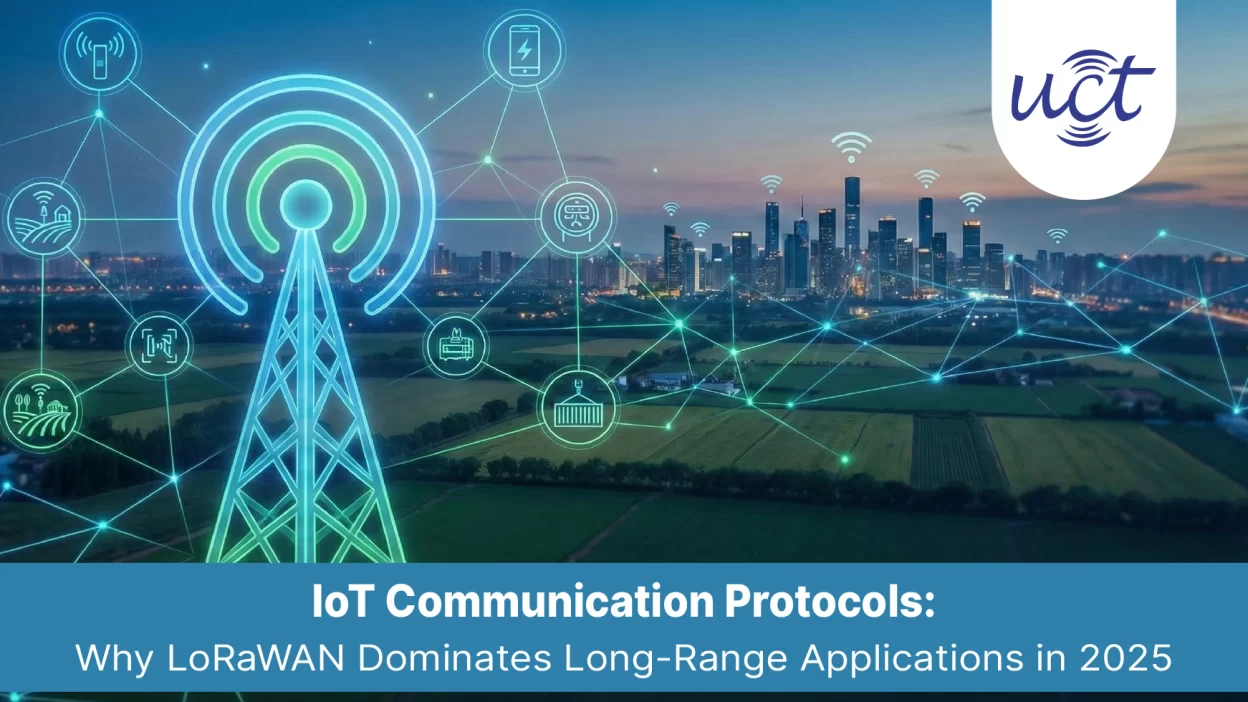
In 2025, LoRaWAN has become one of the most important IoT communication protocols for long‑range, low‑power use cases. While many protocols focus on speed or short‑range performance, LoRaWAN is designed to send small amounts of data over several kilometres using very little energy. This makes it ideal for applications like smart agriculture, smart cities, and industrial monitoring, where devices are spread out and often installed in places where changing batteries is difficult.
This blog will explain the basics of IoT communication protocols, compare the most popular options, and then show clearly why LoRaWAN dominates long‑range applications. The structure, headings, and keywords are chosen to be SEO‑friendly, so the article is easy to scan for search engines and humans, while the language stays simple and readable.
What Are IoT Communication Protocols?
IoT communication protocols are rules and standards that define how IoT devices exchange data with each other and with the cloud. They answer questions like:
- How is data packaged?
- How is it transmitted over the air or over wires?
- How is reliability, security, and power usage handled?
In simple terms, a protocol is like a language. If devices use the same language and follow the same rules, they can understand each other and transfer data safely and efficiently.
IoT protocols must deal with three main challenges:
- Devices often run on batteries for years, so power use must be extremely low.
- Devices may be very far from each other, especially in farms, mines, or city‑wide deployments.
- Networks must scale to thousands or millions of devices without collapsing under heavy traffic.
This is why IoT uses specialized protocols like LoRaWAN, MQTT, Zigbee, and NB‑IoT instead of just relying on classic internet protocols alone.
Protocol Layers: How Data Travels in IoT
To understand IoT communication protocols, it helps to think in layers. Each layer has a different role in moving data from a sensor to the cloud. A simplified view based on the OSI model is enough for most readers.
Physical and Data Link Layer
This is the layer that actually moves bits over a medium, such as radio waves or cables. In IoT, important technologies here are:
- LoRa (Chirp Spread Spectrum): A radio modulation technique used by LoRaWAN. It focuses on long range and robustness, not on high data rate.
- Zigbee (based on IEEE 802.15.4): A short‑range, low‑power technology used for mesh networks, often in homes and buildings.
At this layer, the key questions are: how far can the signal go, how much energy does it use, and how well does it resist interference?
Network and MAC Layer
This layer decides when devices are allowed to send data and how to avoid collisions.
- LoRaWAN MAC: Uses a variant of ALOHA, where devices transmit when they need to, with some rules to manage duty cycles and avoid overloading the airwaves.
- 6LoWPAN: Adapts IPv6 to work over low‑power wireless networks, typically used with technologies like IEEE 802.15.4.
Here the focus is on fairness, scalability, and efficient use of the limited radio spectrum.
Transport and Application Layer
These layers are closer to the actual application logic and cloud services.
Common IoT application/transport protocols include:
- MQTT: A lightweight publish/subscribe messaging protocol, great for sending data from devices to the cloud and back.
- CoAP: A simple protocol similar to HTTP but optimized for constrained devices over UDP.
- HTTP/HTTPS: Used when devices are powerful enough or when integration with web services is straightforward.
LoRaWAN itself defines confirmed and unconfirmed messages at this level: confirmed messages require an acknowledgment, unconfirmed do not. This helps balance reliability and power consumption.
Comparison of Popular IoT Communication Protocols
Search results for “IoT communication protocols” typically list multiple technologies, but they often stop at basic descriptions and do not dive deeply into real‑world trade‑offs like cost, battery life, and scale. To fill that gap, the table below compares popular protocols from a practical point of view, with a special focus on long‑range use.
Table: Key IoT Communication Protocols Compared
| Protocol | Typical Range | Data Rate (approx.) | Power Use (Device) | Cost per Node (relative) | Topology / Scalability | Best Use Cases |
| MQTT | Depends on network | Up to high speeds | Medium | Low | Scales well via brokers | Cloud messaging, gateways, backend |
| CoAP | Depends on network | Low to moderate | Low | Low | Good for small constrained nets | Simple request/response on small devices |
| Zigbee | 10–100 m | Up to 250 kbps | Low | Medium | Mesh; moderate scale | Home automation, building control |
| Wi‑Fi | 50–100 m indoors | Very high | High | Low to medium | Good for small networks | High data, local connectivity |
| LoRaWAN | 2–15 km (and more) | 0.3–50 kbps | Very low | Low | Very high (thousands of nodes) | Long‑range sensors, smart city, farming |
| NB‑IoT | Several kilometres | Low | Low | High (cellular module/SIM) | Scales via mobile network | Urban tracking, carrier‑grade solutions |
Key insights from this comparison:
- LoRaWAN and NB‑IoT are the main choices for truly long‑range, low‑power deployments.
- LoRaWAN tends to have lower per‑device cost because it does not require a SIM card or subscription in many setups.
- Zigbee and Wi‑Fi are better for short‑range, high‑density indoor networks, not for wide‑area coverage.
Why LoRaWAN Dominates Long‑Range Applications in 2025
Now that different protocols are clear, the question becomes: why does LoRaWAN stand out for long‑range IoT in 2025?
Long Range with Very Low Power
LoRaWAN is designed for situations where devices send small messages occasionally, but must stay connected over several kilometres. The combination of LoRa radio modulation and LoRaWAN network design allows:
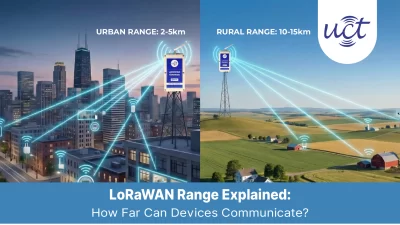
- Coverage of several kilometres in urban environments and even more in rural areas.
- Battery life of several years, even on small batteries, when messages are sent periodically (for example, once every few minutes or hours).
This balance of range and battery life is difficult to achieve with Wi‑Fi or Zigbee, which are more suited to short‑range use.
Simple, Scalable Architecture
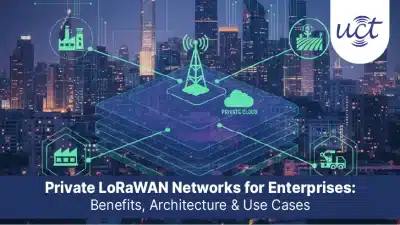
A typical LoRaWAN network has:
- End devices (sensors/actuators) in the field.
- Gateways that receive radio signals and forward them to a network server via IP.
- A network server that handles deduplication, security, and routing.
- Application servers that process data and integrate with dashboards or business systems.
This star‑of‑stars architecture means:
- Adding more devices does not always require more gateways; one gateway can cover a large area.
- The network can grow to thousands or even millions of devices with the right planning.
- The system can be managed centrally while devices remain simple and energy‑efficient.
2025 Enhancements and Ecosystem Maturity
By 2025, the LoRaWAN ecosystem has matured strongly:
- More gateways and end devices are available off‑the‑shelf.
- Open‑source network servers and commercial platforms make deployment easier.
- Tools for coverage planning, network monitoring, and optimization are more accessible.
This maturity reduces project risk and speeds up time to market, which is a key advantage over less established long‑range options.
Real‑World Value: ROI and Deployment Considerations
A strong protocol is not just about technical specs; it must also make financial sense. LoRaWAN often wins long‑range IoT projects because of the balance between coverage, device cost, and operational expenses.
Coverage vs Infrastructure Cost
Because LoRaWAN gateways can cover large areas, fewer base stations are needed compared to short‑range technologies. In many scenarios:
- A handful of gateways can cover an entire industrial site or a small city zone.
- Large rural farms can be monitored with a small number of well‑placed gateways.
This reduces infrastructure cost per square kilometre and makes projects more viable in low‑margin industries like agriculture.
Device and Maintenance Cost
LoRaWAN devices are typically:
- Simple, with low‑cost microcontrollers and radio chips.
- Able to run on batteries for several years without replacement.
- Easy to install and often maintenance‑free for long periods.
Long battery life and simple hardware translate into fewer site visits and lower maintenance budgets. Over a few years, this can be the difference between a profitable and an unprofitable IoT deployment.
Hands‑On View: How a Basic LoRaWAN Setup Works
To give readers a practical feel, it helps to show how a simple LoRaWAN deployment is structured. Below is a high‑level workflow rather than code, to keep the explanation clear and readable.
Basic Steps in a LoRaWAN Project
- Define the Use Case
- Example: soil moisture sensors across a farm, parking sensors in a city block, or temperature sensors in a warehouse.
- Select Devices and Gateways
- Choose LoRaWAN‑enabled sensors that match the measured parameter (temperature, humidity, level, etc.).
- Select indoor or outdoor gateways based on environment and mounting options.
- Plan Coverage
- Use maps and basic radio propagation rules to decide where to place gateways.
- Aim for overlapping coverage where possible to improve reliability.
- Register Devices on the Network Server
- Add device IDs and keys in the network server interface.
- Configure activation method (OTAA is preferred for higher security).
- Deploy and Test
- Install devices and gateways at planned locations.
- Send test messages to confirm good signal strength and data delivery.
- Integrate with Applications
- Connect the network server to your application or dashboard using MQTT or HTTP integrations.
- Set up alerts, charts, and reports.
Simple Data Flow Table
| Step | Component | Action |
| 1. Sense | LoRaWAN Device | Measures temperature/soil/level |
| 2. Transmit | LoRa Radio | Sends small packet over long distance |
| 3. Receive | Gateway | Captures packet and forwards via IP |
| 4. Process | Network Server | Decrypts, deduplicates, routes |
| 5. Deliver | Application | Stores, visualizes, triggers actions |
Explaining the process this way removes fear and shows readers that LoRaWAN is not “magic”; it is a structured flow that they can learn and use.
LoRaWAN Use Cases in 2025
To make the article engaging and useful, it is important to link the protocol discussion to concrete scenarios. Below are some of the strongest use cases where LoRaWAN dominates in 2025.
Smart Agriculture
In agriculture, fields are large, connectivity is poor, and devices must last for seasons with minimal maintenance. LoRaWAN fits perfectly for:
- Soil moisture monitoring to optimize irrigation.
- Weather stations across different zones.
- Livestock tracking over large grazing areas.
Benefits include better yields, reduced water usage, and fewer manual checks in the field.
Smart Cities
Cities need to monitor many small things spread over wide areas. LoRaWAN is often used for:
- Smart parking systems that detect free spots.
- Waste bins that report fill level.
- Street lighting that adjusts based on time or presence.
Because LoRaWAN can cover large parts of a city with a limited number of gateways, it reduces the cost of connecting thousands of devices on light poles, buildings, or underground.
Industrial IoT and Utilities
In industrial environments and utilities, LoRaWAN is used for:
- Monitoring of remote equipment like pumps, compressors, and tanks.
- Energy and water metering, especially in places where wired connections are difficult.
- Predictive maintenance, where sensors collect vibration or temperature data to detect future failures.
Here the advantage is the ability to connect hard‑to‑reach assets without pulling cables or relying on high‑power technologies.
Security, Hybrid Architectures, and Best Practices
Security is a common concern in IoT projects. LoRaWAN addresses this with a security model that uses keys and encryption at the network and application levels.
Security Basics in LoRaWAN
- Each device has unique keys for joining and for encrypting traffic.
- Data is encrypted end‑to‑end between the device and the application.
- Network‑level and application‑level security are separated, which improves flexibility and safety.
Good practices include using secure activation methods, rotating keys when possible, and restricting access to network server interfaces.
Hybrid Architectures: LoRaWAN with MQTT and Other Protocols
In many real deployments, LoRaWAN does not live alone. It is part of a hybrid architecture:
- Devices use LoRaWAN to send data from the field to gateways.
- Gateways forward the data to a network server.
- The network server then uses MQTT or HTTP to deliver data to cloud applications.
This approach combines the strengths of different protocols:
- LoRaWAN for long‑range, low‑power radio.
- MQTT or HTTP for flexible and scalable cloud integration.
How to Choose the Right IoT Communication Protocol
To help readers make a decision, a simple selection framework is helpful. Instead of long theory, ask a few direct questions.
Quick Decision Guide
- Do you need coverage over several kilometres and years of battery life?
→ LoRaWAN or NB‑IoT are your main options; LoRaWAN is often chosen when you want more control and lower recurring costs. - Are devices mainly indoors and close together, like in a home or office?
→ Zigbee, Wi‑Fi, or Bluetooth mesh can be more suitable. - Do you need to send large amounts of data like video or audio?
→ Wi‑Fi or cellular technologies are better, as LoRaWAN is designed for small, infrequent messages. - Do you need deep integration with cloud platforms and a wide developer ecosystem?
→ Using LoRaWAN for the field layer and MQTT/HTTP for the cloud layer gives both range and flexibility.
By walking through these questions, a reader can quickly see if LoRaWAN is the right fit for a project.
Final Thoughts: LoRaWAN’s Role in the Future of IoT
IoT communication protocols are the invisible layer that makes connected devices useful. In 2025, the landscape includes many strong options, but for long‑range, low‑power scenarios, LoRaWAN has established itself as a leading choice. Its mix of range, battery life, cost, and ecosystem support makes it ideal for smart agriculture, smart cities, and industrial monitoring.
For readers planning real projects, the key is to match protocol to use case. When the goal is to connect thousands of simple devices over wide areas with minimal maintenance, LoRaWAN should be at the top of the list. Combined with clear planning, good security practices, and proper integration to the cloud, it forms a solid foundation for scalable IoT solutions.