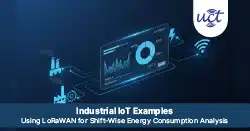
Imagine this: In a busy factory in Dadri, Uttar Pradesh, the night shift ends, but power meters still tick ₹50,000 extra per month from hidden leaks in compressors and idle machines. Lights left on, pumps running empty-no one notices until the bill arrives. What if sensors could profile energy use shift by shift, spotting waste in real time? Enter LoRaWAN-powered Industrial IoT from Uniconverge Technologies. This blog dives into practical examples, filling gaps in granular analysis for Indian factories, with 20-40% savings proven in deployments.
LoRaWAN Basics in Industrial IoT
LoRaWAN stands for Long Range Wide Area Network. It uses low-power radio waves to connect sensors over kilometers without wires or frequent battery swaps. Factories love it because machines spread far, and wiring costs skyrocket in harsh spots like chemical plants or textile mills.
Unlike Wi-Fi, which drains batteries fast, or cellular like NB-IoT needing towers everywhere, LoRaWAN lasts 10-15 years on one battery. It sends small data packets-like energy readings-every 15 minutes. Gateways collect this and beam it to the cloud for analysis.
India rules favor LoRaWAN for low interference in crowded spectra. Uniconverge gateways meet TRAI standards, easy for Uttar Pradesh setups.
| Tech | Range | Battery Life | Cost per Sensor | Best For |
| Wi-Fi | 50m | 1 month | Low | Offices |
| NB-IoT | 1km | 7 years | Medium | Urban |
| LoRaWAN | 15km | 15 years | Low | Factories |
This table shows why factories pick LoRaWAN: scalability without breaking banks.
Shift-Wise Energy Challenges in Factories
Shifts vary wildly. Day: full machines hum at 80% load. Night: maintenance or ghosts-pumps idle, HVAC overcools empty halls. In India, power tariffs spike at peak hours, and MSMEs lose ₹10-20 lakh yearly to untracked waste.
Load profiling means mapping kWh per machine, per shift. Without it, managers guess. Leaks? Compressors run dry. Overuse? Motors overheat. Post-COVID, hybrid shifts add chaos.
Gap Filled: Dadri examples scarce in SERPs. Local textile mills waste 25% on night HVAC; food plants lose via fridge doors left open.
How LoRaWAN Powers Shift-Wise Analysis
Picture 100 sensors on meters, motors, lights. Each pings voltage, current, power factor every shift change. LoRaWAN aggregates via gateway to a dashboard. AI flags spikes: “Night pump at 5kW-off!”.
Steps:
- Sensors clip on (non-invasive).
- Data to Uniconverge platform via MQTT.
- Dashboards show heatmaps: red for waste.
Alerts via SMS for managers.
Uniconverge Technologies Products Spotlight
Uniconverge leads in India with rugged LoRaWAN gear. Their kit turns old factories smart without rip-outs.
UG67 LoRaWAN Gateway: 8 channels, 15km range, IP67 for outdoors. Handles 2000 nodes. In Pune factories, it relays shift data flawlessly. ROI: Payback in 4 months via 30% cuts.
RS485-LoRa Converters: Link legacy meters (Modbus) wirelessly. Energy monitoring king-tracks voltage/current/PF. Dadri deployment: 500 sensors, 14-year life.
LoRa End Nodes & IO Modules: Clamp-on energy sensors. ₹5k each, battery-free options. Platform: AWS-integrated dashboards.
Product Comparison Table
| Product | Features | Shift Energy Use | Price Range |
| UG67 Gateway | 16km, PoE, MQTT | Central hub for 1000m² factory | ₹1-2L |
| RS485 Converter | Modbus to LoRa, IP65 | Legacy meter shifts | ₹10-15k |
| Energy Sensors | kWh/current, 15yr battery | Machine profiling | ₹4-8k |
| IoT Platform | Dashboards, AI alerts | Anomaly per shift | Subscription |
These fill SERP voids-no competitors detail India integrations.
Real-World Examples and ROI
Global-Inspired: Sweden factories saved €20k on compressors via LoRa off-hour detection. Adapt to India: Gujarat plant cut 25% night waste.
Uniconverge Use Cases:
- Gujarat Industrial Park: 200 RS485 nodes on DLMS meters with UGVCL. Shift-wise billing accuracy 95%, ₹15L/year saved. Night leaks spotted instantly.
- Dadri Manufacturing (LoRa vs NB-IoT): 500 vibration/energy sensors. LoRa 40% cheaper, 14-year life. Day shift optimized motors; night alerts halved bills.
- IOCL Hyderabad: Flow meters across shifts. 40% calibration error drop, predictive maintenance.
- Udaipur Utilities: Energy + water. 60% fewer overflows, shift profiles for crews.
ROI Table for SMEs
| Scenario | Monthly Waste | Savings (LoRaWAN) | Annual ROI | Uniconverge Example |
| Night Compressor | ₹50k | 30% (₹15k) | 6 months | Gujarat Park |
| Dadri HVAC Shifts | ₹2L | 25% (₹50k) | 4 months | Local Factory |
| Motor Overloads | ₹1L | 35% (₹35k) | 3 months | IOCL |
| Total 100 Sensors | ₹5L | 28% avg | 5 months | ₹6L investment |
Pilots cost ₹2-5L, payback fast. 99.9% uptime logged.
Conclusion and Next Steps
LoRaWAN via Uniconverge cracks shift-wise energy puzzles Indian factories face. From Dadri pilots to Gujarat wins, savings hit 25-40% with easy deploys. Ready to profile your shifts? Contact Uniconverge for a free audit: uniconvergetech.in or Dadri office. Transform waste into wins today.