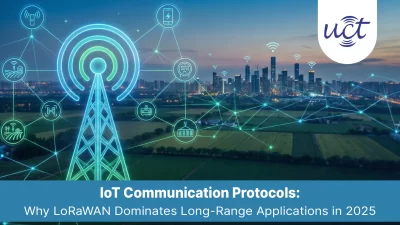
Imagine a small sensor on a factory roof in Mumbai, quietly sending water level alerts across the city to a control room—running for 10 years on one battery, no wires needed. That’s LoRaWAN communication in action, the smart way IoT devices talk long distances with tiny power use. Uniconverge Technologies makes this real for Indian businesses, from smart cities to factories, filling gaps like real tweaks and cost savings that others skip. This easy guide walks you through it all, step by step.
Core LoRaWAN Terms
LoRaWAN means Long Range Wide Area Network. It’s a simple set of rules letting far-apart devices share data safely and cheaply. The main LoRaWAN protocol uses special radio waves called LoRa modulation. These waves spread out like ripples in a pond, cutting through noise to travel far without losing strength.
A LoRaWAN network looks like a star with more stars inside. Devices send info to close gateways, which link to main servers. Uplink means data going from sensor to cloud. Downlink is cloud sending back orders, like “check again soon.” Spreading factor sets how far it goes—low for quick city sends, high for rural reach. Adaptive data rate, or ADR, smartly picks the best speed to save battery. Uniconverge tunes these for 30-40% less power in tough spots like crowded plants.
These words are your starting point. Now, meet the team that makes it work.
Device and Network Components
Start with the heroes: LoRaWAN end devices, nodes, or sensors. These are tough little boxes with a radio chip, brain chip, and sensors for heat, motion, or leaks. They sip power like a slow drip, lasting a decade on cheap batteries, even in rain or dust.
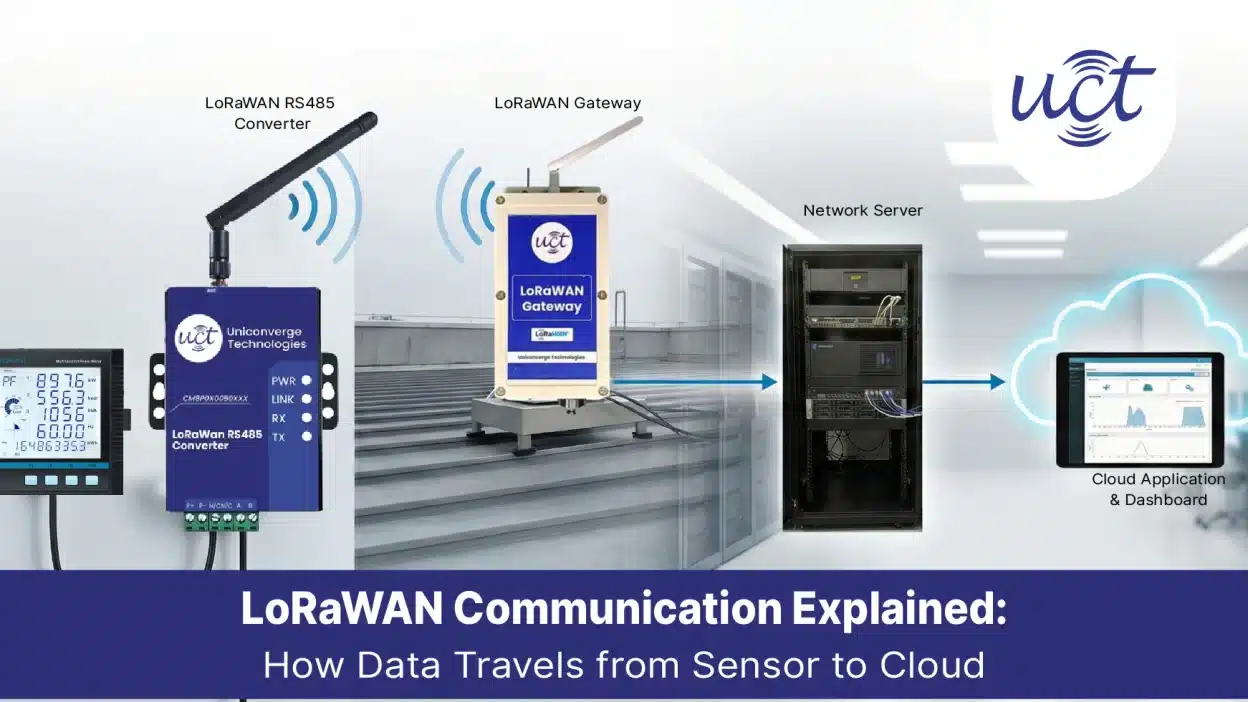
Gateways are the bridges. One unit grabs signals from hundreds of devices up to 15 km away and shoots them online via Wi-Fi or 4G. Uniconverge stacks them for no-drop zones, adding quick-think chips right at the gateway for fast local calls.
Network servers sort the mess—pick one signal if gateways overlap, check IDs, and fix speeds. Application servers turn raw numbers into charts, alerts, or app feeds. Uniconverge builds custom ones linking to your tools. Check this simple breakdown:
| Part | What It Does | Uniconverge Twist |
| Sensor/Node | Measures and sends data | 10-year life for city air checks |
| Gateway | Catches radio, sends to internet | Extra units beat city signal blocks |
| Network Server | Cleans, secures, tunes data | Always-on cloud for steady work |
| App Server | Shows data, runs apps | Your dashboards with easy links |
Together, they make data dance smoothly. Let’s follow one trip.
Data Flow: Sensor to Cloud
Your sensor stirs every 20 minutes. It grabs data—like “tank half full”—bundles it small, and beams an uplink to gateways. No password? It skips. Gateways pass it to the network server, which drops extras and adds tweaks.
Clean data hits the app server, then cloud storage for charts or emails. Downlink flips it: After sending, the sensor listens twice shortly for cloud replies, like new settings, without wasting power.
Uniconverge speeds this for urgent jobs, like factory alerts in seconds.
Quick Fix Tips (Your Edge): Many guides stop here, but try this: Watch signal strength (RSSI). Weak? Raise gateways or add helpers. ADR boosts speed 25% by auto-matching noise. In rainy India, Uniconverge tests spots first to hit 98% sends. Log losses under 1% easy.
Performance and Technical Concepts
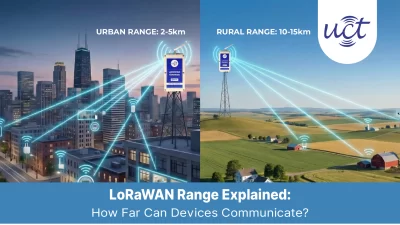
Range rocks: 2-5 km in cities, 15+ km open fields. Twist spreading factor up for walls, down for speed. Data zips 0.3 to 50 kbps—great for hourly pings, not movies.
LoRa modulation chirps frequencies like a sliding whistle, laughing at interference. ADR watches and shifts gears for best battery and reach.
Vs. Others (Smart Compare): See why LoRaWAN wins for spread-out sensors:
| Feature | LoRaWAN | NB-IoT | Sigfox |
| City Range | 2-5 km | 1-3 km | 3-5 km |
| Battery Run | 10 years | 5-8 years | 10 years |
| Speed | Up to 50kbps | 20-100kbps | Very slow |
| Setup Cost | Super low | Phone bills | Locked gear |
Uniconverge picks it for cheap growth in farms or plants.
Security and Reliability
Safety first: AES-128 locks data end-to-end. Air keys hide messages; app keys guard payloads. Each device has a unique tag—no fakes slip in. Counters stop repeat tricks.
It stays steady with airtime caps (1% talk max) and backups. Uniconverge goes extra: Swap keys daily, spot weird patterns with smart watches, meet India rules for safe data homes. Perfect for power grids or health checks.
Uniconverge LoRaWAN Solutions
Uniconverge turns talk into wins. Smart meters save 25% power in tests. Track tools cut lost time 20%. Eco-sensors spot pollution early.
Savings Math (Real Proof): 200 sensors: LoRaWAN $10k setup, 10-year run. Cellular? $30k + fees. Pocket $20k yearly. Mumbai water firm fixed leaks fast, saved lakhs.
Hot 2025 Ideas: Smart edges predict breaks. Mix with 5G for mega scale. Uniconverge adds sim-world tests and future-proof locks. Free chat? Start your trial now—go from idea to live in weeks.