Understanding LoRaWAN Technology
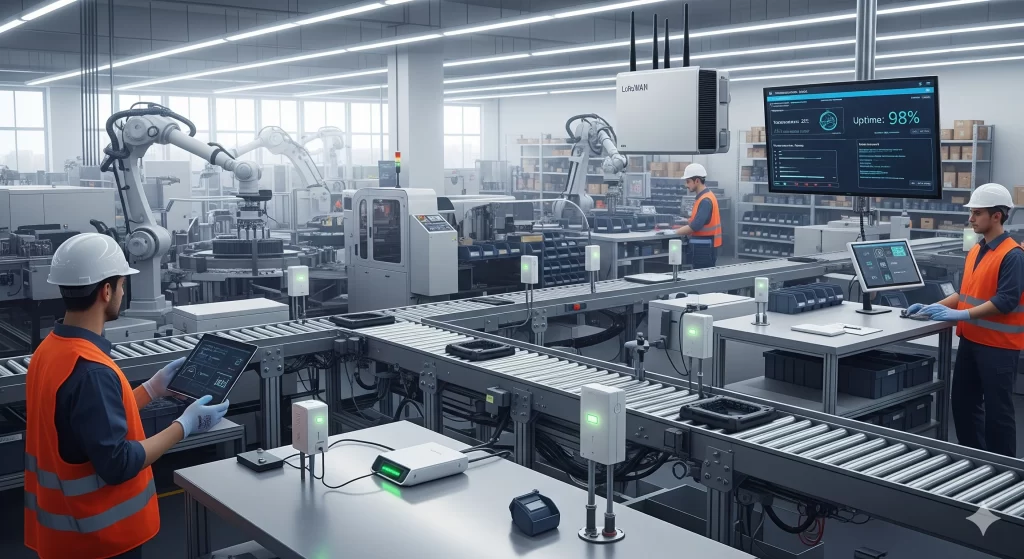
So, what’s LoRaWAN? It’s like a super-efficient messenger for your factory’s devices. LoRaWAN, or Long Range Wide Area Network, is a wireless technology built for the Internet of Things (IoT). Unlike Wi-Fi, which fades after a room or two, LoRaWAN sends signals up to 10-15 kilometers. And it’s stingy with power—devices can run for years on one battery.
Here’s how it works: sensors on machines or shelves collect data, like temperature or vibration. These “end devices” send info to gateways, which act like relay stations. Gateways then pass data to a cloud server for analysis. It’s secure, too, with encryption to keep data safe.
Why’s this great for smart manufacturing? Factories are huge, with metal walls that block signals. LoRaWAN cuts through, connecting thousands of devices without fuss. Compare it to other techs:
| Technology | Range | Power Use | Cost per Device | Best For |
|---|---|---|---|---|
| Wi-Fi | 50-100 meters | High | Medium | High-speed indoor data |
| Bluetooth | 10-100 meters | Medium | Low | Short-range device pairing |
| 5G | 1-10 km | High | High | Ultra-fast mobile networks |
| LoRaWAN | 10-15 km | Very Low | Low | Long-range IoT in factories |
LoRaWAN wins for low-cost, long-range needs. In 2025, its market is booming at $3.7 billion, growing 41% yearly. It’s not flashy like 5G, but it’s reliable—a workhorse for modern plants. New modules from companies are smaller and tougher, fitting right into factory setups. No wires, no hassle—just data flowing smoothly.
The Evolution of Smart Manufacturing
Smart manufacturing has come a long way. From steam engines in the 1700s to assembly lines in the 1900s, we hit Industry 4.0 around 2011. That’s when computers started talking to machines, creating “cyber-physical systems.” In 2025, it’s about connected factories where data drives every choice.
Old-school manufacturing has pain points. Workers check machines manually, missing issues until they explode into costly downtime. LoRaWAN changes that, linking devices into a real-time network. It fuels Industry 4.0’s pillars: automation, data exchange, and smart systems.
Without LoRaWAN, you’re stuck reacting to problems. With it, you predict them. It’s like upgrading from a flip phone to a smartphone—suddenly, everything’s faster and smarter. As we eye Industry 5.0, blending human and machine smarts, LoRaWAN is the foundation.
How LoRaWAN Revolutionizes Smart Manufacturing
How does LoRaWAN shake things up? It starts with connectivity. Wiring sensors in a factory is a headache—expensive and slow. LoRaWAN skips wires. Stick a battery-powered sensor anywhere, and it talks to the network instantly.
The revolution shows in three big ways. First, efficiency soars. Sensors spot issues like a hot pump before it fails, saving hours of downtime. Second, it scales easily. Need 100 more sensors? Add them without ripping up the floor. Third, it’s tough—signals cut through metal walls, perfect for messy factories.
Benefits pile up:
- Cost savings: Up to 30% less on maintenance.
- Scalability: One gateway handles thousands of devices.
- Flexibility: Remote updates mean no site visits.
- Reliability: Works in harsh settings like chemical plants.
LoRaWAN isn’t just for one industry. In pharmaceuticals, it tracks cleanroom conditions, dodging fines. In automotive, it monitors assembly lines, cutting errors by 25%. Aerospace uses it for part tracking, and electronics plants keep supply chains moving. It’s transforming operations across the board.
Integrating Data Analytics with LoRaWAN
LoRaWAN collects the data; analytics makes it sing. Sensors send info—vibration spikes, temperature shifts—to gateways, then to cloud platforms like AWS IoT or Azure. There, algorithms turn raw numbers into insights.
For example, predictive maintenance uses regression algorithms to spot patterns. A motor vibrating 15% more than usual? Analytics flags it for a check. Anomaly detection uses clustering to group normal readings and catch outliers, like a fridge going haywire. Optimization? AI simulates tweaks, like speeding up a conveyor belt.
In 2025, tools like Grafana or Power BI make dashboards that show real-time stats. AI takes it further, learning from LoRaWAN data to auto-fix minor issues. The result? Factories run 40% smoother, with less waste and smarter decisions.
Here’s the flow:
- Sensors collect data (e.g., machine health).
- Gateways relay it to the cloud.
- Analytics platforms crunch numbers.
- Dashboards or AI deliver actionable insights.
This combo—LoRaWAN and analytics—means decisions based on facts, not hunches, driving Industry 4.0 forward.
Key Applications and Case Studies
LoRaWAN shines in practical uses. Asset tracking: Sensors tag pallets, ensuring nothing gets lost. Environmental monitoring: Check humidity or air quality to protect products. Worker safety: Proximity sensors warn of dangers, like a forklift nearby.
Real-world wins prove it. A Volvo factory used LoRaWAN on robotic vehicles. Sensors tracked battery levels, predicting failures and cutting downtime by 35%. In pharma, a plant monitored cleanrooms, halving audit times with instant data. An electronics maker tracked chip supplies, trimming delays by 20%. In automotive, vibration sensors caught a faulty press early, saving $500,000 an hour.
| Industry | Application | LoRaWAN + Analytics Win | Savings/Improvement |
|---|---|---|---|
| Pharma | Compliance Monitoring | Real-time temp logs | 25% faster audits |
| Factory | Predictive Maintenance | Vibration alerts | 30% less downtime |
| Electronics | Supply Chain Tracking | Real-time material updates | 20% shorter delays |
| Automotive | Equipment Health | Failure predictions | 28% uptime boost |
These cases show LoRaWAN turning factories into data-driven winners.
Overcoming Challenges in LoRaWAN Adoption

LoRaWAN isn’t perfect. Latency: It’s great for hourly checks, not split-second needs. Legacy systems: Old machines don’t play nice with new tech. Security: Hackers eye industrial data. Costs: Sensors add up upfront.
Solutions make it doable. For latency, pair LoRaWAN with 5G for critical tasks. For integration, use MQTT protocols to link old and new. Security? Add encryption and blockchain for tamper-proof data. Costs? Savings hit fast—20% lower operations costs in year one. Vendors offer starter kits, and training is quick.
| Challenge | Solution | Outcome |
|---|---|---|
| Latency | Hybrid 5G + LoRaWAN | Fast critical responses |
| Legacy Systems | MQTT protocols | Smooth integration |
| Security | Encryption, blockchain | Hacker-proof data |
| Upfront Costs | Pilot small, scale later | 20% savings in year one |
These fixes turn hurdles into speed bumps, making LoRaWAN a smart bet.
Implementing LoRaWAN: A Practical Guide
Ready to start? Here’s how:
- Assess needs: Map your factory. Need vibration sensors for pumps? Temp checks for storage?
- Pick vendors: Choose reliable names like Semtech for chips or Actility for networks. Budget $50-200 per sensor.
- Pilot test: Start with 10 sensors, link to a dashboard like Tableau.
- Scale up: Add gateways (one covers 1km²) and integrate analytics.
Cost-benefit breakdown:
| Step | Time Estimate | Cost Range | Expected ROI |
|---|---|---|---|
| Needs Assessment | 1-2 weeks | $0 | N/A |
| Vendor Selection | 2-4 weeks | $1K-5K | Setup savings |
| Pilot Testing | 4-6 weeks | $5K-20K | 15% quick wins |
| Full Rollout | 2-3 months | $50K+ | 25% yearly savings |
Tips: Use open-source tools for cheap starts. Train teams with online courses. Track KPIs like data accuracy (aim for 99%). Your LoRaWAN factory is now live.
Future Trends in LoRaWAN for Smart Manufacturing
LoRaWAN’s future is bright. Edge computing processes data at gateways, cutting cloud delays. AI gets smarter, with models learning from LoRaWAN streams to auto-fix lines. Blockchain secures supply chains, making audits bulletproof. Sustainability? LoRaWAN tracks carbon footprints, supporting green goals.
By 2030, 80% of smart factories may use LoRaWAN. Pair it with 6G for denser networks, and you’ve got a hyper-connected plant. It’s evolving from a connector to the brain of manufacturing.
Conclusion
LoRaWAN technology is rewriting the rules for smart manufacturing. With data analytics, it predicts failures, cuts costs, and scales effortlessly. From pharma to automotive, it’s saving millions and boosting uptime. Challenges exist, but solutions are ready. The future—edge computing, blockchain, green tech—is already knocking.
Start a LoRaWAN pilot today. Your factory could be 30% smoother in months. Why wait? Comment below with questions—we’re here to talk LoRaWAN wins.