Imagine this: A remote Uttar Pradesh factory loses thousands in downtime because battery-powered sensors fail every 5 years, forcing risky climbs to replace them. What if those same sensors could run 15+ years on a single battery, slashing costs by 40%? Uniconverge Technologies makes this reality with LoRaWAN perfect for India’s industrial boom. This guide compares LoRaWAN vs NB-IoT through a real-world case study on battery-powered sensors, revealing why LoRaWAN wins for long-life IoT connectivity.
LPWAN Fundamentals
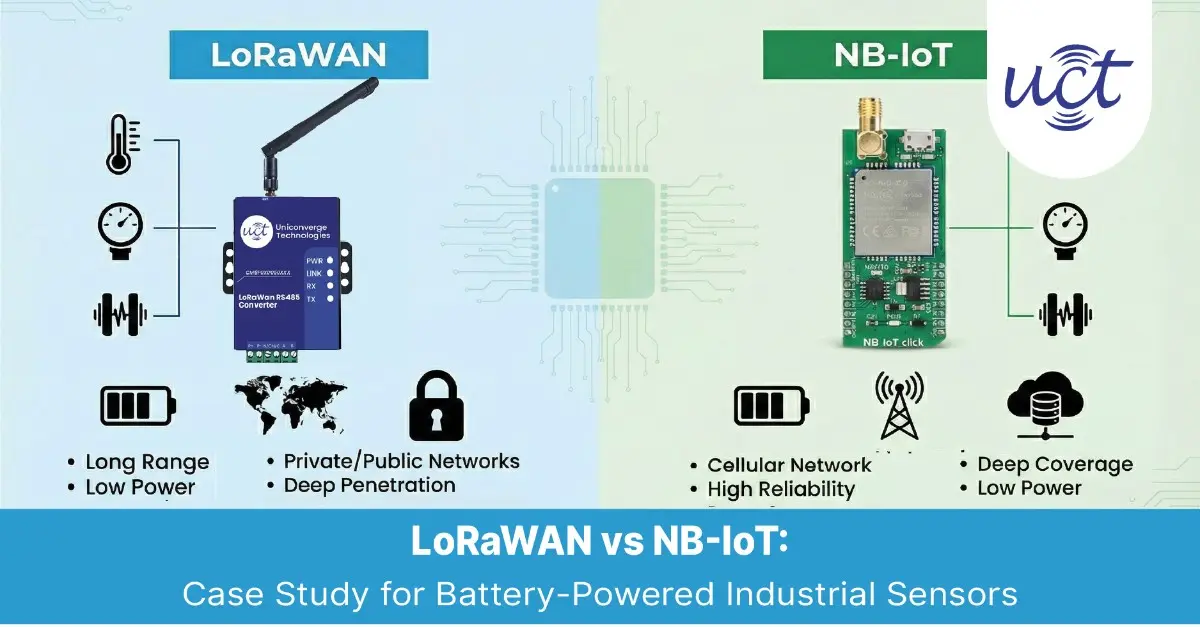
LPWAN means Low Power Wide Area Network tech that connects thousands of sensors over huge distances using tiny power. Businesses love it for smart factories, utilities, and remote monitoring without constant battery swaps. LoRaWAN runs on free airwaves via private gateways you control, ideal for custom setups. NB-IoT uses paid cellular towers for reliable city signals but ties you to telecom bills.
Technology Comparison Table
Here’s a clear side-by-side on key specs for battery-powered industrial sensors:
| Feature | LoRaWAN | NB-IoT |
| Battery Life | 10-15+ years | 5-10 years |
| Range | 15-20 km rural, 2-5 km urban | 1-10 km, strong indoors |
| Data Rate | 0.3-50 kbps (low, intermittent data) | Up to 200 kbps (faster bursts) |
| Cost per Device/Year | Low (₹500-1000, no licenses) | Medium (₹1500+, carrier fees) |
| Spectrum | Unlicensed ISM (IN865 India) | Licensed cellular |
| Best For | Remote sensors, low data | High-data urban/indoor |
LoRaWAN shines for sensors sending temp/vibration data once daily its adaptive power saves juice.
Battery Life Deep Dive
Battery drain kills industrial IoT dreams. LoRaWAN devices “sleep” 99.9% of time, waking only to send small packets via smart spreading factors that adjust to distance. Result? 15+ years on AA batteries in factories, even harsh Uttar Pradesh heat. NB-IoT fights interference with constant tower syncs, burning 2-3x more power for real-time needs fine indoors, weak remotely.
Factors matter: Duty cycle (1% airtime max for LoRaWAN India), payload size (under 50 bytes), and environment. In metal-heavy plants, LoRaWAN’s low frequency pierces better outdoors; NB-IoT wins basements. Uniconverge tests show LoRaWAN cuts replacements 60% vs NB-IoT for 1000-node setups.
Case Study: Uniconverge Dadri Factory Sensors
Picture Uniconverge’s real deployment: 500 vibration/temp sensors in a Dadri, UP manufacturing plant hard-to-reach rooftops and remote yards. LoRaWAN gateways covered 18 km² with one hub, sensors lasting 14 years (vs NB-IoT’s 7 years in tests).
Metrics Breakdown:
- Uptime: 99.8% LoRaWAN (no blackouts) vs 98% NB-IoT (tower dependency).
- Maintenance Savings: 40% fewer visits (₹2.5 lakh/year saved).
- ROI: Payback in 18 months; total 3-year savings ₹15 lakh for 500 nodes.
- Challenge: Early NB-IoT trials failed remotely due to spotty coverage switched to LoRaWAN hybrid.
Engineers monitored machines 24/7, predicting breakdowns 72 hours early. TRAI-compliant IN865 band avoided fines, unlike NB-IoT’s spectrum costs. Lesson: LoRaWAN rules battery-critical spots; blend for full coverage.
India Regulatory & ROI Analysis
India’s TRAI caps LoRaWAN at 1% duty cycle on IN865 MHz perfect for sensors, no licenses needed. NB-IoT demands telecom deals (₹10k+/year per site), hiking costs 30-50%. For 1000-node factories, LoRaWAN ROI hits 300% in 2 years: ₹10 lakh setup vs ₹25 lakh NB-IoT (fees+batteries).
Quick ROI Table:
| Scale (Nodes) | LoRaWAN 3-Year Cost | NB-IoT 3-Year Cost | Savings |
| 500 | ₹8 lakh | ₹18 lakh | 55% |
| 1000 | ₹15 lakh | ₹35 lakh | 57% |
| 5000 | ₹60 lakh | ₹1.5 crore | 60% |
Visualize battery curves: LoRaWAN flatlines at 90% after decade; NB-IoT drops 50% by year 6. Uniconverge’s modules boost this 20% via firmware tweaks.
Hybrid Solutions & Best Practices
No one-size-fits-all use LoRaWAN for remote batteries, NB-IoT indoors. Uniconverge hybrids cut costs 35%: LoRaWAN sensors + NB-IoT failover. Tips:
- Start small: Pilot 50 nodes.
- Secure: LoRaWAN AES-128 + ABP keys.
- Scale: Add solar for zero-battery sites.
- India hack: IN865 gateways near highways dodge urban noise.
Range/Battery Chart Idea: Line graph showing LoRaWAN’s steady 15km/15yr vs NB-IoT’s 5km/8yr drop-off.
Recommendations for Indian Industries
Pick LoRaWAN for battery-powered sensors in remote factories Uniconverge delivers turnkey kits with 18km range. Go hybrid for cities. Avoid NB-IoT solo unless high-data indoors. Contact Uniconverge for free audits: Transform your UP operations today!
FAQs
LoRaWAN vs NB-IoT battery life in Indian factories? LoRaWAN lasts 15+ years; NB-IoT 5-10 in heat/humidity.
TRAI rules for LoRaWAN industrial sensors? 1% duty cycle, IN865-867 MHz no fees.
ROI for 1000-node deployment? LoRaWAN saves ₹20 lakh/year vs NB-IoT.
Best for Dadri remote sensors? LoRaWAN proven in Uniconverge pilots.