
What is LoRaWAN?
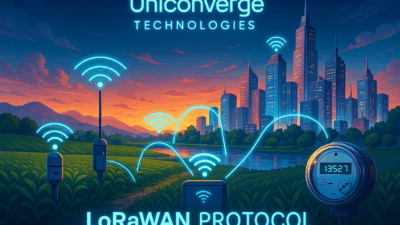
LoRaWAN (Long Range Wide Area Network) is a Low Power Wide Area Network (LPWAN) specification built on top of LoRa (Long Range) radio modulation technology. Developed by the LoRa Alliance, this open standard enables long-range communication between battery-operated devices and internet-connected applications over wireless networks.
The protocol operates in unlicensed radio frequency bands, making it accessible worldwide without requiring expensive spectrum licenses. LoRaWAN networks can span entire cities while supporting thousands of devices on a single gateway, making it ideal for IoT applications requiring wide coverage and minimal power consumption.
Key characteristics of LoRaWAN include:
- Long-range capability: Up to 15 kilometers in rural areas and 5 kilometers in urban environments
- Low power consumption: Devices can operate for years on a single battery
- High capacity: Single gateways can handle thousands of devices
- Secure communication: Built-in AES encryption and multiple security layers
LoRaWAN Network Architecture Overview
LoRaWAN architecture follows a star-of-stars topology, fundamentally different from traditional mesh networks. This design eliminates the need for complex routing algorithms and reduces network maintenance overhead.
The architecture consists of four primary components working in harmony:
- End Devices/Nodes: Sensors, actuators, and IoT devices that collect or act on data
- Gateways: Radio frequency bridges that relay messages between devices and network servers
- Network Server: The central brain managing device connectivity, data routing, and network optimization
- Application Server: The platform processing device data and enabling user interactions
This streamlined architecture enables efficient data flow from sensors to applications while maintaining security and scalability. The star-of-stars topology means devices communicate directly with gateways, which then forward messages to centralized servers, eliminating the complexity of peer-to-peer mesh networking.
Detailed Components of LoRaWAN Architecture

End Devices/Nodes and Device Classes
End devices form the foundation of any LoRaWAN network, collecting environmental data, monitoring equipment status, or controlling actuators. These battery-powered devices are designed for years of operation without maintenance.
LoRaWAN defines three device classes, each optimized for different use cases:
Class A (All Devices)
- Lowest power consumption mode
- Devices initiate uplink transmissions
- Two short downlink receive windows after each uplink
- Perfect for sensors reporting periodic data
- Examples: Temperature sensors, water meters, parking sensors
Class B (Beacon)
- Scheduled receive windows for downlink messages
- Devices synchronize with network beacons
- Enables server-initiated downlink communication
- Balanced power consumption and responsiveness
- Examples: Smart streetlights, irrigation controllers
Class C (Continuous)
- Continuously listening for downlink messages
- Highest power consumption but maximum responsiveness
- Ideal for mains-powered devices requiring immediate response
- Examples: Smart building controllers, industrial monitoring systems
Gateways: Indoor vs Outdoor Types and Use Cases
Gateways serve as the critical bridge between end devices and network infrastructure. They receive LoRa radio signals from devices and forward them to network servers via standard internet protocols.
Indoor Gateways
Indoor gateways typically provide coverage for buildings, offices, or small outdoor areas. These compact units offer:
- Coverage radius: 1-3 kilometers in urban environments
- Lower antenna gain but adequate for dense deployments
- Easy installation and maintenance
- Cost-effective for localized applications
- Use cases: Smart buildings, retail stores, small campuses
Outdoor Gateways
Outdoor gateways maximize coverage area and serve entire neighborhoods or rural regions:
- Coverage radius: 5-15 kilometers depending on terrain
- High-gain antennas and weatherproof enclosures
- Professional installation often required
- Higher capacity and performance
- Use cases: Smart cities, agricultural monitoring, industrial sites
Backhaul Connectivity Options for Gateways
Gateways require reliable internet connectivity to communicate with network servers. Several backhaul options accommodate different deployment scenarios:
Ethernet Connection
- Most reliable and lowest latency option
- Requires existing wired network infrastructure
- Ideal for indoor deployments and urban areas
Wi-Fi Connectivity
- Simple setup using existing wireless networks
- Cost-effective for small deployments
- Potential reliability concerns in congested environments
Cellular Backhaul (3G/4G/5G)
- Essential for remote locations without fixed broadband
- Higher operating costs due to data charges
- Excellent for rural agricultural or environmental monitoring
Satellite Connectivity
- Ultimate solution for extremely remote areas
- Higher latency and costs
- Suitable for specialized applications like maritime or polar monitoring
Network Server: Roles and Functionalities
The network server acts as the central nervous system of LoRaWAN architecture, managing all aspects of device connectivity and network optimization.
Core Functions:
Device Management
- Maintains device registrations and security credentials
- Tracks device locations and signal quality
- Manages device configurations and firmware updates
Adaptive Data Rate (ADR)
The network server continuously optimizes device transmission parameters:
- Adjusts spreading factor based on signal quality
- Modifies transmission power to minimize interference
- Balances battery life with communication reliability
- Maximizes network capacity by optimizing airtime usage
MAC Command Processing
Medium Access Control commands enable network optimization:
- LinkCheckReq/LinkCheckAns: Verifies connectivity and signal quality
- DevStatusReq/DevStatusAns: Monitors device battery and status
- NewChannelReq/NewChannelAns: Configures frequency channels
- DutyCycleReq/DutyCycleAns: Manages transmission duty cycles
Message Routing and Deduplication
- Routes messages between devices and applications
- Eliminates duplicate messages received by multiple gateways
- Implements security checks and message validation
Application Server
Application servers transform raw device data into meaningful insights and enable user interactions. They handle the business logic layer of IoT applications.
Primary Responsibilities:
- Process and store device data
- Implement application-specific logic
- Provide APIs for third-party integrations
- Generate alerts and notifications
- Create dashboards and reporting interfaces
- Manage device configurations and control commands
Join Server and Secure Device Activation Process
The join server manages the secure onboarding process for new devices joining the network. This component ensures only authorized devices can access the network while establishing encryption keys for secure communication.
Activation Methods:
Over-the-Air Activation (OTAA)
- Most secure and recommended method
- Devices use unique DevEUI, AppEUI, and AppKey credentials
- Dynamic session key generation for each activation
- Supports key rotation and enhanced security
Activation by Personalization (ABP)
- Pre-configured security keys programmed during manufacturing
- Faster deployment but less secure
- Fixed session keys throughout device lifetime
- Suitable for controlled environments with strong physical security
How LoRaWAN Operates
LoRaWAN operation follows a sophisticated yet elegant process ensuring reliable, secure communication across the network.
Message Flow Process:
- Uplink Transmission: End devices transmit data packets using LoRa modulation to nearby gateways
- Gateway Relay: Gateways receive radio signals and forward them to network servers via internet connectivity
- Server Processing: Network servers authenticate messages, eliminate duplicates, and route data to appropriate applications
- Application Processing: Application servers process device data and generate responses or control commands
- Downlink Response: If required, the network server queues downlink messages for delivery during the next receive window
Frequency Management:
LoRaWAN networks operate in unlicensed ISM bands (868 MHz in Europe, 915 MHz in North America, 923 MHz in Asia). The protocol employs frequency hopping to minimize interference and comply with regulatory duty cycle requirements.
Security Features in LoRaWAN Architecture
Security is paramount in LoRaWAN architecture, with multiple layers protecting against various threats.
Multi-Layer Security Architecture:
Network Security
- Unique Network Session Key (NwkSKey) for each device
- Message Integrity Code (MIC) validation
- Frame counter verification prevents replay attacks
- Device address verification
Application Security
- Separate Application Session Key (AppSKey)
- End-to-end encryption between device and application server
- Payload encryption independent of network layer
Join Security
- Secure device activation using AES-128 encryption
- Dynamic key derivation prevents key compromise
- Root key protection in secure elements
Key Benefits of LoRaWAN Architecture for IoT
LoRaWAN architecture delivers compelling advantages for IoT deployments:
Scalability
- Single gateways support thousands of devices
- Star-of-stars topology simplifies network expansion
- Minimal infrastructure requirements for wide-area coverage
Cost Efficiency
- Low device manufacturing costs
- Minimal network infrastructure requirements
- Unlicensed spectrum eliminates licensing fees
- Extended battery life reduces maintenance costs
Reliability
- Multiple gateways can receive the same message
- Adaptive data rate optimization
- Robust error correction and retry mechanisms
- Geographic redundancy through gateway diversity
Flexibility
- Support for various device classes and use cases
- Easy integration with existing IT infrastructure
- Vendor-agnostic open standard
- Customizable application layers
Real-World Applications of LoRaWAN in IoT

LoRaWAN architecture enables diverse IoT applications across industries:
Smart Cities
- Parking sensors optimizing urban mobility
- Environmental monitoring for air quality management
- Smart waste management reducing collection costs
- Street lighting control for energy efficiency
Agriculture
- Soil moisture monitoring for precision irrigation
- Livestock tracking and health monitoring
- Weather stations providing localized data
- Crop monitoring using various environmental sensors
Industrial IoT
- Asset tracking across large facilities
- Equipment condition monitoring
- Utility metering for water, gas, and electricity
- Supply chain visibility and logistics optimization
Environmental Monitoring
- Water quality monitoring in lakes and rivers
- Forest fire detection and monitoring
- Weather monitoring in remote locations
- Seismic activity monitoring
Challenges and Considerations in LoRaWAN Deployment
Despite its advantages, LoRaWAN architecture presents certain challenges:
Technical Considerations
- Limited payload size requires efficient data encoding
- Duty cycle restrictions limit message frequency
- Potential interference in densely populated areas
- Line-of-sight requirements for optimal performance
Deployment Challenges
- Gateway placement optimization requires careful planning
- Backhaul connectivity may be challenging in remote areas
- Device battery replacement logistics in large deployments
- Network security management complexity
Future Trends in LoRaWAN Architecture
LoRaWAN architecture continues evolving to meet emerging IoT requirements:
Technological Advancement
- Integration with edge computing for reduced latency
- AI-powered network optimization and predictive maintenance
- Enhanced security features including post-quantum cryptography
- Improved interoperability with other LPWAN technologies
Market Evolution
- Increased adoption in developing countries
- Integration with 5G networks for hybrid connectivity
- Growing ecosystem of specialized sensors and devices
- Standardization of vertical-specific applications
Conclusion
LoRaWAN architecture represents a paradigm shift in IoT connectivity, offering an elegant solution to the challenges of wide-area, low-power communication. Its star-of-stars topology, multi-layered security, and flexible device classes make it ideal for applications ranging from smart city infrastructure to precision agriculture.
Understanding LoRaWAN architecture is essential for anyone involved in IoT deployment. The technology’s combination of long-range capability, low power consumption, and cost-effective infrastructure creates opportunities for innovative applications that were previously impractical or prohibitively expensive.
As IoT continues expanding across industries, LoRaWAN architecture will play an increasingly important role in connecting the billions of sensors and devices that will shape our connected future. Whether you’re designing your first IoT application or scaling an existing deployment, the principles and components outlined in this guide provide the foundation for successful LoRaWAN implementation.
Ready to implement LoRaWAN in your next IoT project? Start by identifying your specific use case requirements, evaluating coverage needs, and selecting the appropriate device class for your application. With proper planning and understanding of LoRaWAN architecture, you’ll be well-equipped to create scalable, efficient IoT solutions that deliver real value.