1. Introduction: Why Smart Cities Need LPWAN
Kick off with that vivid hook I just painted—a story of chaos turning to calm in a typical Indian metro like Bengaluru or Pune. Explain urban headaches: exploding populations straining power grids, choked traffic wasting fuel, overflowing bins breeding disease, all while budgets shrink post-pandemic. Paint the picture of reactive cities vs. data-smart ones.
Then slide into LPWAN as the game-changer: low-power wide-area networks like LoRaWAN connect far-flung sensors without draining batteries or wallets. Unlike power-hungry Wi-Fi or pricey cellular, LoRaWAN stretches 10+ km, sips energy for 10-year battery life, and runs on free airwaves. Drop a stat: Cities using it cut energy bills by 30-50% on lighting alone. End by spotlighting Uniconverge as your local expert, deploying these in Indian smart projects from Kerala campuses to Mumbai utilities. This hooks readers emotionally, teases benefits, and slips in keywords naturally for SEO.
2. LoRaWAN Technology Basics (Made Simple)
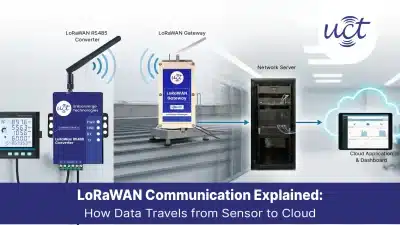
No jargon overload here—think of LoRaWAN like a whisper network for city sensors. Start with LoRa (the radio wave tech) and LoRaWAN (the full protocol stack). Sensors chat to nearby gateways (like post offices), which beam data to a central server, then to apps on phones or dashboards.
Key wins for cities:
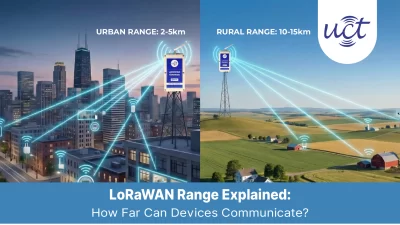
- Range magic: Hits 15 km rural, 2-5 km urban, even underground parking.
- Battery superstars: AA batteries last 5-10 years—no climbs needed.
- Device party: One gateway handles 1,000+ sensors.
Use a simple table to compare:
| Tech | Range | Battery Life | Cost per Node | Best For Cities? |
| LoRaWAN | 2-15 km | 5-10 years | Low | Yes—wide coverage |
| Wi-Fi | 50-100m | Days | Medium | Indoor only |
| Cellular | 1-5 km | 1-2 years | High | High-data apps |
| NB-IoT | 1-10 km | 2-5 years | Medium-High | Licensed spectrum |
This visual nails SEO (tables rank well) and clarifies why LoRaWAN rules smart infrastructure. Tie back to India’s 865-867 MHz band for local flavor.
3. Key Benefits of LoRaWAN for Smart Cities
Drill into four pillars with real-city examples. Coverage: Sensors in manholes or bridges ping alerts without extra wires—perfect for monsoon-flooded streets. Energy: Streetlights adjust to dusk/footfall, slashing 40% power in pilots like Dubai (adapt for Indian towns).
Cost: No spectrum fees mean 70% cheaper than 4G over 5 years. Scalability: Millions of nodes, AES-128 encryption keeps hackers out. Bullet benefits with mini-stories: “Picture Pune saving ₹5 crore yearly on lighting truck rolls.” Weave LSI keywords like “IoT communication” seamlessly.
4. LoRaWAN in Smart City Infrastructure: Top Use Cases
Group into bundles for easy scanning—readers love ready solutions.
- Smart Lighting Bundle: Motion sensors dim lights 70%, integrate with CCTV. Savings: 30-50% energy.
- Parking & Traffic Stack: Ultrasonic sensors free up 20% spots; dynamic signs cut circling 30%.
- Environmental Watch: Long-range sensors track PM2.5, noise—alerts via apps before Diwali smog spikes.
- Waste & Utilities Pack: Bin fill-levels optimize trucks 40%; water meters catch leaks fast.
Add India twist: “In Hyderabad’s smart bins pilot, collections dropped 35%.” Use bullets for scannability, images of sensors (cite if from stock), and a table for impact:
| Use Case | Sensors Needed | ROI Timeline | Uniconverge Edge |
| Smart Lighting | Accelerometers | 12 months | Pre-integrated gateways |
| Parking | Ultrasonic | 6 months | App-ready dashboards |
| Air Quality | Gas sensors | 18 months | India-calibrated nodes |
5. LoRaWAN Smart City Deployment Architecture + Gap: RF Design & Hybrids
Beyond basics, detail layers: Sensors → Gateways (rooftop-mounted) → Fiber/4G backhaul → Cloud server → Dashboards. Gap-fill: RF planning—urban canyons need 1 gateway per 2-4 sq km; use free tools like Semtech simulators.
New sub: Hybrid Strategy—LoRaWAN for low-data sensors, Wi-Fi/5G for video. Uniconverge blends them seamlessly.
6. Step-by-Step LoRaWAN Deployment Strategy + Gaps: Playbook & ROI
This is gold—SERP skips the how-to. Phase 1: Audit pains (e.g., 20% empty truck runs), set KPIs (50% energy cut). Phase 2: RF survey (drones map coverage), pilot 100 lights. Phase 3: Scale with OTA updates.
ROI Calculator Table (gap-filler):
| Item | Cost/Year (₹) | Savings/Year (₹) | Payback |
| 1,000 Lights | 2 Cr install | 80L energy | 2.5 yrs |
| 500 Bins | 50L | 25L fuel | 2 yrs |
| Total Pilot | 2.5 Cr | 1.05 Cr | 2.4 yrs |
India focus: Navigate TRAI rules, start with 100-cr municipal budgets.
7. Security and Reliability + Gap: Governance
Not just “encrypted”—explain keys at join, app, network levels. Best practices: Rotate keys yearly, monitor anomalies. Reliability: 95% packet delivery with redundant gateways. Gap: Data policies—GDPR-like for cities, anonymize citizen data.
8. Practical Challenges and Solutions + Gap: Operations
Urban interference? Elevate gateways 20m. Battery end-life? Plan 10% swaps yearly. Uniconverge’s playbook: Pre-tested kits cut risks 50%. Ops gap: Dashboards track 99.9% uptime, predict failures.
9. Uniconverge Technologies: Your Partner + Gap: Case Narratives
Showcase: Gateways, nodes, LNS hosting. Mini-case: “Tier-2 city deploys 5,000 sensors—traffic down 25%, via Uniconverge.” CTA: “Ready for your pilot? Contact us.”
10. Future of LoRaWAN in Smart Cities + Gap: Roadmap
AI edges analyze data for predictions; 6G backhauls scale. Roadmap: Year 1 pilot, Year 3 AI, Year 5 digital twins. LoRaWAN future-proofs India’s 100 smart cities.