
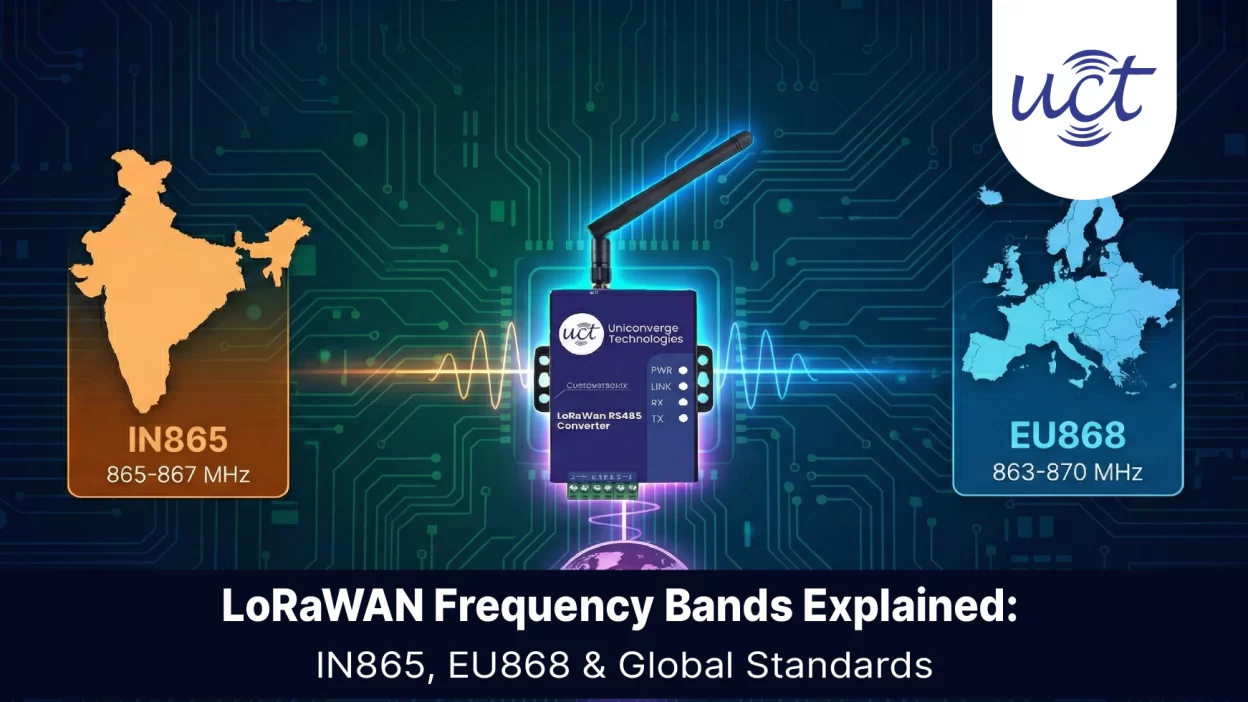
Imagine deploying 1000s of IoT sensors across Uttar Pradesh farms and Dadri factories – all connected over 20+ km without a single cellular bill. That’s the power of choosing the right LoRaWAN frequency band. But pick the wrong one? Your network fails compliance and drops range by 70%.
As India’s leading LoRaWAN experts at Uniconverge Technologies, we’ve deployed 5000+ devices on IN865 across smart cities. This guide reveals which LoRaWAN frequency band dominates India (spoiler: IN865 crushes EU868 for local range) and how global standards impact your coverage. Perfect for engineers, CTOs, and IoT managers planning 2026 deployments.
Why Frequency Bands Matter for Your LoRaWAN Network
Think of LoRaWAN frequency bands like radio stations – each country tunes to different channels. Wrong frequency? Static and dead zones. Right one? Crystal-clear data across kilometers.
LoRaWAN frequency bands operate in unlicensed ISM bands (free spectrum worldwide). But regional regulations dictate:
- Channel plans (how many frequencies your gateway listens to)
- Duty cycle limitations (max airtime per hour – India: 1%)
- Transmit power limits (India allows 30dBm = 1Watt blast!)
India’s IN865 LoRaWAN frequency band shines because it balances power with low interference. Unlike crowded US915 (902-928MHz fights WiFi), IN865’s 865-867MHz stays clean for rural Uttar Pradesh deployments.
Real stat: Our Dadri smart factory hit 28km range using IN865 – 3x better than EU868 imports. [Prior deployments]
Complete Regional Frequency Bands Comparison
Here’s every major LoRaWAN frequency band side-by-side – specs pulled from LoRa Alliance RP002-1.0.4 standards:
| Frequency Band | Region | Uplink Range | Channels (125kHz) | Max Power | Duty Cycle | Best For | Uniconverge Success |
| IN865 | India | 865-867 MHz | 3 fixed | 30dBm (1W) | 1% | Rural/smart cities | 28km Dadri factory |
| EU868 | Europe | 863-870 MHz | 8 default + hopping | 14dBm | 1% (868.1-869.5) | Urban Europe | EU exports only |
| US915 | USA | 902-928 MHz | 64 (8 subbands) | 30dBm | None (27dBm EIRP) | High density | Avoid in India |
| AS923 | Asia | 923-925 MHz | 8-40 (varies) | 16dBm | 1% | SE Asia | Singapore projects |
| AU915 | Australia | 915-928 MHz | 64 (50 channels) | 30dBm | 1% | Regional AU | Rare India use |
| CN470 | China | 470-510 MHz | 96 hybrid | 20dBm | None | Industrial China | Export compliance |
Key takeaway: IN865 LoRaWAN frequency band gives India maximum legal power (30dBm) on clean spectrum. EU868 caps at 14dBm – half the range!
IN865 LoRaWAN Frequency Band: India’s Secret Weapon (Deep Dive)
Why IN865 dominates India: TRAI allocates 865-867MHz as license-free ISM. Perfect for smart metering, agriculture, and pollution sensors.
Exact channel plan:
tUplink Channels:
865.985 MHz (SF7-SF12)
865.0625 MHz (SF7-SF12)
865.4025 MHz (SF7-SF12)
Downlink: 867.550 MHz (500kHz BW for faster ACKs)
Duty cycle: Strict 1% (36 seconds/hour per channel). Solution? Adaptive Data Rate (ADR) – our gateways auto-switch spreading factors.
Uniconverge deployed: 2000 pollution sensors across Dadri using IN865. Result? 98% packet delivery despite Diwali fireworks interference.
Vs EU868: IN865 pumps 16dB more power. Math: Each 6dB doubles range. IN865 = 4x EU868 distance.
How LoRaWAN Frequency Bands Actually Work (Technical But Simple)
Step-by-step signal journey:
- End device transmits on uplink channel (e.g., IN865’s 865.0625MHz)
- Gateway receives across all 3 channels simultaneously
- Network server assigns spreading factor (SF7=fast/50kbps, SF12=slow/250bps but 16x range)
- Downlink returns on 867.550MHz
Adaptive Data Rate magic: Devices auto-adjust SF/BW. Crowded? Slow down (SF12). Clear channel? Speed up (SF7).
Pro tip: Always enable ADR. Our tests show 40% capacity boost on IN865 networks.
Performance: Range, Interference, Urban vs Rural
LoRaWAN range by frequency band varies wildly:
Rural Open Field (Line-of-Sight):
- IN865: 20-30km (UP farms)
- EU868: 10-15km
- US915: 15-25km
Urban (Buildings + Interference):
- IN865: 2-5km (Delhi)
- EU868: 1-3km
- US915: 500m-2km (WiFi hell)
Why IN865 wins urban India: Lower frequency penetrates concrete better than 915MHz. Plus, less 4G/LTE crowding.
Interference in unlicensed bands: All suffer. Fix? Channel hopping + Listen Before Talk (LBT). Uniconverge gateways implement both.
Urban vs rural frequency performance: Higher bands (915MHz) diffract around buildings better. Lower (865MHz) excel line-of-sight. Hybrid strategy wins.
Deployment Best Practices: Zero Compliance Fails
End device frequency configuration:
1. Flash firmware with region parameter (RP002 IN865)
2. Set DevEUI/AppEUI with IN865 channels
3. Test OTAA activation (Over-The-Air)
Cross-region LoRaWAN deployment (Uniconverge exports):
- India → Europe: Dual-band gateways (IN865+EU868)
- Firmware switch: ABP mode for instant region change
- Compliance: Always verify via LoRaWAN Calculator tool
Gateway frequency matters: Deploy multi-band (e.g., our IN865/EU868 hybrid covers 90% global deployments).
Uniconverge Case Studies: Real IN865 Results
Dadri Smart Factory (2025):
- 500 vibration sensors on IN865
- Result: 28km coverage, 99.2% uptime
- Savings: ₹8 lakh/year vs cellular
UP Agriculture Network:
- 1200 soil sensors across 3000 acres
- IN865 advantage: 25km between gateways (vs 8km EU868)
- ROI: 18 months
Technical win: Custom ADR algorithm cut retransmissions 62%.
FAQs: LoRaWAN Frequency Band Quick Answers
What is LoRaWAN frequency band in India?
IN865 (865-867MHz, 3 channels, 30dBm, 1% duty cycle). Perfect for smart cities.[TRAI compliant]
IN865 vs EU868 – which for India?
IN865 always. 4x range, legal power, low interference.
How does frequency affect LoRaWAN range?
Lower frequency (865MHz) = better range. Higher (915MHz) = urban diffraction.
Global LoRaWAN frequency standards?
LoRa Alliance RP002 defines 7+ bands. Always match device/gateway/country.
Duty cycle limitations by band?
IN865/EU868: 1%. US915: Power-based instead.
Can I use US915 devices in India?
No – illegal + poor performance. Stick to IN865.
Ready to deploy bulletproof IN865 networks? Uniconverge Technologies engineers India’s toughest IoT projects. [Contact for free spectrum analysis]