| Picture this: A water pipe buried under a busy Delhi road silently bursts at 2 AM. No alarm rings. No engineer notices. By morning, 40 lakh litres of drinking water are lost and an entire lane is caved in. Now imagine the same pipe fitted with a thumb-sized IoT sensor. The moment pressure drops, an alert fires to a control room dashboard. A crew is dispatched before the road even cracks. That is not science fiction. That is LoRaWAN-powered smart infrastructure, and it is already working in Indian cities today. |
India is in the middle of the biggest infrastructure build-out in its history. Roads, bridges, water networks, power grids, industrial corridors billions of rupees are being committed every year. But here is the uncomfortable truth: most of this infrastructure is being built blind. It has no sensors, no connectivity, and no real-time visibility. When something breaks, we find out after the damage is done.
This blog explains how IoT and LoRaWAN technology change that equation and why Uniconverge Technologies is helping Indian cities, utilities, and factories build infrastructure that doesn’t just stand, but thinks.
What You Will Learn in This Blog
- What smart infrastructure really means and why it goes beyond just smart cities
- How LoRaWAN works and why it is the ideal protocol for large-scale deployments
- India-specific regulatory requirements (WPC, BIS, DoT) that most vendors skip
- Real use cases: street lighting, water networks, highways, factories, and more
- A 5-year Total Cost of Ownership (TCO) comparison between LoRaWAN and 4G/NB-IoT
- A step-by-step deployment roadmap from pilot to citywide scale
- Real Uniconverge deployments in Delhi NCR, Hyderabad, and Uttar Pradesh
- What comes next: AI, digital twins, and hybrid 5G + LoRaWAN architectures
1. What Is Smart Infrastructure? A Simple Definition
When most people hear ‘smart infrastructure’, they think of smart cities glowing dashboards in a control room, traffic lights that change automatically, apps that tell you where to park. That picture is accurate, but it is only one part of a much larger story.
Smart infrastructure is any physical system a road, a bridge, a water pipeline, a factory floor, a power grid that has been fitted with sensors and connectivity so it can communicate its own condition in real time. Instead of waiting for an engineer to come and inspect it, the asset reports on itself.
Think of it like this: a traditional bridge is just steel and concrete. A smart bridge has vibration sensors on its pillars, strain gauges on its beams, and water-level sensors near its foundations. If a truck that is too heavy crosses it, or if one pillar begins to show stress fractures, the system alerts an engineer immediately not six months later during a scheduled inspection.
India’s scale makes this urgent. Under the PM GatiShakti programme, India is building 25 industrial corridors, 100+ new airports, and thousands of kilometres of highways. Under Jal Jeevan Mission, it is piping drinking water to 19 crore rural households. Under the Smart Cities Mission, it is digitising 100 cities. None of this investment reaches its full potential without the intelligence layer that IoT provides.
2. Why LoRaWAN Is the Right Connectivity Technology
Before we talk about solutions, we need to understand the connectivity problem that infrastructure creates. Imagine a city with 50,000 street lights, 8,000 water meters, 200 flood sensors, and 500 waste bins all needing to send small data packets to a central system. How do you connect all of that, cheaply, reliably, and without changing batteries every year?
Most wireless technologies were not built for this kind of deployment. Here is the problem with the alternatives:
- Wi-Fi covers only 50–100 metres and drains batteries in weeks
- 4G and NB-IoT require a SIM card and recurring data charges per device that adds up to crores when you have tens of thousands of nodes
- Bluetooth is great for short range but useless across a city block
LoRaWAN (Long Range Wide Area Network) was designed specifically to fill this gap. It is a communication protocol built for IoT devices that need to send small amounts of data over long distances, using almost no power, at very low cost.
How LoRaWAN Works In Plain Language
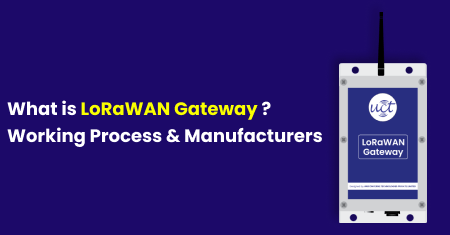
Think of LoRaWAN like a radio station. Your IoT sensor is a person whispering a short message. The LoRaWAN gateway is the radio tower that picks up the whisper from several kilometres away and sends it to a central server. That server then forwards the data to your dashboard or application.
The magic is in how efficiently it does this. A LoRaWAN sensor only wakes up when it has something to say maybe once every 15 minutes, or once an hour. The rest of the time, it is in deep sleep. This is why a single AA battery can last 7 to 15 years inside a LoRaWAN device.
LoRaWAN’s Key Technical Advantages
| Feature | LoRaWAN | NB-IoT / 4G | Wi-Fi |
|---|---|---|---|
| Range (Urban) | 2–5 km | 1–3 km (tower-dependent) | 50–100 m |
| Range (Rural/Open) | 10–15 km | Depends on tower density | 100–200 m |
| Battery Life | 7–15 years | 3–5 years | Days to weeks |
| Data Cost per Device | None (private network) | Monthly SIM charges | Broadband cost |
| Deep Indoor Penetration | Excellent | Good | Poor (walls block signal) |
| Devices per Gateway | 100,000+ | Limited by operator | 100–200 |
| Best For | Massive sensor deployments | High-data, mobile assets | Office/home devices |
3. India-Specific Regulatory Requirements (What Most Vendors Don’t Tell You)
| This section is critical for anyone planning a government smart infrastructure tender or municipal deployment in India. Most global LoRaWAN content skips Indian regulatory requirements entirely. |
Deploying LoRaWAN in India is not as simple as ordering hardware and installing gateways. There is a regulatory framework that governs wireless deployments, and getting this wrong can delay or invalidate your project especially on government infrastructure.
Here is what you need to know:
The IN865 Frequency Band
In India, LoRaWAN operates in the 865–867 MHz band, known as IN865. This band is designated for IoT and LPWAN use under WPC (Wireless Planning and Coordination Wing) licence-exempt rules. This means you do not need a per-device licence, but your gateway hardware must be certified for this specific band.
Required Certifications and Approvals
| Requirement | What It Covers | Who Needs It |
|---|---|---|
| WPC Type Approval | Gateway hardware operating on IN865 band | Every LoRaWAN gateway deployed in India |
| BIS Certification | End devices and sensors meeting Indian standards | All end-node sensors and devices |
| DoT Coordination | Deployments on civic or government-owned infrastructure | Municipal projects, public utilities |
| TRAI Compliance | Spectrum usage rules for unlicensed bands | Network operators and large deployments |
Uniconverge advantage: Uniconverge’s gateways and end-node sensors are BIS-compliant and DoT-approved for deployment. For municipal clients, Uniconverge manages end-to-end compliance. Regulatory approvals typically add 6–8 weeks to a deployment timeline plan for this in your project schedule.
4. Smart Infrastructure Use Cases: Where IoT + LoRaWAN Delivers Real Results
Here is where things get practical. These are not theoretical applications they are active deployments solving real infrastructure problems across India and the world.
A. Smart Street Lighting
Traditional street lights run at 100% power all night, whether there is anyone on the road or not. Smart street lights use motion and ambient light sensors to dim automatically when streets are empty and brighten when pedestrians or vehicles are detected.
Uniconverge deployed LoRaWAN-connected controls across 3,200 luminaires in Delhi NCR. The result: energy savings of 40–50%, remote fault detection, and elimination of manual patrol rounds. Each luminaire can be individually monitored and controlled from a web dashboard.
B. Water Infrastructure Leak Detection and Smart Metering
Water loss from leaking pipes is one of India’s most pressing infrastructure problems. Cities lose anywhere from 30% to 60% of treated water before it reaches taps largely due to undetected pipe bursts and illegal connections.
LoRaWAN-connected pressure sensors and flow meters installed at regular intervals along a water distribution network can detect pressure anomalies within minutes. A water meter running on LoRaWAN can operate for 7–10 years on a single battery, making it economical to deploy across entire distribution zones.
- Jal Jeevan Mission alignment: LoRaWAN metering enables the government to verify water delivery at the household level
- Ahmedabad’s smart water programme reported 20–30% water savings using IoT-enabled meters
- Uniconverge’s ML-based anomaly detection layer distinguishes genuine pipe bursts from legitimately high consumption events reducing false alarms significantly
C. Highway and Linear Infrastructure Monitoring
This is a use case that almost no competitor is covering in the Indian context, yet it is one of the most valuable applications for a country building thousands of kilometres of new highways every year.
The Hyderabad Outer Ring Road (ORR) project is a strong example. The ORR spans approximately 158 kilometres of highway infrastructure requiring automated irrigation management for the green belts along its entire length. Uniconverge implemented a LoRaWAN network to remotely control irrigation valves, monitor soil moisture sensors, and manage the entire corridor from a single control room without any new wired infrastructure along the route.
The same architecture can be applied to:
- Structural health monitoring of bridges and flyovers (vibration, tilt, strain sensors)
- Road surface condition monitoring (load cells, temperature sensors in asphalt)
- Pipeline monitoring for water, oil, and gas corridors
- Railway corridor asset tracking and perimeter security
D. Smart Buildings and Campuses
A single LoRaWAN gateway installed in a multi-storey building can communicate with hundreds of sensors through walls, floors, and concrete structures that would block Wi-Fi entirely. This makes LoRaWAN ideal for retrofitting older buildings with smart systems no rewiring required.
- HVAC optimisation based on real-time occupancy data
- Energy sub-metering by floor, zone, or tenant
- Access control integration and asset tracking
- Automated fire and flood early warning
E. Industrial Facilities and Factories
Indian factories especially in manufacturing hubs like Dadri, Pune, and Ahmedabad are increasingly adopting LoRaWAN for shift-wise energy monitoring and predictive maintenance. A factory losing ₹50,000 per month in idle-machine energy consumption often does not know it until the bill arrives.
Uniconverge’s industrial deployments have demonstrated 20–40% energy savings through granular shift-by-shift consumption profiling. In one Dadri plant, 500 vibration and temperature sensors covered an 18 km² facility from a single LoRaWAN hub — with sensors designed to last 14 years on a single battery.
F. Environmental Monitoring and Flood Early Warning
With climate patterns becoming increasingly erratic, cities need early warning systems for floods, air quality spikes, and extreme heat events. LoRaWAN’s low cost and long range make it practical to deploy hundreds of environmental sensors across a city for a fraction of what cellular-based equivalents would cost.
5. The Real Cost of Smart Infrastructure: A 5-Year TCO Breakdown
One of the most common mistakes organisations make when evaluating IoT solutions is comparing hardware prices instead of total cost of ownership (TCO). A lower-cost sensor that requires cellular connectivity can cost significantly more over five years than a slightly more expensive LoRaWAN device that runs for free on a private network.
Here is a structured comparison for a 1,000-node deployment:
| Cost Element | LoRaWAN (Private Network) | NB-IoT / 4G Cellular |
|---|---|---|
| Hardware per node | ₹3,000 – ₹6,000 | ₹4,000 – ₹8,000 |
| Gateway infrastructure | ₹80,000 – ₹1,50,000 per gateway (covers km²) | Relies on existing towers (operator-dependent) |
| Recurring data cost per device per year | ₹0 (private network) | ₹500 – ₹1,200 (SIM + data tariff) |
| Battery replacement cycle | Every 7–15 years | Every 3–5 years |
| Total 5-Year Cost (1,000 nodes) | ~₹1.2 – 1.8 crore (one-time + minimal ops) | ~₹2.8 – 3.5 crore (hardware + recurring tariffs) |
| 5-Year Cost Advantage | ✅ 40–60% lower | Baseline |
| Key insight: The cost advantage of LoRaWAN compounds over time. In year one, the difference is moderate. By year five, the elimination of per-device data tariffs for thousands of nodes creates a saving of crores — money that can fund the next phase of your smart infrastructure programme. |
For cities managing 10,000+ sensor nodes — a realistic number for a mid-sized Indian city — the five-year saving over a cellular-based alternative can exceed ₹10 crore. This is why municipalities that run the full TCO calculation almost always choose LoRaWAN.
6. From 50 Sensors to 50,000: Your Deployment Roadmap
| The most common failure mode in smart infrastructure is not a technology problem — it is a scaling problem. Cities run a 50-node pilot, declare success, and then stall on scaling because no one owns the procurement process for the next 5,000 nodes. Structure your pilot to answer procurement and integration questions, not just technology questions. |
Phase 1 — Assess and Pilot (Weeks 1 to 12)
- Conduct an RF (radio frequency) survey to map gateway placement and coverage across your target area
- Define clear, measurable KPIs before deploying a single sensor — e.g., 40% energy reduction, 95% meter-read accuracy, zero manual bin-collection trips to half-empty bins
- Deploy 100–200 nodes on a single high-impact use case (street lighting or water metering work well as pilots)
- Test integration with your existing dashboards, SCADA systems, or ERP platforms via standard APIs
- Use the pilot phase to map the procurement and governance process for scale — which department owns it, who approves budget, what is the maintenance model?
Phase 2 — Integrate and Validate (Months 3 to 6)
- Connect sensor data to your city management platform or operations centre
- Push OTA (over-the-air) firmware updates to all devices to test remote management capability
- Run the pilot long enough to capture seasonal variation — especially important for flood detection and irrigation systems
- Calculate actual vs. projected savings to build the business case for full-scale investment
Phase 3 — Scale and Optimise (Month 6 Onwards)
- Expand to additional use cases on the same gateway infrastructure — this is the ‘build once, deploy many’ model that delivers the best ROI
- Add an AI/ML anomaly detection layer on top of the sensor data
- Plan for battery lifecycle — for a 10,000-node network, approximately 10% of devices will need battery replacement each year; build this into your maintenance budget
- Establish roaming agreements if your deployment spans areas served by third-party networks
7. Uniconverge in the Field: Three Real Deployments
Case Study 1: Smart Street Lighting, Delhi NCR
| Parameter | Details |
|---|---|
| Deployment Scale | 3,200 LoRaWAN-connected luminaires across NCR |
| Technology | Uniconverge LoRaWAN gateways + dimmable LED controller nodes |
| Energy Savings | 40–50% reduction vs. fixed-schedule operation |
| Key Capability | Individual fault detection, remote dimming, real-time consumption monitoring |
| Maintenance Impact | Eliminated scheduled patrol rounds; faults self-reported within minutes |
Case Study 2: Irrigation Automation, Hyderabad Outer Ring Road
| Parameter | Details |
|---|---|
| Project Scope | 158 km of highway green belt irrigation management |
| Challenge | Remote valve control and soil moisture monitoring across a vast linear corridor with no existing wired infrastructure |
| Solution | LoRaWAN network covering the full 158 km corridor, connecting irrigation valves, motor controllers, and soil sensors to a central control room |
| Outcome | Precise water distribution, elimination of manual rounds, real-time alerts for valve faults or over-irrigation |
| Significance | One of the longest single LoRaWAN linear deployments in India |
Case Study 3: Industrial Energy Monitoring, Dadri, Uttar Pradesh
| Parameter | Details |
|---|---|
| Facility Type | Large-scale manufacturing plant |
| Deployment | 500 vibration and temperature sensors; RS485-LoRa converters on legacy Modbus meters |
| Coverage | 18 km² facility served by a single LoRaWAN hub |
| Battery Life | Devices rated for 14-year operation in industrial conditions |
| Energy Saving | 20–40% reduction through shift-wise load profiling |
| ROI | Typical payback period of 4 months through energy and maintenance savings |
8. What Comes Next: AI, Digital Twins, and 5G Hybrid Architecture
Smart infrastructure does not stop at sensor deployment. The next wave of value comes from what you do with the data those sensors generate. Three emerging capabilities are going to significantly raise the ceiling on what smart infrastructure can deliver.
AI and Machine Learning on Top of Sensor Networks
The sensors already generate the data. An ML layer on top of that data is what turns raw readings into actionable intelligence.
Uniconverge is actively integrating ML-based anomaly detection into its water metering deployments. The models are trained to distinguish a genuine pipe burst from a legitimately high-consumption event — based on network-wide patterns, not just a single meter reading. This dramatically reduces false alarms while catching real issues faster.
Similar AI applications are emerging for predictive maintenance (flagging machines before they fail), traffic forecasting (predicting corridor congestion three hours ahead), and transformer health monitoring (identifying transformers likely to fail before they cut power).
Digital Twins for Infrastructure Management
A digital twin is a live virtual replica of a physical asset — updated in real time by sensor data. Imagine a digital twin of Delhi’s water distribution network: every pipe, every valve, every pump represented in a 3D model, with live flow and pressure data streaming in from thousands of LoRaWAN sensors. Engineers can simulate what happens if one zone’s supply is cut, or test a new routing plan, without touching the physical network.
Uniconverge’s digital transformation practice builds the connectivity and analytics backbone that digital twins run on — making this capability accessible for Indian cities and industrial facilities.
Hybrid LoRaWAN + 5G Architecture
5G and LoRaWAN are not competing technologies. They are designed for different problems and they work best together. LoRaWAN handles the massive, distributed, low-power sensor layer — the bins, the streetlights, the water pipes, the air quality monitors. 5G handles applications that need real-time video, high-bandwidth backhaul, or ultra-low latency — like traffic cameras, emergency response systems, or autonomous vehicle corridors.
Uniconverge’s next-generation gateways support both protocols, which positions cities to build toward more complex Smart Cities 2.0 applications without replacing their existing LoRaWAN infrastructure.
9. Common Challenges — And How to Solve Them
| Challenge | Why It Happens | How to Solve It |
|---|---|---|
| Urban RF interference | Dense buildings, metal structures, competing wireless signals | Elevate gateways 15–20m above ground; use directional antennas in dense areas; run an RF survey before deployment |
| Data security concerns | Sensors transmitting on unlicensed spectrum can be intercepted | LoRaWAN’s AES-128 end-to-end encryption is robust; rotate device keys annually; monitor for join anomalies |
| Legacy system integration | Existing SCADA, PLCs, and Modbus meters don’t natively support LoRaWAN | Use RS485-LoRa converters (Uniconverge supplies these) to bridge legacy systems without replacement |
| Procurement stalls at scale | No one owns the process for scaling from pilot to full deployment | Structure the pilot to answer procurement questions; define the full-scale budget and approval chain in Phase 1 |
| Data privacy for city deployments | Citizen-facing infrastructure collects location and consumption data | Anonymise device data at the application layer; comply with India’s Digital Personal Data Protection Act, 2023 |
| Packet loss in large networks | Duty cycle limits and gateway placement gaps | Achieve 95%+ packet delivery with redundant gateways at strategic locations; use adaptive data rate (ADR) |
10. Why Uniconverge Technologies?
There are dozens of LoRaWAN vendors globally. Very few of them have deployed infrastructure at the scale described in this blog across Indian conditions, under Indian regulations, serving Indian government clients.
Here is what makes Uniconverge’s position unique:
- Made in India: Uniconverge’s gateways and sensors are designed and assembled in India, which matters for government procurement (Make in India preference) and for support response times
- End-to-end capability: RF survey and network design → hardware procurement → application layer development → ongoing network management — all under one roof
- Regulatory compliance built in: BIS-certified devices, DoT-approved gateways, and a team that manages WPC approvals for municipal clients
- Proven at scale: From 3,200 streetlights in NCR to a 158 km highway corridor in Hyderabad to industrial plants in Uttar Pradesh
- Future-ready hardware: Next-generation gateways supporting LoRaWAN + 5G hybrid architecture
- AI integration roadmap: Active development of ML anomaly detection on top of sensor networks
Conclusion: The Time to Build Smart is Now
India is building infrastructure at a scale and pace that the country has never seen before. The decisions made right now — which protocols to use, which vendors to choose, which data architectures to adopt — will shape these networks for the next 15 to 20 years.
LoRaWAN + IoT is not an experimental technology. It has passed 125 million deployed devices globally, growing at 25% per year. It is running in more than 100 cities worldwide. It is being used to monitor water networks, control highways, automate factories, and optimise energy grids at a cost that makes it viable for even mid-sized Indian cities with budget constraints.
The infrastructure you are building today will either be intelligent — or it will need to be retrofitted at great expense in five years. The sensor layer costs a fraction of the civil works. The ROI is measurable in months, not years.
| Ready to start your smart infrastructure pilot? Uniconverge Technologies offers a free RF survey and deployment scoping session for cities, utilities, and industrial facilities across India. Talk to our team to scope your first 100-sensor pilot and build the business case for citywide scale. |
Frequently Asked Questions
What is the difference between LoRa and LoRaWAN?
LoRa refers to the physical radio modulation technology (the signal itself). LoRaWAN is the full network protocol built on top of LoRa — it defines how devices join a network, how data is routed and encrypted, and how the system manages thousands of devices simultaneously. When deploying for smart infrastructure, you are always deploying LoRaWAN, not just LoRa.
Do I need a spectrum licence to deploy LoRaWAN in India?
No. LoRaWAN operates in the IN865 licence-exempt band in India. However, your gateway hardware must have WPC type approval, your end devices must be BIS-certified, and deployments on government or civic infrastructure require DoT coordination. Uniconverge manages all of this for its clients.
Can LoRaWAN handle thousands of sensors in a dense city environment?
Yes. A single Uniconverge LoRaWAN gateway can handle 100,000 or more sensor nodes within its coverage area, using adaptive data rate (ADR) technology to manage the channel efficiently. For very dense deployments, additional gateways are placed to provide redundancy and increase throughput the network is designed to scale horizontally.
What happens to existing infrastructure? Do we need to rip and replace?
No. LoRaWAN integrates with legacy infrastructure using RS485-LoRa converters and Modbus bridges. Existing electricity meters, water meters, and industrial sensors can be connected to the LoRaWAN network without replacement just an adaptor. This dramatically reduces the cost and disruption of a smart infrastructure rollout.
How long does a LoRaWAN deployment take?
A well-scoped 200-node pilot can be live in 8 to 12 weeks, including the regulatory approval period. A full-city rollout of 5,000 to 10,000 nodes typically takes 6 to 12 months depending on scale, terrain, and integration complexity. Uniconverge has pre-tested deployment kits that cut typical risk factors by around 50%.
─────────────────────────────────────
© 2025 Uniconverge Technologies Pvt. Ltd. | uniconvergetech.in
Made in India | Industrial IoT | Smart Infrastructure | LoRaWAN Solutions