
Introduction
The Internet of Things (IoT) continues to transform industries by connecting devices and enabling intelligent decision-making. At the core of this transformation is LoRaWAN technology, a communication protocol designed for long-range, low-power wireless networks. By enabling devices to transmit data over several kilometers with minimal energy consumption, LoRaWAN modules have become essential components in IoT ecosystems spanning agriculture, healthcare, manufacturing, smart cities, and logistics.
Uniconverge Technologies specializes in delivering customized IoT solutions built around state-of-the-art LoRaWAN modules and gateways. Selecting the right module is a fundamental step that can determine the success of your smart device deployment. This guide walks you through everything you need to know about choosing an optimal LoRaWAN module, taking into account technical specifications, application requirements, environmental factors, security considerations, and real-world insights.
What is a LoRaWAN Module?
A LoRaWAN module is a compact communication device embedded in IoT sensors or endpoints that transmits data wirelessly using LoRa (Long Range) modulation and the LoRaWAN protocol. It enables efficient communication over long distances at low bit rates, making it ideal for battery-powered devices in remote or wide-area deployments.
Core Components of a LoRaWAN Module

- LoRa Transceiver Chip: The heart of the module that modulates and demodulates radio signals using chirp spread spectrum technology, providing robust and long-range communication.
- Microcontroller Unit (MCU): Handles the processing of data, protocol management, and peripheral interfacing.
- Power Management System: Optimizes energy consumption by facilitating sleep modes and managing battery use.
- Radio Frequency (RF) Front-End: Includes the antenna and circuitry responsible for signal amplification and filtering.
- Interfaces: Support for UART, SPI, I2C, and GPIO to connect with various sensors and actuators.
Uniconverge Technologies offers a variety of modules tailored for different industries, ensuring seamless integration, reliability, and regulatory compliance.
Why Choosing the Right LoRaWAN Module Matters
Selecting an unsuitable module could lead to connectivity issues, poor battery performance, non-compliance with local regulations, or security vulnerabilities. Conversely, the right module improves device lifespan, data reliability, and network scalability, ultimately maximizing return on investment.
Key Factors to Consider When Selecting a LoRaWAN Module
1. Frequency Band and Regulatory Compliance
Different countries allocate specific frequency bands for LoRaWAN use, such as 868 MHz in Europe, 915 MHz in North America, 923 MHz in Asia-Pacific, and 865 MHz in India. Utilizing modules that support the appropriate regional bands and have necessary certifications (such as WPC and DoT approval in India) is essential for lawful operation and minimizing interference.
Uniconverge modules cover multiple bands and are compliant with Indian regulations, ensuring reliable deployment and consistent performance.
2. Communication Range and Signal Sensitivity
Modules with high receiver sensitivity (down to -140 dBm in some cases) can detect weaker signals, enabling greater transmission distances—sometimes up to 15 kilometers in open rural areas. However, real-world range varies depending on factors such as building density, terrain, and atmospheric conditions.
Urban and industrial deployments often require modules with advanced interference tolerance and optimized antenna design to maintain connectivity across shorter distances typically ranging from 2 to 5 kilometers.
3. Power Consumption and Battery Life
Low power consumption is critical for battery-operated IoT devices, especially those in remote or hard-to-access locations. Sleep current under 5 microamperes and configurable transmit power (typically between 14 and 20 dBm) are vital specifications to consider. Modules supporting advanced power-saving modes can extend device operation from several months to years without battery replacement.
Uniconverge designs its modules to optimize for low energy consumption while maintaining communication reliability.
4. Security Features
With growing cyber threats targeting IoT networks, security mechanisms built into LoRaWAN modules are indispensable. Features to look for include AES-128 or AES-256 encryption, secure key storage, mutual authentication, and secure boot functionality. Support for Over-the-Air (OTA) firmware updates also ensures ongoing protection by allowing remote patching of software vulnerabilities.
Uniconverge’s solutions prioritize security to guard data integrity and network safety.
5. Interfaces and Integration
The variety of sensors and actuators in IoT applications requires flexible hardware interfaces. Modules should ideally offer UART, SPI, I2C, and multiple GPIO pins to simplify connectivity and enhance functionality.
An integrated microcontroller with adequate processing power and memory enables complex sensor data handling and reduces the need for additional components.
6. Environmental Durability
For outdoor and industrial use cases, modules must withstand harsh environmental elements including moisture, dust, vibration, and extreme temperatures. Look for Ingress Protection (IP) ratings such as IP65 or higher, and operational temperature ranges from -40°C to +85°C.
Uniconverge rigorously tests its modules to ensure resilience and longevity in demanding settings such as farmlands, factories, hospitals, and city infrastructure.
Application-Based Selection Framework
Choosing a LoRaWAN module also depends heavily on the specific industry and application. Below is a simplified framework to align your needs:
| Industry | Priority Features | Use Cases | Uniconverge Product Examples |
|---|---|---|---|
| Agriculture | Long range, low power, weather-resistant | Soil moisture sensing, crop monitoring | 14DI to RS485 Module, RS485 to LoRa Converter |
| Healthcare | Secure data, low latency, battery efficiency | Remote patient monitoring | Secure OTA-enabled LoRa Modules |
| Manufacturing | Interference immunity, fast response | Equipment monitoring, automation | 8DI 8DO to RS485 Modules |
| Logistics | GPS compatibility, live tracking | Fleet management, asset tracking | GPS-integrated RS485 to LoRa Converters |
| Smart Cities | Scalability, urban penetration | Pollution monitoring, smart lighting | Multi-band IoT Gateways |
This framework simplifies decision-making, matching module capabilities with deployment goals.
Technical Specifications to Compare in Detail
| Specification | Typical Range or Values | Why It Matters |
|---|---|---|
| Frequency Bands | EU868, US915, AS923, IN865 | Legal compliance and interference avoidance |
| Max Transmission Power | 14-20 dBm | Signal strength and battery usage |
| Receiver Sensitivity | Down to -140 dBm | Ability to detect weak signals |
| Data Rates | 0.018 kbps to 62.5 kbps | Affects speed and energy efficiency |
| Sleep Current | <5 microamperes | Battery life extension |
| Operating Temperature | -40°C to +85°C | Hardiness in extreme conditions |
| Interfaces | UART, SPI, I2C, GPIO | Sensor and peripheral compatibility |
| Security Features | AES-128/256 encryption, secure key storage | Protects against data and network breaches |
| OTA Firmware Updates | Supported | Enables remote updates and security patches |
Uniconverge’s products meet or exceed these requirements, ensuring they are future-ready and performant.
Real-World Insights and Field Testing
Datasheets and technical specs only tell part of the story. Practical performance depends on conditions such as:
- Obstructions and Campus Layout: Buildings and trees attenuate signals.
- Weather Influences: Rain, humidity, and temperature can impact reliability.
- Wireless Congestion: Coexisting technologies like Wi-Fi can introduce noise.
- Power Profile in Operation: Actual data transmission vs standby power impacts battery life.
Uniconverge performs extensive field tests across different environments—farms, factories, urban sites—to offer clients trusted data and deployment advice tailored to their specific needs.
Troubleshooting and Maintenance Best Practices
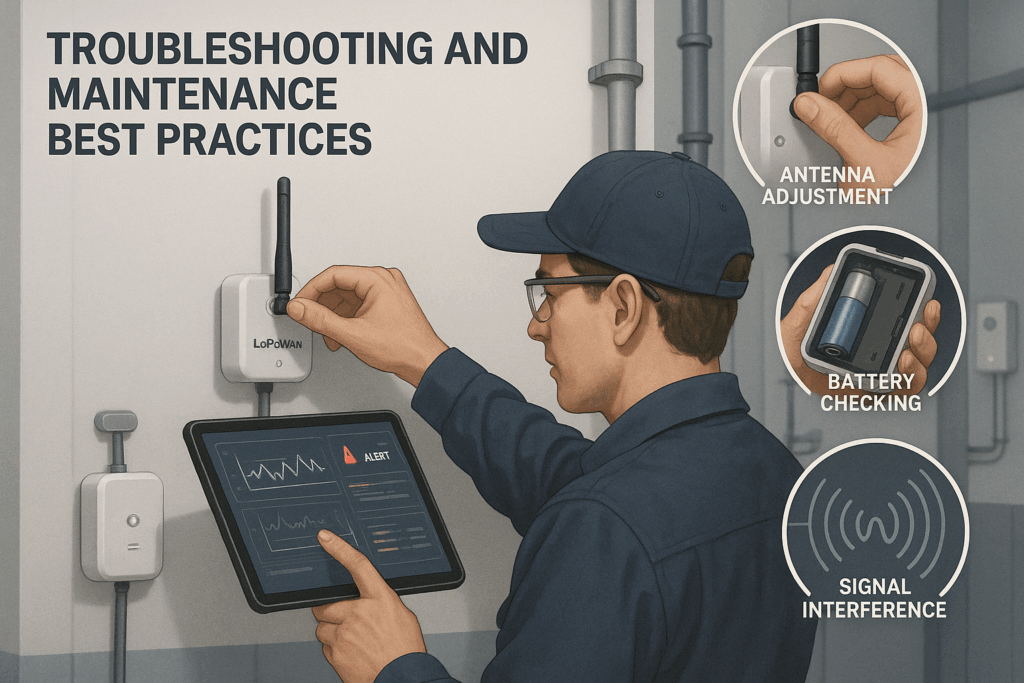
To maintain reliable operations post-deployment, consider the following:
- Antenna Optimization: Position antennas correctly to maximize coverage.
- Regular Firmware Updates: Use OTA upgrades to patch security and improve features.
- Battery Health Monitoring: Employ sensors and cloud alerts to preempt and handle battery depletion.
- Evaluate Interference: Use spectrum analyzers to identify and mitigate congested frequency bands.
- Remote Diagnostics: Automated health checks with alerting reduce downtime and maintenance costs.
Uniconverge also provides dedicated technical assistance to quickly resolve operational challenges.
Why Uniconverge Technologies?
Uniconverge offers a comprehensive IoT product portfolio comprising over 50 devices that span LoRaWAN modules, gateways, and end nodes, tailored to multiple industry sectors. Our value lies in:
- Customized Solutions designed to meet distinct client requirements.
- Robust and Reliable Hardware engineered for diverse, demanding environments.
- Regulatory Compliance including certifications recognized in India and globally.
- End-to-End Support from system design and deployment to continuous maintenance and upgrades.
This end-to-end approach ensures clients receive not only cutting-edge equipment but also expert guidance and service.
Conclusion
The success of any IoT deployment hinges on selecting the right LoRaWAN module. Balancing parameters like frequency compliance, range, power consumption, security, and integration capabilities enables devices to perform optimally in their specific environments.
Uniconverge Technologies combines product innovation and industry expertise to provide modules and solutions that empower your IoT ambitions. Discover how our customizable hardware and support services can simplify your journey toward smarter, connected devices