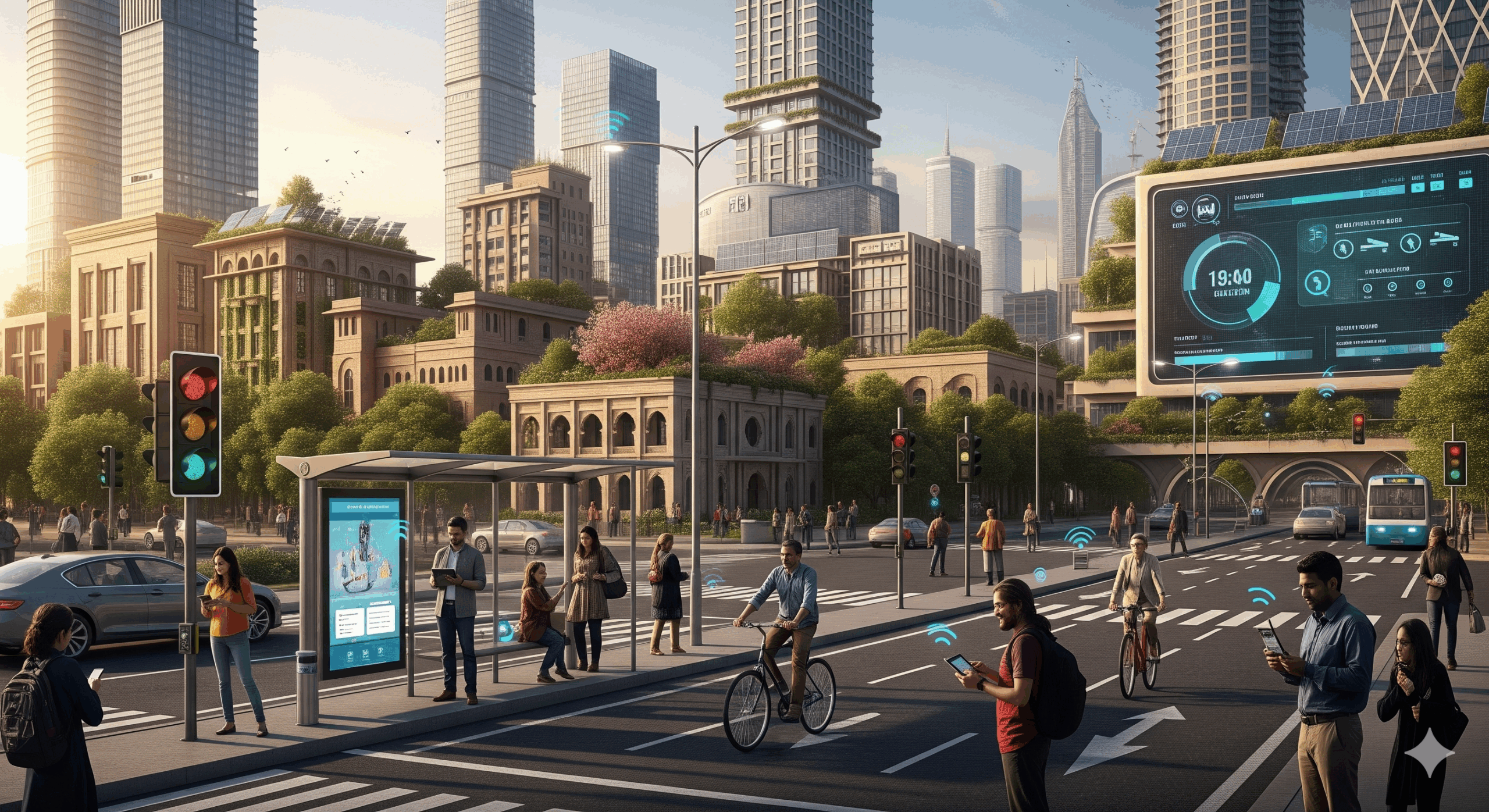
Imagine navigating the bustling streets of Mumbai during rush hour, where traffic lights intuitively adjust to ease congestion, streetlights dim automatically to save energy, and emergency services arrive swiftly thanks to real-time alerts from connected sensors. This isn’t a scene from a sci-fi movie—it’s the emerging reality of IoT in Smart Cities across India. As the nation grapples with rapid urbanization, where over 600 million people are projected to live in cities by 2030, the integration of Internet of Things (IoT) technologies is not just innovative; it’s essential for sustainable growth. IoT in Smart Cities promises to transform chaotic urban landscapes into efficient, livable hubs, addressing everything from pollution to public safety. In this comprehensive exploration, we’ll delve into how IoT in Smart Cities is revolutionizing India’s urban future, drawing from real-world examples and expert insights to highlight its potential and pitfalls.
Introduction
India’s cities are at a crossroads. With urbanization accelerating at an unprecedented pace, challenges like overcrowded public transport, water scarcity, air pollution, and inefficient waste management are straining resources and diminishing quality of life. According to recent studies, Indian cities lose billions annually due to traffic congestion alone, while environmental degradation exacerbates health issues for millions. This is where innovation steps in: IoT in Smart Cities offers a lifeline by connecting devices, data, and decisions in real-time to create responsive urban ecosystems.
At its core, IoT in Smart Cities involves embedding sensors and networks into everyday infrastructure to collect and analyze data, enabling smarter resource allocation and citizen services. In the Indian context, this technology isn’t merely about gadgets; it’s about bridging the gap between rapid population growth and sustainable development. As India aims to build 100 smart cities under the Smart Cities Mission launched in 2015, IoT in Smart Cities plays a pivotal role in making these visions a reality. This blog will unpack the outline of IoT in Smart Cities, exploring its applications, successes, challenges, and future prospects, while emphasizing how companies like UniConverge Technologies are driving this transformation.
Understanding IoT in the Indian Context
To grasp the impact of IoT in Smart Cities, we must first define what IoT entails. IoT, or the Internet of Things, refers to a network of interconnected devices that communicate and exchange data over the internet without human intervention. Core components include sensors that gather data (like temperature or motion), networks (such as Wi-Fi, 5G, or LoRaWAN) that transmit this information, and advanced data analytics platforms that process it to derive actionable insights. In smart cities, these elements form the backbone of intelligent systems, from monitoring air quality to optimizing energy grids.
What makes IoT in Smart Cities uniquely suited to India? The country’s urban landscape is defined by its scale—home to some of the world’s most populous cities like Delhi and Bangalore—coupled with diverse climates, cultures, and socio-economic disparities. For instance, in tropical regions like Chennai, IoT sensors can monitor humidity and predict flooding, while in arid areas like Rajasthan, they optimize water distribution. Cultural factors, such as festival crowds in Varanasi, demand adaptive crowd management systems. Moreover, India’s vast diversity requires inclusive solutions that cater to rural-urban migrants and marginalized communities. Unlike Western models, Indian IoT in Smart Cities must prioritize affordability and scalability, often leveraging low-cost, low-power technologies like LoRaWAN to cover expansive areas without straining budgets.
This adaptation is evident in government initiatives. The Smart Cities Mission emphasizes IoT in Smart Cities to address local needs, integrating it with India’s push for digital inclusion under schemes like Digital India. By focusing on vernacular data models and community-driven designs, IoT in Smart Cities ensures that technology serves all citizens, not just the elite.
Key Applications and Impact Areas
IoT in Smart Cities manifests in various applications, each targeting critical urban pain points. Let’s explore the primary areas where this technology is making waves.
Smart Mobility: Traffic, Parking, and Public Transit Optimization

Traffic jams in Indian cities like Bangalore can waste up to 243 hours per year per commuter. IoT in Smart Cities counters this through intelligent traffic management systems (ITMS). Sensors embedded in roads detect vehicle density and adjust signal timings dynamically, reducing wait times by up to 30%. In parking, IoT-enabled apps guide drivers to available spots via real-time data from ultrasonic sensors, minimizing circling and emissions.
Public transit benefits immensely too. IoT in Smart Cities integrates GPS trackers in buses and trains for predictive arrivals, as seen in Mumbai’s BEST fleet. This not only improves efficiency but also encourages public transport use, easing road congestion.
Utilities and Resource Management: Water, Energy, Sanitation
Resource scarcity is a hallmark of Indian urbanization. IoT in Smart Cities revolutionizes this through smart metering. For water management, sensors detect leaks in pipelines, potentially saving 20-30% of water loss in cities like Ahmedabad. Energy grids use IoT for demand-response systems, where smart meters adjust consumption during peaks, promoting renewable integration.
Sanitation sees gains via IoT-monitored waste bins that signal when full, optimizing collection routes and reducing overflow. In Indore, India’s cleanest city, such systems have enhanced waste management efficiency by 40%.
Environmental and Pollution Monitoring (Air, Noise, Water)
India’s air quality crisis, with Delhi often topping global pollution charts, demands proactive solutions. IoT in Smart Cities deploys low-cost sensors for real-time monitoring of PM2.5, noise, and water quality. Data feeds into dashboards for public alerts and policy decisions, like restricting vehicles during high-pollution days.
Public Safety: Surveillance, Emergency Response, Biometrics + IoT Integration
IoT in Smart Cities enhances safety through connected CCTV networks with AI analytics for anomaly detection. In emergencies, sensors trigger automated responses, such as alerting fire services to smoke detection. Biometric integration, like facial recognition at airports, adds layers of security while raising ethical questions we’ll address later.
Digital Governance and Citizen-Centric Platforms
IoT in Smart Cities fosters transparent governance via apps that allow citizens to report issues, like potholes, directly to authorities. Platforms aggregate data for better planning, ensuring services are responsive and inclusive.
| Application Area | IoT Technologies Used | Impact in Indian Cities |
| Smart Mobility | Traffic sensors, GPS trackers | Reduced congestion in Bangalore; 25% faster transit in Mumbai |
| Utilities Management | Smart meters, leak detectors | Water savings in Ahmedabad; Energy efficiency in Chennai |
| Environmental Monitoring | Air quality sensors | Pollution alerts in Delhi; Noise control in Kolkata |
| Public Safety | CCTV with AI, biometric sensors | Faster emergency response in Hyderabad |
| Digital Governance | Citizen apps, data platforms | Improved service delivery in Pune |
This table illustrates how IoT in Smart Cities delivers tangible benefits across sectors.
Success Stories and Lessons From Pilot Projects
India’s Smart Cities Mission has yielded inspiring case studies, showcasing IoT in Smart Cities in action.
In Pune, the Pune Smart City Development Corporation has implemented IoT for traffic and surveillance. Over 1,500 cameras and sensors monitor key areas, reducing crime by 20% and optimizing traffic flow. However, initial integration challenges highlighted the need for robust networks.
Surat’s success in flood management via IoT sensors along the Tapi River has prevented disasters, saving lives and property. The city’s integrated command center uses data analytics for real-time decisions, but scalability issues in expanding to sanitation underscore the importance of phased rollouts.
GIFT City in Gujarat, India’s first greenfield smart city, exemplifies comprehensive IoT integration. Automated utilities, district cooling systems, and smart security reduce energy use by 30%. Lessons include the value of public-private partnerships, though high costs limit replicability in smaller cities.
Other pilots, like Bhubaneswar’s smart lighting, show energy savings but reveal failures in maintenance due to skill gaps. Practical recommendations: Invest in training, start small, and iterate based on feedback to ensure IoT in Smart Cities succeeds.
| City | Key IoT Initiative | Success Metrics | Lessons Learned |
| Pune | Surveillance and traffic IoT | 20% crime reduction | Need for network redundancy |
| Surat | Flood monitoring sensors | Disaster prevention | Importance of data integration |
| GIFT City | Automated utilities | 30% energy savings | Focus on PPP models |
| Indore | Waste management IoT | 40% efficiency gain | Regular maintenance protocols |
These snapshots demonstrate that while IoT in Smart Cities works well in targeted areas, holistic planning is key to avoiding pitfalls.
Benefits of IoT for Urban India
The advantages of IoT in Smart Cities extend beyond efficiency to profound societal impacts.
Improved quality of life is paramount. Inclusive features, like voice-assisted apps for the visually impaired or real-time bus info for low-income commuters, enhance accessibility. In terms of sustainability, IoT optimizes resources, cutting carbon emissions by up to 15% in piloted areas.
Cost savings are significant: Cities save millions through predictive maintenance, reducing infrastructure breakdowns. For businesses, IoT in Smart Cities opens avenues for innovation, from startups developing sensor tech to enablers like UniConverge Technologies providing scalable solutions.
| Benefit Category | Specific Advantages | Examples in India |
| Quality of Life | Inclusivity, accessibility | Adaptive services for marginalized groups |
| Resource Efficiency | Cost savings, sustainability | Energy reduction in GIFT City |
| Economic Opportunities | New jobs, tech ecosystems | Growth for IoT firms like UniConverge |
Overall, IoT in Smart Cities fosters resilient, equitable urban environments.
The Unaddressed Gaps & Future Opportunities
Despite progress, gaps persist in IoT in Smart Cities. Customization is crucial: Solutions must tailor to city profiles, like monsoon-prone Mumbai versus desert-like Jodhpur, and include marginalized groups through affordable, user-friendly designs.
Open standards and interoperability are vital to prevent silos. Indian-specific data models and common APIs can standardize integrations, avoiding vendor lock-in. Vendor-neutral approaches encourage competition and innovation.
Lessons from pilots emphasize testing in real-world testbeds. Emerging tech like edge analytics—processing data locally for faster responses—and blockchain for secure data sharing address latency and privacy. Secure citizen consent frameworks ensure ethical use.
R&D priorities include 5G-enhanced IoT for massive connectivity and AI for predictive urban planning. These opportunities position India as a global leader in IoT in Smart Cities.
Challenges and the Path Forward

Implementing IoT in Smart Cities faces hurdles. Infrastructure constraints, like unreliable power in tier-2 cities, hinder deployment. Scalability and costs—initial setups can exceed budgets—pose barriers for smaller municipalities.
Data privacy and security are critical: With biometrics and surveillance, risks of breaches loom large. Ethical issues, such as biased AI in facial recognition, demand oversight. Policies like the Personal Data Protection Bill aim to mitigate this, but enforcement is key.
The path forward involves capacity building through training programs, public engagement for trust, and collaborative policies. By addressing these, IoT in Smart Cities can achieve sustainable success.
| Challenge | Description | Mitigation Strategies |
| Infrastructure | Power and connectivity issues | Invest in resilient networks |
| Security & Privacy | Data breaches, ethical concerns | Blockchain, consent frameworks |
| Costs & Scalability | High upfront expenses | Phased implementations, subsidies |
| Policy Gaps | Lack of standards | Government regulations, open APIs |
Uniconverge Technologies’ Vision
UniConverge Technologies stands at the forefront of enabling IoT in Smart Cities. With expertise in LoRaWAN and wireless solutions, they offer interoperable, future-proof systems for urban transformation. Their vision: Empower cities with citizen-centric tech that enhances efficiency and sustainability.
Unique offerings include smart street lighting solutions that use IoT for remote monitoring and energy optimization, reducing costs by up to 50%. Frameworks like their LPWAN-based platforms ensure seamless integration across devices, avoiding lock-in. Services span consulting, product development, and deployment, serving clients like Adani Group and NTPC in India. By focusing on scalable, secure IoT, UniConverge drives inclusive smart cities.
Conclusion
IoT in Smart Cities holds transformative potential for India’s urban future, turning challenges into opportunities for efficiency, sustainability, and inclusivity. From optimizing traffic to securing data, this technology paves the way for resilient cities. However, success demands an open, collaborative approach—integrating stakeholders, prioritizing ethics, and innovating continuously.
As India marches toward its smart city goals, partnering with specialists like UniConverge Technologies is crucial. Whether you’re a policymaker, innovator, or citizen, engage now to shape this future. Let’s build IoT in Smart Cities that truly serve everyone.