
Introduction to LoRa Technology
LoRa, short for Long Range, is a low-power wide-area network (LPWAN) protocol engineered to connect devices over long distances while using minimal energy. Unlike traditional wireless technologies that struggle in large or obstructed spaces, LoRa excels in Industrial IoT solutions by providing robust connectivity for wireless sensor networks. It’s tailor-made for smart factory automation, where IoT gateways for factories serve as central hubs to collect and process data from remote sensors.
LoRa operates on unlicensed spectrum bands, such as 915 MHz in North America or 868 MHz in Europe, using chirp spread spectrum modulation to achieve ranges of up to 10 kilometers in open areas or 2-5 kilometers in dense factory settings. Its low power consumption allows sensors to operate for years on small batteries, making it ideal for remote monitoring tasks like tracking temperature, vibration, or equipment performance. The global LoRaWAN market is growing rapidly, driven by its adoption in manufacturing for scalable, cost-effective solutions.
Factories face unique challenges: sprawling layouts, metal structures that block signals, and the need for real-time data to prevent costly downtime. LoRa addresses these with unmatched reliability and efficiency. This blog dives into the top five benefits of LoRa, while also tackling practical implementation tips, comparisons with alternatives, and emerging trends in smart factory automation. By the end, you’ll understand why LoRa is a must-have for modern factories.
Benefit 1: Long-Range Connectivity for Expansive Factory Environments

LoRa’s standout feature is its exceptional long-range connectivity, enabling data transmission over several kilometers without repeaters or complex wiring. In factories, where production floors can span thousands of square meters filled with machinery, walls, and obstacles, short-range technologies like Bluetooth or Wi-Fi often require multiple access points, driving up costs and complexity.
With LoRa, sensors placed in remote corners—such as on conveyor belts, storage silos, or high-bay racks—can send data directly to IoT gateways for factories, ensuring seamless monitoring. Its ability to penetrate metal equipment and concrete walls makes it ideal for wireless sensor networks in Industrial IoT solutions. This connectivity empowers smart factory automation by allowing managers to track assets across entire facilities in real time, reducing risks like equipment failure or inventory mismanagement.
For example, in a large automotive manufacturing plant, LoRa was used to monitor assembly line sensors across a 2-kilometer facility. This setup improved operational efficiency by 15%, as data flowed without additional infrastructure. LoRa’s long-range capability ensures comprehensive coverage, making it a cornerstone for factories with expansive or challenging layouts.
Benefit 2: Low Power Consumption for Extended Device Lifespan
Energy efficiency is a defining strength of LoRa for remote monitoring. LoRa devices consume so little power that sensors can run on small batteries for up to 10 years, eliminating frequent maintenance in hard-to-reach or hazardous factory areas. This is critical in industrial settings, where downtime for battery replacements can disrupt production and increase costs.
LoRa achieves this through adaptive data rates and sleep modes, where devices only activate to send small data packets, conserving energy. In smart factory automation, this means less maintenance and more uptime. For Industrial IoT solutions, deploying hundreds of sensors without worrying about battery life enhances sustainability and operational continuity.
For instance, LoRa sensors monitoring environmental conditions in a factory can reduce maintenance costs by up to 30% due to their long battery life. This makes LoRa a key player in Industrial IoT solutions, allowing factories to focus on production rather than device upkeep.
Benefit 3: Cost-Effectiveness and Scalability
LoRa delivers cost-effective remote monitoring by eliminating the need for expensive wired infrastructure or cellular subscriptions. Operating on unlicensed spectrum bands, LoRa enables factories to set up private networks at a fraction of the cost of traditional systems, making it accessible for businesses of all sizes.
Scalability is another major advantage. Factories can start with a handful of sensors and expand to thousands without exponential cost increases, thanks to LoRa’s efficient architecture. This scalability is perfect for IoT gateways for factories, where adding new devices is simple and affordable.
Compared to alternatives like NB-IoT, which involves ongoing cellular fees, or Zigbee, which lacks range for large factories, LoRa offers a cost-efficient solution. In one industrial case, a factory deployed LoRa to monitor hundreds of assets, achieving significant savings over wired systems. This cost-effectiveness, tied to IoT gateways for factories, makes LoRa a top choice for scalable smart factory automation.
Benefit 4: Enhanced Reliability and Real-Time Monitoring
In harsh factory environments, reliability is critical, and LoRa excels with its ability to penetrate obstacles like metal machinery and concrete walls. This ensures consistent data transmission, even in noisy settings with electromagnetic interference from equipment.
LoRa supports real-time monitoring, enabling immediate alerts for issues like abnormal machine vibrations or temperature spikes. This capability is vital for predictive maintenance, helping factories avoid costly breakdowns. For smart factory automation, reliable data flow translates to proactive decision-making and reduced downtime.
A common challenge in factories is signal interference. LoRa mitigates this through adaptive data rates, adjusting transmission to maintain performance. Studies show LoRa-enabled systems can reduce equipment downtime by 20% in industrial settings, reinforcing its role in smart factory automation and wireless sensor networks.
Benefit 5: Improved Security and Flexibility in Industrial Deployments
Security is paramount in Industrial IoT solutions, and LoRa delivers with AES-128 encryption and mutual authentication to protect data in wireless sensor networks. This ensures sensitive factory data, like equipment performance or environmental metrics, remains secure from cyber threats.
LoRa’s flexibility allows it to integrate with existing factory systems, supporting hybrid setups that combine with other protocols or legacy infrastructure. This adaptability makes it easy to deploy in diverse environments, from small workshops to large manufacturing plants.
Compliance is also key. LoRa operates in unlicensed spectrum bands, but factories must adhere to regional regulations, such as FCC in the US or ETSI in Europe, to ensure legal and secure deployments. This combination of security and flexibility positions LoRa as a leader in Industrial IoT solutions for smart factory automation.
How LoRa Compares to Other IoT Technologies in Factories
To understand LoRa’s value, it’s helpful to compare it with other IoT technologies used in factories. NB-IoT offers similar range but relies on cellular networks, incurring subscription costs and less control over private setups. Zigbee excels in short-range mesh networks but lacks the distance needed for large factories. Wi-Fi provides high bandwidth but consumes more power and struggles with signal penetration in industrial settings.
| Technology | Range | Power Consumption | Cost | Suitability for Factories |
| LoRa | Up to 10 km | Very Low | Low (no subscriptions) | High: Long-range, low-power for remote monitoring |
| NB-IoT | Up to 10 km | Low | Medium (cellular fees) | Medium: Costly for private networks |
| Zigbee | Up to 100 m | Low | Low | Low: Limited range for large factories |
| Wi-Fi | Up to 100 m | High | Medium | Low: High power, poor penetration |
LoRa’s balance of range, low power, and cost makes it ideal for IoT gateways for factories and smart factory automation, offering a versatile solution for remote monitoring.
Real-World Case Study: LoRa in Action
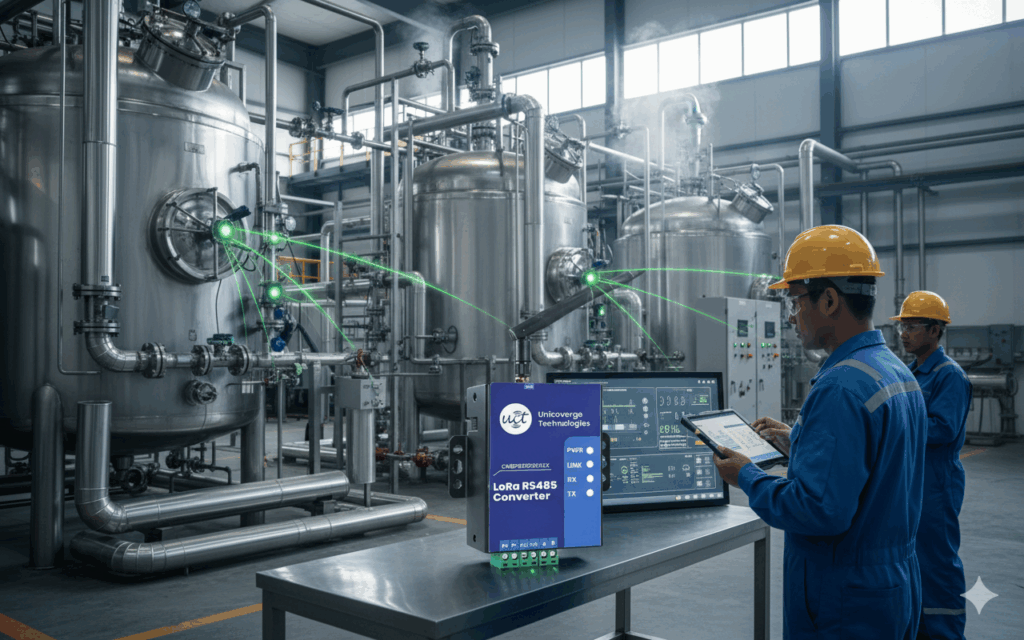
In a chemical processing plant, LoRa was deployed to monitor temperature and humidity across 50 sensors in a hazardous environment. The system achieved 15% cost savings by reducing maintenance needs and maintained 99% uptime, preventing leaks and enhancing safety. This case highlights LoRa’s impact in Industrial IoT solutions, delivering measurable outcomes through wireless sensor networks.
Another example involves a brake pad manufacturing facility, where LoRa enabled low-cost monitoring of production equipment, boosting operational efficiency. These real-world applications demonstrate LoRa’s ability to transform factory operations with reliable, scalable solutions.
Future of LoRa in Smart Factories
As factories evolve toward Industry 5.0, LoRa is set to play a pivotal role by integrating with AI and 5G. AI-powered LoRa systems can predict equipment failures with up to 90% accuracy, enhancing predictive maintenance. Hybrid networks combining LoRa with 5G could further improve data speeds for real-time analytics, driving smart factory automation to new heights.
Emerging trends also include LoRa’s role in human-centric automation, where it supports sustainable, intelligent operations. For IoT gateways for factories, these advancements ensure LoRa remains a forward-looking solution for the next generation of manufacturing.
Conclusion
LoRa’s top five benefits—long-range connectivity, low power consumption, cost-effectiveness, reliability, and security—make it a cornerstone for remote monitoring in factories. By overcoming challenges like interference and offering unmatched scalability, LoRa empowers Industrial IoT solutions to drive efficiency and innovation. Real-world cases and comparisons with alternatives like NB-IoT and Zigbee highlight its superiority, while future integrations with AI and 5G promise even greater potential. Explore LoRa today to transform your factory into a hub of smart factory automation, leveraging wireless sensor networks and IoT gateways for factories. For SEO optimization, include images of LoRa deployments and meta descriptions like: “Unlock the power of LoRa for factory remote monitoring with Industrial IoT solutions.”