Introduction: Industrial Problems Are Rarely Just One Problem
Modern industries face a wide range of operational challenges.
A manufacturing plant may need better visibility into machines. An energy-intensive facility may need to understand where electricity is being consumed. A water facility may need remote flow monitoring. A warehouse may need better asset visibility. A remote industrial site may need to collect data from equipment located hundreds of metres apart.
Although these problems are different, they often have something in common:
The need for reliable data, connectivity, monitoring, and actionable insights.
This is where Industrial IoT can make a difference.
At UniConverge Technologies, industrial IoT solutions are designed around the specific requirements of an application rather than forcing every industry into the same technology or architecture.
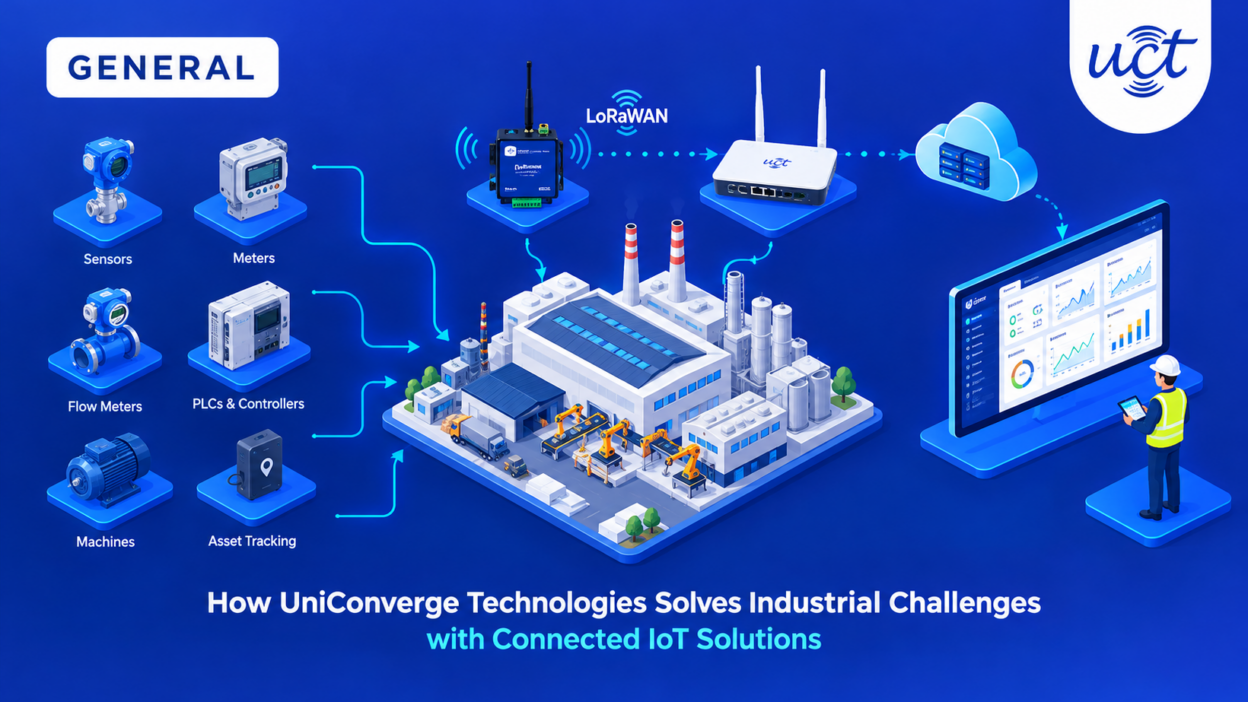
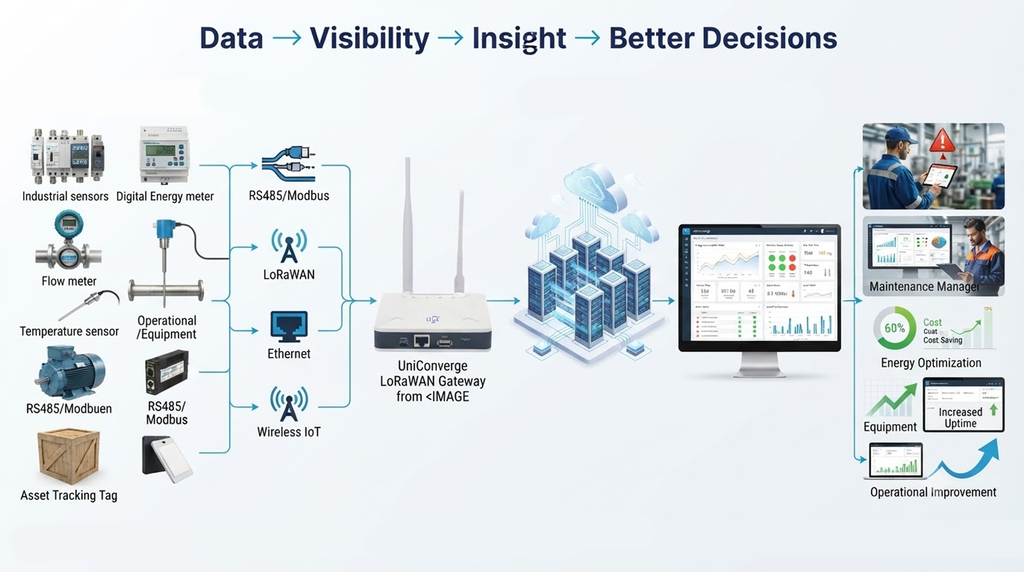
From field devices and sensors to connectivity, gateways, data platforms, and monitoring systems, the objective is to create a connected ecosystem that helps industries collect data, understand operations, and make better decisions.
1. Why Industrial Problems Need More Than a Single Technology
There is no single technology that can solve every industrial challenge.
Different environments have different requirements.
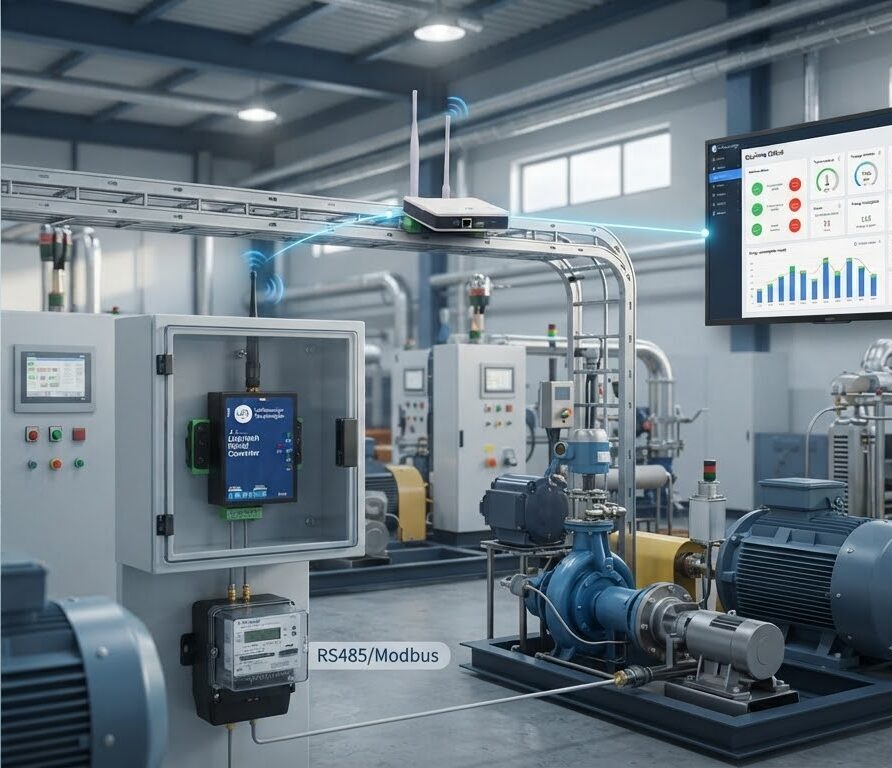
A factory may already have machines communicating through RS485 and Modbus RTU.
A remote water-monitoring location may require long-range wireless connectivity.
An energy-monitoring application may require continuous measurement from multiple electrical meters.
An asset-tracking application may require location information from equipment or personnel.
This means an effective Industrial IoT system needs multiple layers working together.
A typical connected industrial ecosystem
Industrial Equipment & Sensors
↓
Data Collection & I/O
↓
Connectivity Layer
↓
LoRaWAN / Gateway / Network
↓
Cloud or Local Platform
↓
Dashboard & Analytics
↓
Action
The technology is important, but the real objective is simple:
Turn industrial data into useful information that people can act on.
2. Challenge: Existing Industrial Equipment Is Not Always Connected
Many industrial facilities already have valuable equipment installed.
Meters, PLCs, flow meters, sensors, controllers and other devices may already generate useful data.
The problem is that these devices may use older communication technologies such as RS485 and Modbus RTU.
Replacing all existing equipment simply to make it IoT-enabled can be expensive and disruptive.
The UniConverge approach
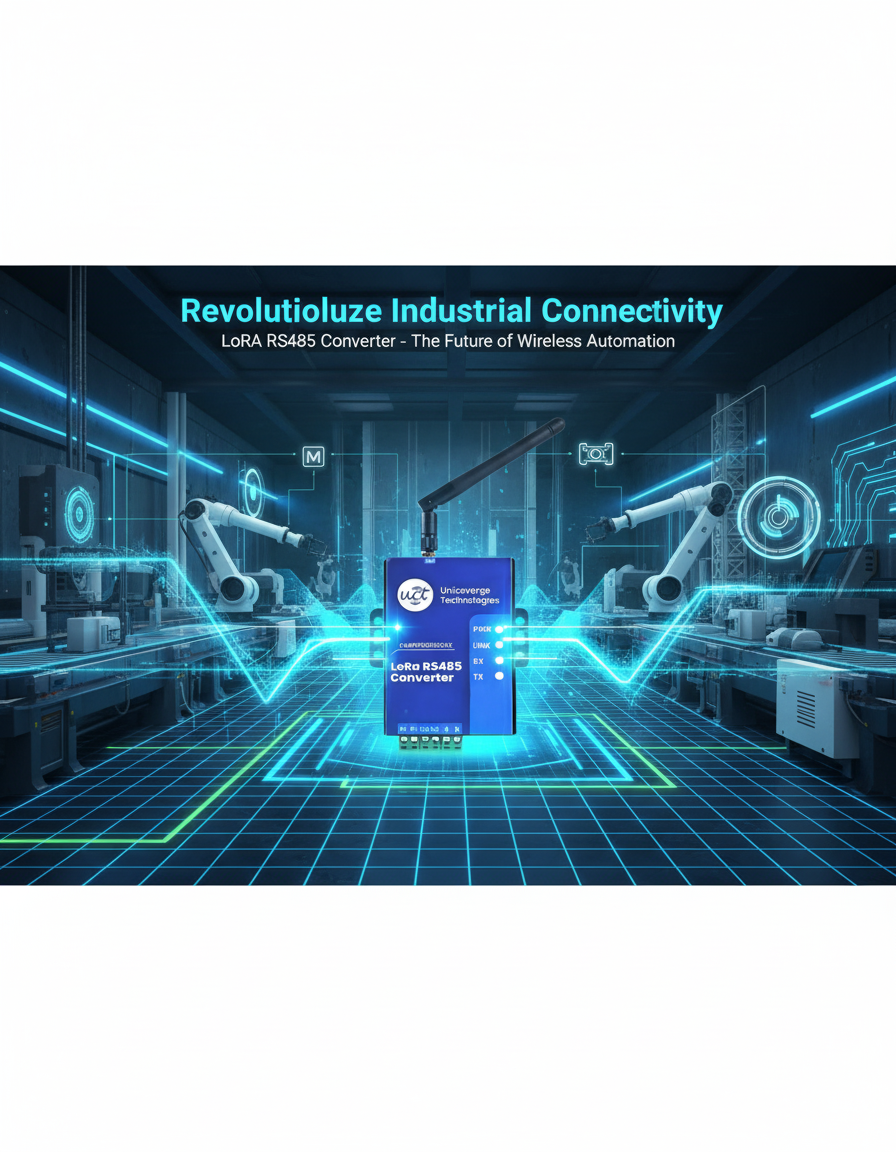
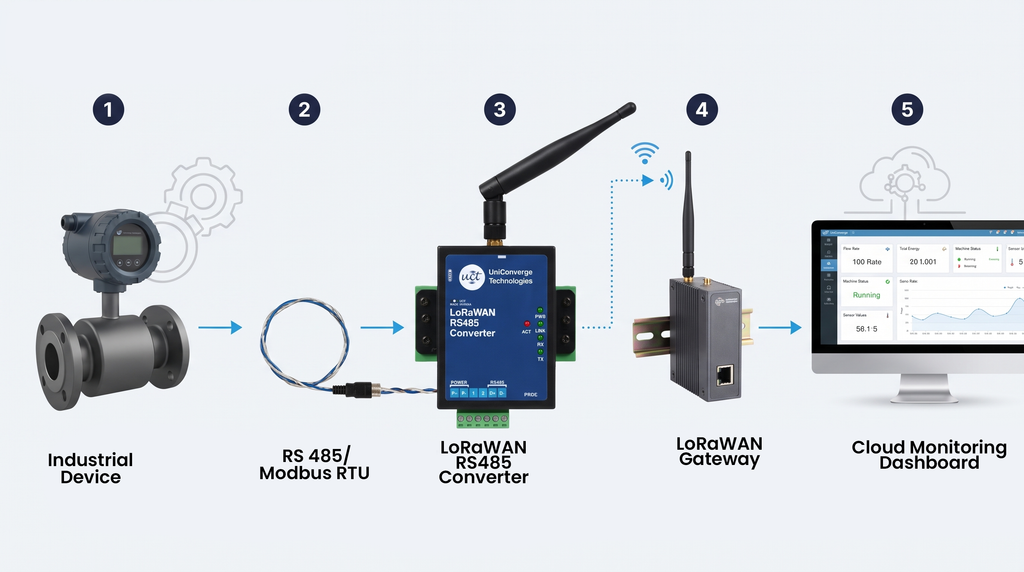
UniConverge can use connectivity solutions such as RS485-to-LoRaWAN converters to bring compatible legacy devices into a modern wireless IoT architecture.
Instead of replacing the entire system:
Existing RS485 Device
→ RS485/Modbus
→ Connectivity Converter
→ LoRaWAN
→ Gateway
→ Monitoring PlatformThis approach can help industries modernize existing infrastructure while reducing the need for extensive new cabling.
3. Challenge: Long Cable Runs and Difficult Installations
Industrial facilities can cover large areas.
Connecting every sensor or machine using physical cables can become complicated when equipment is:
- Far away from the control room
- Located across multiple buildings
- Installed in difficult-to-access areas
- Spread across large plants
- Located in remote infrastructure
Long cable routes can also increase installation complexity and maintenance requirements.
The UniConverge approach
LoRaWAN-based connectivity can provide a wireless communication layer for suitable industrial applications.
Instead of running a dedicated cable from every field device back to a central location, compatible devices can transmit data wirelessly to a LoRaWAN gateway.
Field Devices → LoRaWAN → Gateway → Network/Cloud → Dashboard
This can simplify connectivity for applications where long-range, low-power wireless communication is appropriate.
4. Challenge: Industries Need Real-Time Visibility
Collecting data is only the first step.
Industrial teams need to know what is happening now, not only what happened yesterday or at the end of the month.
Without timely information, problems can remain hidden.
Examples include:
- Abnormal machine conditions
- Unexpected energy consumption
- Changing tank levels
- Water flow variations
- Asset movement
- Environmental changes
- Equipment operating outside expected conditions
The UniConverge approach
Connected sensors, gateways and monitoring platforms can bring field data into a centralized system.
This allows teams to move from:
Manual Checking
to
Continuous Monitoring
and ultimately toward:
Data-Driven Decisions
The exact monitoring architecture depends on the application, equipment and communication requirements.
5. Challenge: Energy Consumption Is Difficult to Understand
Energy costs can represent a significant operating expense.
However, knowing the total electricity consumption of a facility does not always reveal where energy is being used or wasted.
Industries may need to monitor:
- Machines
- Production lines
- Electrical panels
- Motors
- Pumps
- Compressors
- Individual circuits
The UniConverge approach
IoT-enabled energy monitoring can collect information from compatible energy meters and sensors and make that information available through a centralized monitoring system.
A typical architecture can look like:
Energy Meter / Sensor
↓
RS485 / Wireless Connectivity
↓
LoRaWAN Gateway
↓
Cloud / Data Platform
↓
Energy Dashboard
This provides a more detailed view of energy consumption and can help teams identify unusual patterns and opportunities for improvement.
UniConverge already has dedicated energy-monitoring content and deployments, so this article should use energy monitoring as one example of the broader ecosystem, rather than repeating the existing dedicated energy article.
6. Challenge: Monitoring Water and Flow in Remote Locations
Water infrastructure often extends beyond easily accessible areas.
Manually checking meters and flow conditions can require time, personnel and repeated site visits.
Industries may need to monitor:
- Water consumption
- Flow rates
- Tank levels
- Leakage conditions
- Pump operation
- Remote infrastructure
The UniConverge approach
Connected flow meters, level sensors and communication devices can transmit field data to a centralized monitoring platform.
For example:
Flow Meter / Level Sensor
→ RS485 / Modbus
→ IoT Connectivity
→ LoRaWAN Gateway
→ Cloud / Dashboard
This enables remote visibility without requiring operators to physically inspect every measurement point.
UniConverge has also documented water-monitoring deployments and LoRaWAN-based monitoring applications, making this a strong real-world category to include.
7. Challenge: Finding and Managing Industrial Assets
Industrial facilities can contain thousands of tools, components, machines and mobile assets.
When teams cannot quickly determine where an asset is, time can be lost searching for equipment.
This becomes particularly important in:
- Manufacturing plants
- Warehouses
- Logistics facilities
- R&D environments
- Large industrial campuses
The UniConverge approach
IoT-based asset tracking can provide visibility into the location and movement of connected assets.
Depending on the application, a solution may combine:
Asset → Tracking Device → Wireless Network → Gateway → Platform → Dashboard
This changes asset management from a largely manual process into a more data-driven operation.
UniConverge already has dedicated asset-tracking content and case studies, so here we should focus on how asset tracking fits into the wider industrial IoT ecosystem, rather than reproducing that article.
8. Challenge: Unplanned Equipment Failures
Unexpected equipment failure can interrupt production and increase maintenance costs.
Traditional maintenance approaches often rely on:
Fixed schedules
or
Repair after failure
Industrial IoT introduces another possibility:
Monitor → Detect Changes → Analyse → Act
The UniConverge approach
Sensors can monitor parameters such as:
- Temperature
- Vibration
- Current
- Operating conditions
- Other application-specific parameters
The collected data can then be used to identify abnormal patterns and support condition-based or predictive maintenance strategies.
The important point is that IoT does not automatically mean predictive maintenance.
Good predictive maintenance depends on appropriate sensors, reliable data, analytics and a suitable maintenance workflow.
This makes the solution more practical and technically credible than simply claiming that “AI predicts every failure.”
9. Challenge: Worker and Environmental Safety
I ndustrial environments may involve hazardous areas, restricted zones and changing environmental conditions.
Industries may need visibility into:
- Worker location
- Hazardous areas
- Environmental conditions
- Air quality
- Temperature
- Gas-related parameters
- Emergency situations
The UniConverge approach
IoT devices and wireless connectivity can collect information from distributed locations and provide it to a centralized monitoring system.
For personnel-related applications, tracking technologies can help provide location visibility.
For environmental monitoring, connected sensors can continuously collect measurements.
The result is a system that gives operators more information about conditions across the facility, helping them respond faster when predefined conditions require attention.
10. Challenge: Different Industrial Devices Need to Work Together
One of the biggest challenges in industrial digital transformation is that facilities rarely start from zero.
They already have:
- PLCs
- Sensors
- Meters
- Controllers
- Industrial machines
- Existing communication protocols
- Different vendors
- Different generations of equipment
Creating a connected ecosystem therefore requires more than installing sensors.
The UniConverge approach
Connectivity and protocol integration can act as a bridge between existing equipment and modern IoT infrastructure.
Depending on the application, this may involve technologies such as:
- RS485
- Modbus RTU
- LoRaWAN
- Ethernet
- Wi-Fi
- Cellular connectivity
- IoT gateways
- Cloud platforms
- APIs and software integration
The goal is not to replace everything.
The goal is to connect what already works and modernize where it makes sense.
11. From Individual Problems to One Connected Ecosystem
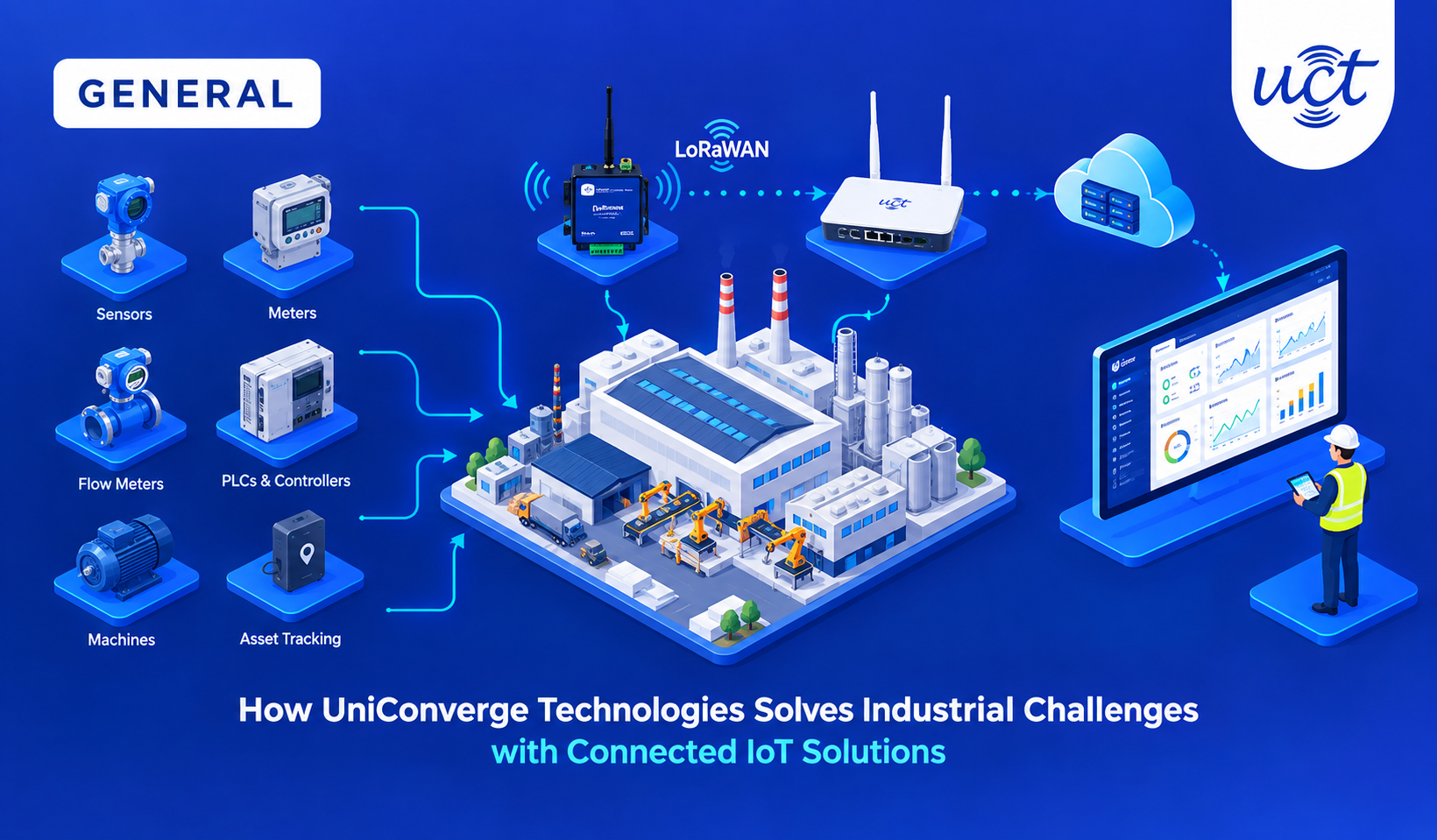
This is where the different solutions come together.
Imagine a manufacturing facility that needs to solve several problems at once:
Machine Monitoring
Sensors collect equipment parameters.
Energy Monitoring
Meters provide energy consumption data.
Asset Tracking
Tracking devices provide asset visibility.
Water Monitoring
Flow and level sensors provide utility data.
Environmental Monitoring
Sensors monitor conditions across the facility.
Legacy Equipment Connectivity
RS485/Modbus devices are connected to the IoT network.
Instead of creating completely separate systems for every requirement, an integrated architecture can bring multiple data sources into a connected ecosystem.
The bigger picture
Sensors & Industrial Devices
↓
Connectivity & IoT Devices
↓
LoRaWAN / Gateways / Networks
↓
Data Platform
↓
Dashboards & Analytics
↓
Operational Decisions
That is the real value of Industrial IoT.
12. Why UniConverge Takes a Solution-Based Approach
Industrial digital transformation is rarely identical from one facility to another.
A solution that works for a manufacturing plant may not be suitable for a water utility or a remote infrastructure application.
That is why the solution needs to consider:
Existing Infrastructure
What equipment is already installed?
Connectivity Requirements
Does the application need wired, LoRaWAN, cellular, Ethernet or another communication method?
Deployment Environment
Is the equipment indoors, outdoors, remote or distributed across a large facility?
Data Requirements
What information needs to be collected and how frequently?
Integration
Where does the data need to go?
Scalability
Can the system expand when more machines, sensors or locations are added?
This solution-first approach helps ensure that technology is selected because it fits the problem, rather than choosing a technology first and trying to force the application around it.
13. From Field Data to Actionable Intelligence
A connected device by itself does not solve an industrial problem.
The real value comes from what happens after data is collected.
Step 1 — Sense
Sensors and industrial devices collect field information.
Step 2 — Connect
Connectivity devices and gateways transmit the information.
Step 3 — Collect
The data reaches a local or cloud-based platform.
Step 4 — Visualize
Dashboards turn raw readings into understandable information.
Step 5 — Analyse
Teams identify patterns, abnormalities and opportunities.
Step 6 — Act
Operators and maintenance teams use those insights to make decisions.
Sense → Connect → Collect → Visualize → Analyse → Act
This is how an Industrial IoT system becomes an operational tool rather than simply another layer of technology.
14. What Makes an Industrial IoT Solution Effective?
A successful industrial IoT deployment is not necessarily the one with the most sensors.
It is the one that solves a real operational problem.
An effective solution should consider:
Reliability
Industrial data needs dependable communication and equipment.
Scalability
The architecture should support future expansion.
Integration
New IoT systems should work with relevant existing infrastructure.
Security
Industrial data and connected devices require appropriate security measures.
Usability
Operators need information they can understand and act upon.
Cost
The solution should provide meaningful value relative to deployment and operating costs.
Maintainability
The system should remain manageable after deployment.
These factors are often more important than simply choosing the newest technology.
15. UniConverge Technologies: Building Connected Industrial Solutions
UniConverge Technologies provides Industrial IoT and connectivity solutions designed around different industrial applications.
Its portfolio spans areas including:
- LoRaWAN solutions
- LoRaWAN gateways
- RS485-to-LoRaWAN connectivity
- Industrial IoT devices and nodes
- Energy monitoring
- Asset tracking
- Remote monitoring
- Industrial automation
- Predictive maintenance
- Custom IoT solutions
- OEM/ODM development
The objective is to connect field-level equipment and data with the systems businesses use to monitor and manage their operations.
Rather than asking:
“Which product should we sell?”
the better question is:
“What industrial problem are we trying to solve?”
From there, the appropriate combination of devices, connectivity, gateways, software and integration can be considered.
16. Real Industrial Applications
The value of an Industrial IoT ecosystem becomes clearer when looking at practical applications.
Manufacturing
Monitor machines, energy consumption, production environments and industrial assets.
Oil & Gas
Monitor tank levels, flow rates, personnel and remote assets.
Water & Utilities
Monitor flow, consumption, levels and distributed infrastructure.
Energy
Track consumption and identify unusual energy patterns.
Warehousing & Logistics
Improve visibility of assets, equipment and operational conditions.
Infrastructure
Monitor distributed assets and environmental conditions remotely.
The same core principle can support different applications:
Collect the right data → connect it reliably → make it visible → use it to improve operations.
17. The Future of Industrial Connectivity Is Connected, Not Isolated
Industrial digital transformation does not mean replacing every existing machine.
It means creating better connections between:
Machines
Sensors
People
Data
Software
As more industrial equipment becomes connected, companies can build increasingly comprehensive views of their operations.
The future is not simply about having more devices.
It is about creating an ecosystem where those devices can communicate, share data and support better decisions.
Conclusion: One Company, Multiple Industrial Challenges, Connected Solutions
Industrial problems come in many forms.
A factory may need machine visibility.
A facility may need energy monitoring.
A remote site may need wireless connectivity.
A utility may need flow and level monitoring.
A warehouse may need asset tracking.
A legacy plant may need to connect existing RS485 equipment.
These are different problems, but they can all depend on the same fundamental requirement:
Reliable data and connectivity.
UniConverge Technologies approaches Industrial IoT by combining devices, connectivity, gateways, monitoring platforms and integration according to the requirements of each application.
The goal is not to provide the same solution to every industry.
The goal is to build the right connected solution for the problem.
UniConverge Technologies
Connecting Industrial Data. Enabling Smarter Decisions.
Frequently Asked Questions
What types of industrial problems can IoT solve?
Industrial IoT can support applications such as machine monitoring, energy monitoring, asset tracking, remote monitoring, environmental monitoring, water and flow monitoring, equipment condition monitoring and industrial automation.
Can existing industrial equipment be connected to an IoT system?
Yes. Depending on the equipment and protocol, existing devices using technologies such as RS485 and Modbus RTU can be integrated into modern IoT architectures using appropriate connectivity solutions.
Why is LoRaWAN useful for industrial applications?
LoRaWAN can provide long-range, low-power wireless connectivity for suitable applications, particularly where devices are distributed across large areas or where extensive cabling is difficult.
Does Industrial IoT require replacing existing machines?
Not necessarily. A well-designed IIoT deployment can often integrate with existing equipment and infrastructure rather than replacing everything.
Can one IoT platform monitor different industrial applications?
Yes, depending on the architecture and software integration. Multiple types of sensors and industrial devices can feed data into a centralized monitoring environment.
How does UniConverge Technologies approach industrial IoT?
UniConverge focuses on application-specific solutions combining industrial devices, connectivity technologies, gateways, monitoring systems and integration based on the requirements of the deployment.