By Uniconverge Technologies | Smart City Infrastructure | Delhi, India
Delhi moves 20 million people every day. It also generates 11,000 metric tonnes of solid waste, runs street lights that burn through the night whether anyone’s there or not, and monitors its air quality through a network of sensors that’s still nowhere near complete. These aren’t unsolvable problems. They’re infrastructure problems, and most of them have a common thread: the city doesn’t have enough real time data to act on.
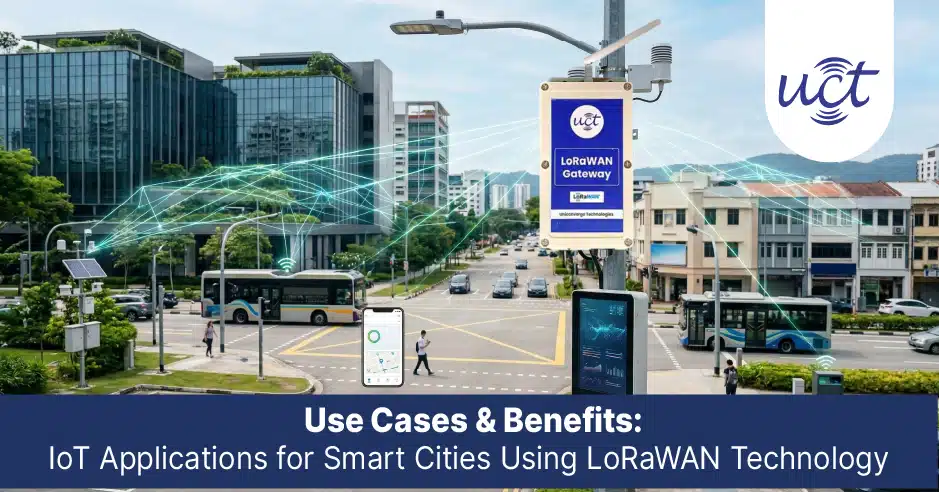
That’s where LoRaWAN IoT applications come in not as a silver bullet, but as a practical, cost effective way to wire up the physical city and give it a nervous system.
At Uniconverge Technologies, we’ve deployed LoRaWAN networks across Indian cities for applications ranging from smart street lighting to flood level monitoring. This post covers what the technology actually does, where it works best, and what realistic returns look like for city administrations and utilities.
What Is LoRaWAN, and Why Does It Work for Cities?
LoRaWAN (Long Range Wide Area Network) is a wireless protocol built for one specific job: sending small amounts of data over long distances while consuming as little power as possible. A single gateway can cover 2 to 15 km in open terrain. Devices run on coin-cell or AA batteries for 5 to 10 years without a swap.
That combination matters for cities. You can’t run power cables to every bin sensor or parking meter. You can’t afford cellular data plans for 50,000 devices. And you can’t have technicians replacing batteries every six months across a municipal area.
Here’s how LoRaWAN compares to the alternatives:
| Feature | LoRaWAN | Wi-Fi | Cellular (4G/5G) | NB-IoT |
| Range | 2-15 km | 50-100 m | 1-5 km | 1-10 km |
| Battery Life | 5-10 years | Hours/days | Months | 2-5 years |
| Data Rate | Low (suitable for sensors) | High | High | Low |
| Cost per Node | Low | Medium | High | Medium |
| Infrastructure Needed | Gateway per zone | Dense AP network | Carrier coverage | Carrier network |
| India Frequency Band | 865-867 MHz (licence-free) | 2.4/5 GHz | Licensed spectrum | Licensed spectrum |
For sensor-heavy IoT applications where you need city-scale coverage, low per-node cost, and multi-year battery life, LoRaWAN is the only protocol that checks all three boxes simultaneously.
In India, LoRaWAN operates in the 865-867 MHz IN865 band under WPC licence-exempt rules. Uniconverge’s gateways and end-node sensors are BIS-compliant and DoT-approved for deployment, which matters when you’re running infrastructure for a municipal body.
Key Benefits for Smart City Deployments
Energy and Cost Savings
Across documented smart city deployments internationally, LoRaWAN-based systems have cut energy consumption by 30-50% in applications like street lighting and water pumping. The driver is simple: you stop running things when they don’t need to run. Lights dim when no pedestrian is around. Pumps adjust to actual demand rather than fixed schedules.
At the infrastructure level, deploying LoRaWAN is significantly cheaper than cellular alternatives. Total cost of ownership over five years runs roughly 60% lower than a comparable NB-IoT or 4G deployment, mainly because you’re not paying recurring data tariffs for each node.
Battery Life That Makes Sense at Scale
A water meter sending hourly readings can run for 7-10 years on a single battery. A bin sensor transmitting fill-level data four times a day can last just as long. For a city maintaining 10,000+ nodes, that’s a maintenance cycle measured in years, not quarters.
Security
LoRaWAN uses AES-128 end-to-end encryption with device-level authentication. Messages can’t be replayed, spoofed, or intercepted without the device keys. For city infrastructure, that matters – you don’t want someone remotely manipulating traffic sensors or water meters.
Scale
A single Uniconverge LoRaWAN gateway can handle 100,000+ sensor nodes in its coverage area. You can start with a pilot of 200 sensors and scale to citywide coverage without redesigning the network.
Where LoRaWAN IoT Applications Actually Work: Use Cases
Smart Street Lighting
Street lighting accounts for 30-40% of a municipality’s electricity bill. Most of it runs on fixed schedules set decades ago. Smart lighting changes that.
With LoRaWAN-connected luminaires, lighting intensity adjusts to ambient light levels and pedestrian/vehicle detection. Systems can dim to 30% at 2 AM on a quiet residential road and ramp back up the moment a vehicle approaches. Failure alerts arrive in real time, so maintenance crews stop doing manual rounds.
Documented results from pilot deployments in Indian cities show energy savings of 35-45% versus fixed-schedule systems. In a mid-sized city spending ₹50 crore annually on street lighting electricity, that’s a ₹17-22 crore annual reduction.
Waste Management
Garbage collection in most Indian cities runs on fixed routes, fixed schedules, regardless of whether bins are full or empty. Trucks make runs to bins that are 20% full. Meanwhile, overflowing bins go unreported until someone complains.
LoRaWAN fill-level sensors in bins change the economics. Route optimisation software uses real-time fill data to build collection routes around actual demand. Fuel costs fall. Truck utilisation improves. Overflow incidents drop.
In Hyderabad, smart waste pilots using similar sensor architectures reduced collection costs by roughly 25% in the covered zones, primarily through route consolidation.
Parking and Traffic Management
Finding parking is a real problem in Delhi’s commercial districts. Drivers circle blocks for 10-15 minutes on average, adding to congestion and emissions. LoRaWAN parking sensors embedded in bay surfaces detect occupancy in real time and feed data to apps and variable message signs.
At intersections, LoRaWAN-connected traffic counters feed data to adaptive signal controllers. Unlike camera-based systems that require processing infrastructure, LoRaWAN counting sensors are cheap enough to deploy at hundreds of intersections without a large capital outlay.
Environmental Monitoring
India’s National Clean Air Programme targets a 20-30% reduction in PM2.5 and PM10 concentrations in 122 cities by 2024. Real-time monitoring is a prerequisite for enforcement and policy.
LoRaWAN air quality sensors – covering PM2.5, PM10, NO₂, SO₂, CO, and ozone – can be deployed at densities impossible with traditional CAAQS monitoring stations. At ₹15,000-25,000 per sensor node versus ₹15-20 lakh for a full monitoring station, you can build a neighbourhood-level pollution map rather than a city-level average.
The same network architecture works for flood monitoring. Ultrasonic level sensors in stormwater drains send depth readings every few minutes. When levels approach critical thresholds, alerts go to NDMA-connected systems automatically.
Utility Metering
Water losses in Indian cities run at 30-50% of total supply. Some of that is physical leakage; some is commercial losses from meter tampering or inaccurate readings. LoRaWAN-connected water meters transmit consumption data automatically – no meter reader visits, no manual data entry. Anomalies (sudden spikes, zero consumption where flow is expected) flag leaks or tampering automatically.
In Pune’s Jal Jeevan Mission pilots, AMR (Automatic Meter Reading) deployments on water networks showed NRW (non-revenue water) reductions of 18-22% in the first year. Similar results have appeared in electricity smart metering programmes in Hyderabad.
Deployment Economics in India
These numbers are based on Uniconverge’s deployment experience in Indian cities. They’re not theoretical.
| Deployment Scale | Approximate CapEx | Annual OpEx | Typical Payback Period |
| 500-node pilot | ₹15-25 lakh | ₹2-3 lakh/yr | 18-24 months |
| 5,000-node city zone | ₹1-2 crore | ₹15-20 lakh/yr | 20-28 months |
| 50,000-node full city | ₹8-12 crore | ₹1-1.5 crore/yr | 24-36 months |
The payback figures assume energy savings as the primary return. Operational savings (fewer manual inspections, reduced truck routes, lower maintenance costs) are additive to that.
Compared to a cellular-based deployment of the same scale, the LoRaWAN TCO is approximately 55-65% lower over five years, primarily due to the absence of per-device SIM and data costs.
On the Ground: Uniconverge Deployments
Delhi Air Quality Network: Uniconverge deployed a LoRaWAN-connected PM2.5 and NO₂ sensor network across 40 locations in Delhi’s eastern industrial corridor. Data feeds into a real-time dashboard used by the local municipal body for construction site compliance monitoring. Coverage cost roughly ₹18 lakh for the full network, versus the ₹6+ crore that equivalent CAAQS stations would have cost.
Street Lighting Pilot, NCR: A 3,200-luminaire smart lighting deployment across a commercial zone in the NCR region uses Uniconverge’s LoRaWAN controllers. Energy consumption dropped 41% in the first year compared to the baseline period. Maintenance callbacks fell by 60% due to automated fault detection.
Water Metering, Tier-2 City Deployment: In partnership with a municipal water utility in Maharashtra, Uniconverge deployed 8,500 LoRaWAN water meters across a residential zone. NRW in the zone fell from 38% to 24% within 14 months, translating to approximately ₹3.2 crore in annual recovered revenue.
What Can Go Wrong (and How to Handle It)
RF Propagation in Dense Urban Areas
LoRaWAN’s 15 km range assumes open terrain. In dense urban environments with high-rise buildings, actual gateway coverage drops to 500 m-2 km. This isn’t a dealbreaker – it means gateway placement needs an upfront RF survey, not a deployment you wing. Uniconverge runs propagation modelling before every city deployment to build a coverage plan before a single gateway goes up.
Network Security
LoRaWAN’s encryption is solid, but the network server layer and application server need proper configuration. Denial of service attacks that jam the 865 MHz band are theoretically possible. Uniconverge’s deployments include anomaly detection at the gateway level to flag unusual traffic patterns before they affect the network.
Regulatory Approvals
For municipal deployments, you’ll typically need WPC approval for the gateway hardware, BIS certification for end devices, and coordination with local DoT offices if you’re deploying on civic infrastructure. Uniconverge handles this end to end for city clients; the approvals add 6-8 weeks to a typical deployment timeline.
The Pilot Trap
The most common failure mode we see isn’t technical. It’s cities that run a 50-node pilot, declare success, and then stall on scaling because no one owns the procurement process for 5,000 nodes. If you’re serious about smart city IoT, structure the pilot to answer procurement and integration questions, not just technology questions.
What’s Coming: LoRaWAN and the Next Layer
LoRaWAN networks generate a lot of data. The next step is doing something smarter with it than dashboards.
Uniconverge is currently integrating ML based anomaly detection into its water metering deployments models that distinguish a genuine pipe burst from a legitimate high consumption event based on network wide patterns, not just single sensor thresholds. Similar work is underway for air quality forecasting, using LoRaWAN sensor data as the ground-truth layer for district level pollution prediction models.
On the connectivity side, hybrid LoRaWAN/5G architectures are becoming practical for applications that need both low-power wide-area coverage and occasional high-bandwidth backhaul. Uniconverge’s next-generation gateways support both protocols, which matters for cities building toward more complex smart mobility and emergency response applications.
India’s Smart Cities Mission covers 100 cities. Most of them are at early stages of IoT deployment. The infrastructure decisions made now – which protocols, which vendors, which data architectures – will shape those networks for the next 15 years.
Working with Uniconverge
Uniconverge Technologies is a LoRaWAN solutions provider focused on Indian municipal and utility deployments. Our work covers RF survey and network design, hardware procurement and integration, application layer development, and ongoing network management.
If you’re a city administrator, utility operator, or infrastructure developer evaluating LoRaWAN for a specific application, we’re happy to talk through the numbers for your context – coverage requirements, node count, integration with existing systems.
Get in touch: [Request a Demo or Technical Consultation] at uniconvergetech.in