India’s Smart Cities Mission set out to digitize 100 cities. Four years in, roughly 20 of them have anything close to working digital infrastructure. That gap is not a policy failure as much as it is a procurement one cities kept buying expensive, siloed systems that couldn’t talk to each other and cost too much to maintain.
IoT changes the math, but only when it’s deployed right.
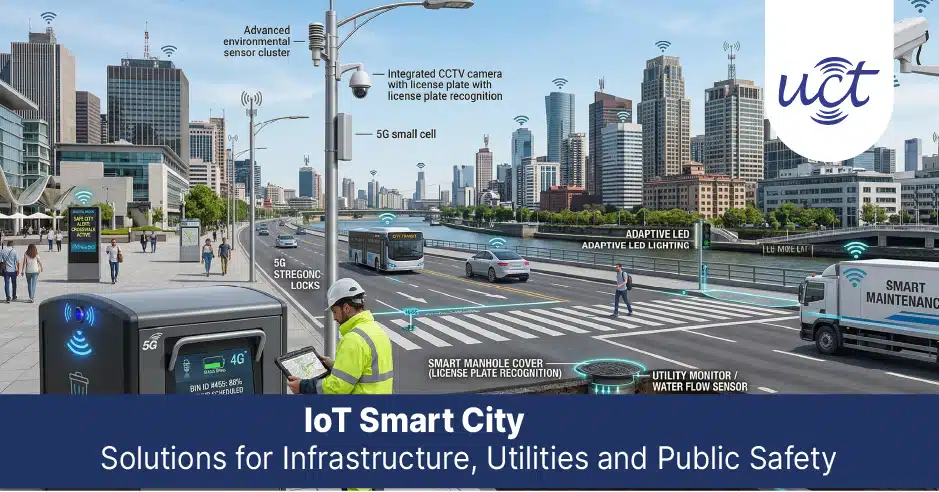
This post covers what’s actually working across three areas infrastructure (traffic signals, street lighting, parking), utilities (water and energy networks), and public safety (air quality, flood detection, surveillance) with real numbers from deployments in Delhi, NCR, and Hyderabad.
Why Most Smart City Projects Stall Before They Scale
The promise was always there. Sensors on every streetlight, real-time data dashboards for city administrators, water leaks detected before they become sinkholes. The reality in most Indian cities was a pilot that ran for eight months, generated a good PowerPoint, and quietly died when the budget cycle turned.
The failure pattern is usually the same. Projects built on 4G SIM cards work fine for ten nodes. At a thousand nodes, the monthly data cost alone runs into lakhs and nobody budgeted for that when the pilot was approved.
Then there’s hardware mismatch. A sensor that checks a dustbin’s fill level every six hours doesn’t need a 4G modem. It needs a radio that draws almost no power and costs a fraction of the price. Buying the wrong technology for the use case sounds obvious to avoid, but it keeps happening because vendors default to what they already sell.
And compliance gets ignored until it’s a problem. India’s 865 MHz band has specific DoT and BIS requirements. Many vendors don’t flag this until deployment, when it becomes an expensive, time-consuming problem to fix retroactively.
LoRaWAN Long Range Wide Area Network solves all three. A single gateway covers up to 15 km in line-of-sight conditions. Nodes run on batteries that last up to 10 years. The cost per node is roughly one-tenth of an NB-IoT equivalent.
Infrastructure: Traffic, Parking, and Street Lighting
Traffic and Congestion
Adaptive signal controllers connected to road sensors can cut congestion by around 30% in corridor-level deployments. The mechanism is straightforward: sensors count vehicle density at intersections and pass that data to a central controller, which adjusts green-light durations in real time instead of running on fixed timers set a decade ago.
Parking is a related problem. Ultrasonic sensors in parking bays broadcast occupancy status every few minutes. Drivers see open spots on a mobile app. The city reduces the share of traffic that’s just people circling.
Street Lighting
This is where the numbers get interesting fast. Dusk-to-dawn dimming control where streetlights brighten when motion is detected and dim during low-traffic hours consistently saves between 40% and 50% of energy consumption compared to fixed-on systems.
In NCR, Uniconverge Technologies deployed LoRaWAN-connected controls across 3,200 luminaires. The result was 41% lower energy use and 60% less maintenance intervention, because the system flags faults automatically rather than waiting for a resident complaint or a manual inspection round.
That’s not a marginal improvement. For a city running tens of thousands of streetlights, it’s a budget line that changes.
Utilities: Water, Energy, and Waste
Water Networks
India loses an estimated 40% of treated water before it reaches taps, mostly through distribution leaks that go undetected for months. Pressure sensors and flow meters installed at network nodes can localize a leak within hours. The sensor reports a pressure drop; the system triangulates the location; a crew goes to that spot.
Water quality sensors checking pH, turbidity, and chlorine levels are also relatively straightforward to deploy on LoRaWAN. They matter less for distribution and more for source monitoring and treatment plant compliance.
Energy and Gas
Smart metering at scale requires two things most Indian cities don’t have: reliable last-mile connectivity and a backend that can actually process billing data automatically. LoRaWAN handles the first problem. The meters themselves are simple; they read and transmit. Predictive analytics on consumption patterns can flag anomalies that indicate tampering or equipment failure before they show up in billing.
Waste Collection
The Hyderabad smart bin deployment is a clean example of the ROI case. Ultrasonic sensors in bins report fill levels. The collection schedule shifts from fixed routes running on fixed days to dynamic routing that only sends trucks to bins that are actually full.
The outcome: 35% fewer collection trips. That’s diesel, driver hours, and vehicle wear, all reduced without any change in service quality for residents.
Public Safety: Air, Floods, and Surveillance
Air Quality
Delhi’s air quality problem is well-documented. What’s less discussed is the cost of monitoring it. A traditional CPCB-grade reference station costs somewhere between ₹40 lakh and ₹60 lakh per installation. You can’t build a useful network of those at that price.
Uniconverge’s Delhi PM2.5 network put 100+ LoRa-connected sensors in place for roughly ₹18 lakh total. The comparable deployment using conventional telemetry would have run closer to ₹6 crore. That’s not a slight efficiency gain it’s a different order of magnitude, which means a city can run a real network instead of a handful of reference stations.
PM2.5, PM10, NO₂, CO, and ozone sensors on these nodes report every 15 minutes. The data feeds a public-facing dashboard and an alert system for schools and hospitals.
Flood and Disaster Monitoring
River-level sensors and rain gauges on LoRaWAN report continuously. When levels cross a threshold, the system pushes alerts to emergency responders and, if configured, to residents via SMS. The response time advantage compared to manual monitoring is significant a sensor reports at the moment water rises, not an hour later when someone notices.
Surveillance and Emergency Response
Geo-fenced camera alerts reduce the volume of footage operators have to review. Instead of watching 200 feeds simultaneously, operators get flagged when something crosses a boundary or a defined event type is detected. Pairing this with drone deployment for large events or post-disaster assessment is increasingly common in Indian city deployments.
LoRaWAN vs. the Alternatives
A comparison worth spelling out:
| Technology | Power Use | Cost per Node | Range | Nodes per Gateway |
| LoRaWAN | Very Low | ₹800–2,500 | Up to 15 km | Up to 1,00,000 |
| NB-IoT | ~10x higher | ₹3,000–8,000 | Cell-dependent | Carrier-managed |
| 4G/LTE | High | ₹5,000–15,000+ | Cell-dependent | Carrier-managed |
For smart city use cases where nodes sit in bins, on lamp posts, or in water pipes and need to run for years without service LoRaWAN’s power profile and cost structure are hard to argue against.
Uniconverge’s hardware operates on India’s licensed IN865 band, satisfies BIS and DoT compliance requirements, and is architected for hybrid 5G integration when cities eventually need higher-bandwidth applications alongside their sensor networks.
What Three Deployments Actually Cost and Delivered
Delhi Air Quality Network
100+ LoRaWAN PM2.5 sensors across the city. Total deployment cost: approximately ₹18 lakh. A comparable network using conventional monitoring hardware was quoted at ₹6 crore. The LoRaWAN network has been running continuously, feeding the city’s air quality dashboard.
NCR Street Lighting (3,200 Nodes)
LoRaWAN-connected dimming controllers on 3,200 luminaires. Energy savings: 41%. Maintenance interventions: down 60% because faults are reported in real time. Payback period on the installation cost was under 18 months based on energy bills alone.
Hyderabad Smart Bins
Ultrasonic fill-level sensors in municipal bins. Dynamic routing replaced the fixed collection schedule. Collection trips dropped 35%. The city didn’t cut any collection staff it reassigned them. Total operational expenditure on waste collection fell materially.
Facility Pilot (Multi-Application)
A combined infrastructure, utilities, and safety pilot using Uniconverge gateways. Operational expenditure across monitored systems fell by 50% compared to the pre-deployment baseline.
Compliance, Security, and the Vendor Selection Problem
Indian cities have been burned before by vendors who promised compliance and delivered hardware that sat in customs or failed BIS certification. This is not a minor issue. DoT licensing for the IN865 band requires specific device approval, and networks built on non-compliant hardware can be ordered offline.
On security: LoRaWAN uses AES-128 encryption end-to-end. For deployments where data privacy matters public safety cameras, energy consumption data edge AI processing keeps sensitive data local and only transmits aggregated results to the central platform. This architecture also reduces backhaul bandwidth requirements.
When evaluating vendors, the questions worth asking:
- Do their devices have BIS Type Approval for IN865?
- Do they have DoT authorization for operating the network infrastructure?
- What’s their encryption implementation device-level, transport, or both?
- What does the SLA look like for gateway uptime, not just device connectivity?
Where This Goes Next
The near-term additions to smart city IoT are AI analytics layered on top of existing sensor networks. The sensors already generate the data. A model that can predict when a transformer is likely to fail based on load patterns before the outage, not after or that can forecast peak traffic on specific corridors three hours ahead based on event data, adds value without requiring new hardware.
5G and LoRaWAN are not competitors. The likely architecture for Smart Cities 2.0 is hybrid: LoRaWAN for the dense, low-power sensor layer (the bins, the streetlights, the water pipes) and 5G for applications that need real-time video or high-throughput data. They cover different parts of the problem.
The Practical Starting Point
Most cities don’t need a 10-year masterplan to start. A focused pilot street lighting on one corridor, waste bins in one zone, air quality in a target area generates the data to justify the next phase. Uniconverge has run these pilots in Delhi and NCR; the model transfers.
If you’re evaluating an IoT deployment for a smart city project, the number worth calculating first is five-year TCO, not hardware price. LoRaWAN comes out roughly three times cheaper than 4G-based alternatives at scale, mostly because power and connectivity costs compound over time.
To discuss a specific pilot scope, get in touch with the Uniconverge team.