By UniConverge Technologies | Industrial IoT & Smart Infrastructure
| Did you know?India loses nearly 40% of its treated water before it even reaches a tap. At the same time, floods destroy livelihoods every monsoon season often because no one knew the river was rising until it was too late. The solution exists. It fits in the palm of your hand. And it runs for ten years on a single battery. |
Introduction: The Problem with “Checking Manually”
Picture a municipal engineer in Maharashtra. Every morning, she drives 40 kilometres to read a water-level gauge on a reservoir. She jots down a number, drives back, and files a report. By the time anyone acts on that data, hours have passed. In a flood situation, hours can be the difference between a warning and a catastrophe.
This is not a rare scenario. Across India, thousands of water bodies, tanks, rivers, dams, and distribution pipelines are still monitored the same way they were fifty years ago manually, slowly, and at great cost.
IoT-based water level monitoring powered by LoRaWAN technology is changing all of that. With wireless sensors that transmit data every few minutes, gateways that cover 15 kilometres on a single installation, and cloud dashboards that alert the right person in seconds, smart water level monitoring is no longer a luxury for large utilities. It is a practical, affordable solution for municipalities, industries, agricultural operations, and infrastructure managers of every size.
This guide explains exactly how it works, why LoRaWAN is the right technology for the job, and what real deployments in India have achieved.
India’s Water Crisis Is Also a Data Crisis
India is the world’s largest user of groundwater. It manages thousands of kilometres of irrigation canals, hundreds of municipal water distribution networks, and faces one of the most intense monsoon cycles on the planet. Yet for all this complexity, the data infrastructure is thin.
Consider a few realities:
- Indian cities lose between 30% and 50% of treated water through distribution leaks that often go undetected for weeks or months.
- Floods cause an average of over Rs. 1,800 crore in damage every year, much of it preventable with early warning.
- Schemes like Jal Jeevan Mission, AMRUT 2.0, and the Smart Cities Mission are pushing utilities to modernise but without real-time sensing infrastructure, digital dashboards simply display old data.
The root cause of most of these failures is the same: decisions are being made without current, accurate information about where the water is and where it is going.
Real-time water level monitoring solves this at the source. It gives utilities, flood managers, and farmers a continuous stream of ground truth and the ability to act on it immediately.
What Is LoRaWAN And Why Does It Fit Water Monitoring So Well?
LoRaWAN stands for Long Range Wide Area Network. It is a wireless communication protocol designed specifically for battery-powered IoT devices that need to transmit small amounts of data over long distances without consuming much energy.
Think of it as a WhatsApp for sensors except instead of messages, your devices send water level readings, and instead of mobile data, they use a free, unlicensed radio frequency band.
Key Technical Advantages
- Range: Up to 15 kilometres in rural areas and 2–5 kilometres in dense urban environments from a single gateway.
- Battery life: Sensors can operate for 8–12 years on a standard battery, making them ideal for remote or hard-to-access locations like riverbeds and underground pipes.
- Scalability: One LoRaWAN gateway can handle thousands of sensors simultaneously.
- Security: End-to-end AES-128 encryption protects all transmitted data.
- Cost: Compared to cellular or SCADA-based systems, LoRaWAN deployments cost a fraction of the infrastructure investment.
LoRaWAN vs. Other Connectivity Options
| Feature | LoRaWAN | NB-IoT | Cellular (4G) | Wi-Fi |
| Range | Up to 15 km | 1–10 km | Unlimited (SIM) | ~100 m |
| Battery Life | 8–12 years | 5–10 years | 1–3 years | Days |
| Cost per Node | Very Low | Low–Medium | High (SIM fees) | Low (short range only) |
| Network Dependency | Private or public | Telecom operator | Telecom operator | Local router |
| Best For | Wide-area water/flood monitoring | Dense urban IoT | High-data applications | Indoor, short range |
| India Frequency Band | IN865 MHz | LTE bands | LTE bands | 2.4 / 5 GHz |
For water level monitoring where sensors are spread across wide areas, data packets are small, and power sources are scarce LoRaWAN is the natural fit.
How a Smart Water Level Monitoring System Actually Works
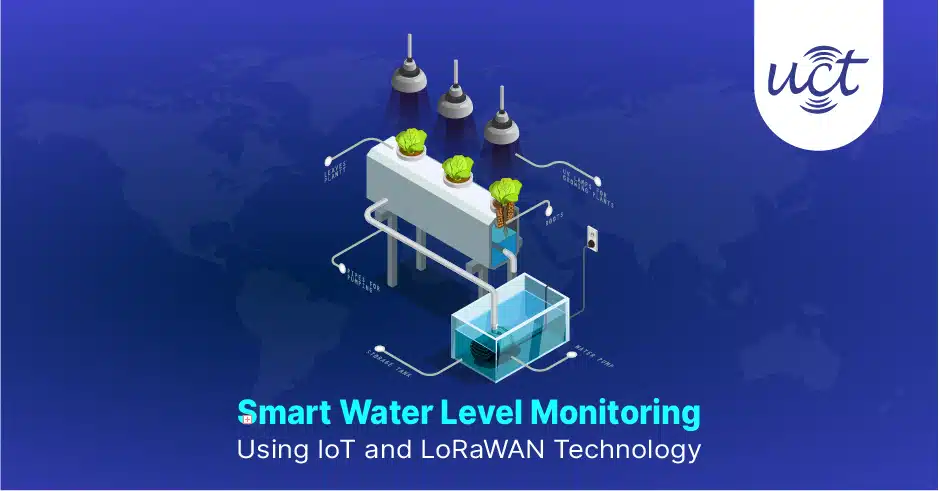
A LoRaWAN-based water level monitoring system has four layers. Each layer plays a specific role, and together they create a complete picture from sensor to screen.
| Layer | Component | What It Does |
| 1. Sensing | Water level sensor (ultrasonic, pressure, or radar) | Measures water depth or level at set intervals and encodes it as a small data packet. |
| 2. Transmission | LoRaWAN end node | Sends the data wirelessly to the nearest gateway using the LoRa radio protocol. |
| 3. Gateway | LoRaWAN Gateway (e.g., UniConverge UG67) | Receives signals from hundreds of sensors within range and forwards them to the cloud via 4G or Ethernet. |
| 4. Cloud & App | Network Server + IoT Platform + Dashboard | Processes the data, triggers alerts when thresholds are crossed, and displays trends on a real-time dashboard accessible on any device. |
The entire data journey from sensor reading to alert on your phone typically takes less than five seconds. Sensors can be configured to report every 15 minutes during normal conditions and every 60 seconds during a flood event, preserving battery while prioritising critical data.
Uniconverge’s LoRaWAN infrastructure includes the full stack: end nodes, indoor and outdoor gateways, a network server, and a cloud IoT platform with API integrations for existing SCADA and ERP systems. This means you are not patching together hardware from different vendors the entire system is designed to work together.
Which Water Level Sensor Should You Use?
The sensor is where the system meets the water. Choosing the right type depends on your environment, the liquid being monitored, and the accuracy you need. Here is a straightforward comparison of the most common types.
| Sensor Type | How It Works | Best For | Key Strength | Limitation |
| Submersible Pressure Sensor | Measures hydrostatic pressure exerted by the liquid column above it. Converts pressure into depth. | Wells, underground tanks, rivers, reservoirs | Highly accurate; unaffected by surface conditions like foam or wind | Requires direct submersion; fouling from sediment possible |
| Ultrasonic Distance Sensor | Sends ultrasonic pulses downward; calculates distance based on echo return time. | Open channels, tanks, stormwater drains, irrigation canals | Non-contact; easy to install; no contamination risk | Can be affected by heavy foam or turbulent water surface |
| Radar Level Sensor | Uses microwave radar pulses for high-precision non-contact measurement. | Chemical tanks, industrial reservoirs, harsh environments | Extremely accurate; unaffected by temperature, vapour, or dust | Higher cost; used in specialised industrial settings |
| Float/Mechanical Sensor | Physical float rises and falls with water; triggers switches at set levels. | Simple tank monitoring, legacy systems | Very low cost; simple to understand | Low accuracy; no continuous data; high maintenance |
Uniconverge deploys both submersible pressure sensors and clamp-on ultrasonic meters depending on the application. For example, the Tata Motors water metering project used clamp-on ultrasonic sensors in compact overhead zones contactless, battery-free, and accurate without interrupting existing pipework.
Must-Have Features in a Production-Grade System
Not all water level monitoring systems are built for real-world conditions. Here are the features that separate a pilot project from a system that works reliably year after year.
Durability and Weatherproofing
Any sensor deployed outdoors or in water must carry at minimum an IP67 rating (withstands submersion up to 1 metre for 30 minutes). Sensors installed in rivers, wells, or open reservoirs should be IP68 rated (continuous submersion). During Indian monsoons, this is not optional.
Configurable Alert Thresholds
A good system lets you define multiple alert levels for example: Normal (below 50 cm), Alert (50–100 cm), Caution (100–150 cm), and Dangerous (above 150 cm). When a threshold is crossed, the system instantly sends an SMS, email, or push notification to the people responsible for taking action.
Solar Power Compatibility
For remote sites rivers, agricultural channels, isolated reservoirs solar-powered sensor nodes eliminate the need for any grid connection. Combined with the long battery backup of LoRaWAN devices, these systems can operate autonomously for years.
Legacy System Integration
Most industrial and municipal clients already have existing meters electromagnetic flow meters, pressure gauges, or older SCADA systems. A good LoRaWAN deployment should not require replacing all of that. Uniconverge’s RS485-to-LoRa converters connect existing Modbus-compatible meters to the LoRaWAN network without any hardware replacement, protecting prior investments.
Real-Time Dashboard and Historical Analytics
Raw numbers are not enough. A well-designed dashboard shows current levels, trends over time, map-based sensor locations, and allows you to export data for reporting. Uniconverge’s IoT platform also supports OTA (over-the-air) firmware updates, which means sensors can be updated remotely without a site visit.
Real-World Applications Where This Technology Is Being Used
6.1 Flood Early Warning Systems in Indian Cities
This is perhaps the most urgent application. Ultrasonic level sensors installed in stormwater drains, urban canals, and river monitoring points send depth readings every few minutes. When water approaches a critical threshold, alerts go out automatically to municipal control rooms, NDMA-linked systems, or local ward offices.
The city of Brunei provides a compelling global parallel: a canal near a major airport can overflow in under 20 minutes during heavy rain. A LoRaWAN-based monitoring system now provides enough advance warning for the airport to take protective action before flooding begins. The same logic applies to Chennai, Mumbai, and Hyderabad, all of which experience acute urban flooding events every monsoon season.
6.2 Irrigation Automation The ORR Hyderabad Project
One of Uniconverge’s most visible deployments is the irrigation automation system along Hyderabad’s Outer Ring Road a 158-kilometre stretch that requires consistent, automated watering to maintain its green corridor.
The system uses LoRaWAN to remotely control irrigation valves, monitor flow meters and pressure sensors, and detect leaks in real time. It saves approximately 6 lakh litres of water per day compared to conventional tanker-based irrigation, and delivers annual savings of around Rs. 6 crore. The project was commissioned by the Telangana government and featured in Telangana Today.
6.3 Industrial Tank and Process Monitoring IOCL
Indian Oil Corporation Limited needed a reliable way to monitor ethanol flow and storage tank levels across multiple facilities. Traditional systems were slow, prone to inaccuracy, and could not provide the real-time data required for both operational efficiency and regulatory compliance.
Uniconverge deployed a LoRaWAN-based solution with high-precision RS485 flow meters and LoRaWAN-connected tank level sensors. The result was a significant improvement in measurement accuracy, faster response to potential safety incidents, and a scalable platform that can expand to new facilities without additional infrastructure investment.
6.4 Smart Water Metering Tata Motors
Tata Motors required a way to track and reduce water consumption across its manufacturing plants. The challenge was that plants already had a range of mechanical and electromagnetic meters in place replacing all of them would be expensive and disruptive.
Uniconverge’s approach was to retrofit rather than replace. Pulse-to-LoRa and RS485-to-LoRa converters were attached to existing meters, extracting real-time readings without any hardware replacement. In compact or overhead zones where existing meters could not be adapted, clamp-on ultrasonic meters were deployed instead, battery-free and contactless.
The outcome: real-time water consumption monitoring across multiple plants, rapid leak detection, and Rs. 2.5 crore in annual savings.
6.5 Municipal Water Infrastructure and Government Schemes
India’s Jal Jeevan Mission, AMRUT 2.0, and Smart Cities Mission all mandate the modernisation of urban water infrastructure. LoRaWAN water level monitoring fits directly into these frameworks providing the real-time sensing layer that makes smart water distribution networks possible.
In Pune, early AMR (Automatic Meter Reading) deployments on LoRaWAN water networks showed a reduction in non-revenue water of 18–22% in the first year. Similar results have been recorded in Hyderabad. These numbers represent real savings for cash-strapped municipal utilities and real water saved for communities.
What Does It Cost And What Is the Return?
One of the most persistent misconceptions about IoT systems is that they are expensive. The reality, especially with LoRaWAN, is almost the opposite.
| Cost Dimension | Traditional SCADA / Wired System | LoRaWAN IoT System (Uniconverge) |
| Deployment Cost per Site | Rs. 80 lakh – Rs. 1.2 crore (wiring, shelter, power) | Rs. 2.5 lakh – Rs. 5 lakh (wireless, minimal civil work) |
| Battery / Power Cost | Continuous grid power required | 10-year battery or solar; near-zero ongoing power cost |
| Maintenance Visits | Monthly or more frequent | Reduced by 40%+ with remote diagnostics |
| Scaling Additional Sensors | Each new point requires new wiring | Add sensors instantly; one gateway handles thousands |
| Legacy Integration | Often requires full hardware replacement | RS485-LoRa converters retrofit existing meters |
| Typical Payback Period | 5–8 years | 12–24 months |
The economics are clear. For a large water utility or industrial facility, a LoRaWAN deployment typically pays for itself within the first two years through reduced water losses, lower maintenance costs, and avoided emergency response expenses.
How to Deploy Uniconverge’s Three-Stage Approach
There is no universal template for deploying a water level monitoring system the right approach depends on the site, the existing infrastructure, and the specific use case. That said, Uniconverge has refined a three-stage deployment methodology across dozens of projects in India.
Stage 1: Assessment and Planning
Before any hardware is installed, the team conducts a thorough site audit. This covers the physical layout of the monitoring area, the existing meters and sensors already in place, the connectivity environment (urban density, building obstructions, underground zones), and the specific data requirements how frequently readings are needed, what alert levels matter, and where data needs to go.
Gateway placement is planned using RF coverage modelling to ensure that every sensor has a reliable communication path without unnecessary hardware duplication.
Stage 2: Integration and Hardware Deployment
For sites with existing meters, RS485-to-LoRa or Pulse-to-LoRa converters are deployed first. This immediately brings legacy equipment into the IoT network without replacement cost. Where new sensing points are needed, plug-and-play sensor nodes are installed configured via NFC from a smartphone, requiring no specialist tools.
LoRaWAN gateways (Uniconverge UG67, rated IP67 for outdoor use) are installed at planned positions, connected to the internet via 4G or Ethernet backhaul. Each gateway can handle up to 2,000 sensors across a 15-kilometre radius, making it practical to monitor large areas from just a handful of installations.
Stage 3: Activation, Calibration, and Handover
Once hardware is live, sensors are calibrated against reference readings to validate accuracy. Alert thresholds are configured on the platform, and the operations team receives training on the dashboard how to read trends, set custom alerts, export reports, and escalate to maintenance.
OTA firmware updates mean that any future improvements to the sensing software can be pushed remotely, without a site visit. Ongoing support from Uniconverge’s team ensures that any anomalies are caught early.
Challenges and How to Handle Them
Like any technology, LoRaWAN-based water monitoring has limitations. Being aware of them upfront makes deployments more reliable.
| Challenge | Why It Happens | How to Solve It |
| Sensor fouling in rivers | Sediment, algae, and debris accumulate on submersible sensors over time | Use IP68-rated sensors with smooth enclosures; schedule quarterly cleaning checks; use ultrasonic sensors for above-water deployment where possible |
| Signal gaps in dense urban areas | Concrete structures and underground locations attenuate LoRa signals | Increase gateway density in problem zones; use outdoor-mounted gateways at elevation; test spreading factors during planning |
| Monsoon interference | Heavy rain and flooding can affect sensor calibration temporarily | Deploy pressure sensors (unaffected by surface conditions) in flood scenarios; set wider calibration tolerance during monsoon months |
| Legacy system data gaps | Existing meters use RS485 or pulse output and cannot natively join LoRaWAN | Uniconverge RS485-to-LoRa and Pulse-to-LoRa converters bridge this gap without any meter replacement |
| Higher latency than cellular | LoRaWAN is optimised for power efficiency, not speed | For most water monitoring use cases, 5–15 second data delivery is sufficient; use cellular for applications requiring sub-second response |
The Future of Smart Water Level Monitoring
The technology is already mature LoRaWAN water monitoring is deployed at scale across India and globally. What is evolving rapidly is how the data is used.
AI-Powered Predictive Analytics
Uniconverge is already integrating machine learning models into its water metering deployments. These models learn the normal patterns of water flow and level across a network, and flag anomalies distinguishing a genuine pipe burst from a legitimately high-consumption event based on network-wide behaviour rather than single-sensor thresholds. Applied to flood monitoring, the same approach can predict rising levels hours before they become dangerous.
Digital Twins of Water Infrastructure
As sensor density increases, it becomes possible to build a live digital replica of an entire water distribution network a digital twin that shows pressure, flow, and level at every point in real time. This allows utilities to simulate the impact of a valve closure or a pump failure before making any physical change.
Hybrid LoRaWAN and 5G Architectures
For city-scale deployments, the most practical architecture is hybrid: LoRaWAN handles the dense, low-power sensor layer across wide areas, while 5G handles applications that need high-throughput data like CCTV feeds from flood-prone zones. Uniconverge is actively building this hybrid capability into its smart city deployments.
Satellite IoT Backhaul for Remote Sites
For dam monitoring or river sensing in areas with no cellular coverage, satellite-connected LoRaWAN gateways are becoming viable. This opens up water level monitoring to truly remote geographies high-altitude reservoirs, remote catchment areas, and border region infrastructure.
Conclusion: From Reactive to Proactive Water Management
India cannot afford to manage its water infrastructure reactively any more. The combination of rising demand, climate variability, aging infrastructure, and government modernisation mandates creates a clear imperative to move to real-time, data-driven water management.
Smart water level monitoring using IoT and LoRaWAN technology is not a futuristic concept. It is proven, deployed, and delivering measurable results from Rs. 2.5 crore in savings at a Tata Motors facility to Rs. 6 crore in annual cost avoidance on a Hyderabad highway. It is preventing floods in cities, conserving water in farms, and helping utilities meet the demands of India’s growing urban population.
The path from manual gauge readings to automated, intelligent water monitoring does not require replacing everything at once. It starts with a site audit, a pilot deployment, and a clear view of where the highest-value problems are. Uniconverge’s end-to-end LoRaWAN infrastructure designed and supported in India makes that path as short and cost-effective as possible.
| Ready to explore water level monitoring for your facility or infrastructure? UniConverge Technologies offers free consultations to assess your site requirements and provide a tailored deployment roadmap. From municipal utilities to industrial plants to smart city projects our team has deployed LoRaWAN water monitoring solutions across India. Visit uniconvergetech.in or contact our team to get started. |
Frequently Asked Questions
What is smart water level monitoring?
It is the use of IoT sensors and wireless communication technology to continuously measure and transmit water level data from tanks, rivers, dams, or pipelines to a centralised cloud platform enabling real-time visibility, automated alerts, and data-driven decision-making without manual inspection.
How does LoRaWAN work for water level monitoring in India?
LoRaWAN sensors at the water source transmit small data packets using long-range radio waves on India’s IN865 MHz unlicensed band. A nearby gateway (often 5–15 km away) receives these packets and forwards them to a cloud server via 4G or Ethernet. The data appears on a dashboard within seconds and can trigger SMS or email alerts if levels cross defined thresholds.
How long do LoRaWAN water level sensors last on battery?
With standard transmission intervals (every 15 minutes), most LoRaWAN water sensors operate for 8–12 years on a single battery pack. Some models using ultra-low-power modes can extend this further. Clamp-on ultrasonic sensors can be configured to draw power from the pipe they are monitoring, eliminating batteries entirely.
Can these sensors work during monsoon and flood conditions?
Yes. Submersible pressure sensors are rated IP68 and are specifically designed to operate while submerged. Ultrasonic sensors are mounted above the water line and are unaffected by submersion. Uniconverge deploys both types in flood monitoring projects and configures sensors to increase their transmission frequency automatically when water levels rise rapidly.
What is the approximate cost of a LoRaWAN water monitoring deployment in India?
Costs vary significantly by site scale and complexity. A single-site monitoring system for a small reservoir or industrial tank can be deployed for as little as Rs. 2.5 lakh. A city-scale flood monitoring network covering multiple rivers and stormwater drains across an urban area may run to Rs. 50–80 lakh. In both cases, the cost is typically 10–20 times lower than equivalent SCADA-based wired systems.
Can UniConverge integrate with our existing SCADA or ERP system?
Yes. Uniconverge’s IoT platform supports standard integration protocols including MQTT, REST APIs, and Modbus. Data can be forwarded to existing SCADA systems, SAP instances, or any third-party management platform. RS485-to-LoRa converters also allow existing Modbus-compatible meters to be brought into the LoRaWAN network without hardware replacement.
Explore More from UniConverge Technologies
- LoRaWAN Water Metering at Tata Motors Full Case Study
- ORR Hyderabad Irrigation Automation Project Overview
- Tank Level and Flow Monitoring at Indian Oil Case Study
- LoRaWAN vs NB-IoT: Which Is Right for Your Industrial Application?
- LoRaWAN Environmental Monitoring: Air, Water, and Climate Parameters
uniconvergetech.in | Made in India