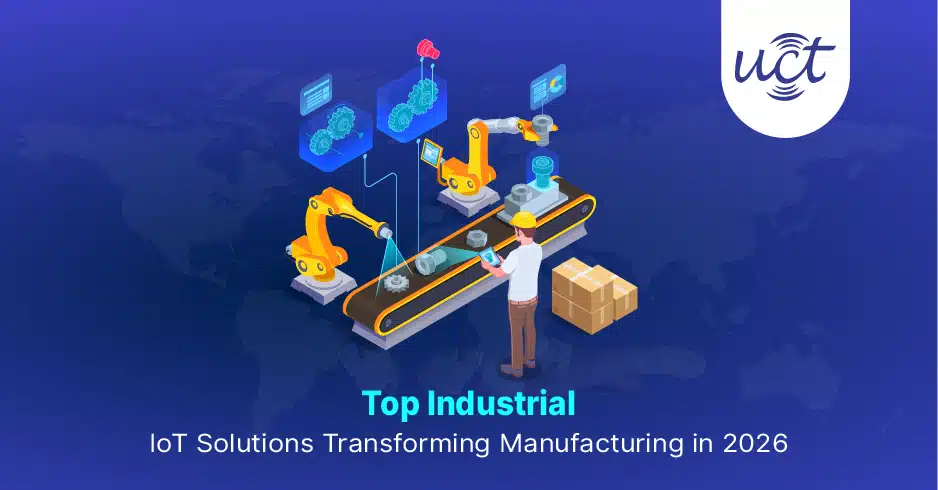
Top Industrial IoT Solutions Transforming Manufacturing in 2026
A factory in Noida lost ₹5 lakhs in a single shift because a pump failed without warning. Here’s how Industrial IoT is making sure that never happens again — and why Indian manufacturers can no longer afford to wait.
India’s manufacturing sector is at a crossroads. Global IoT adoption stands at 40% — yet India sits at just 15%. With the government’s Make in India initiative pushing for 25% smart factories by 2027, one question matters most: Is your factory ready, or are you already falling behind?
Why Manufacturers Can’t Wait Anymore
Think about the last time a machine broke down unexpectedly on your factory floor. The scramble to find the fault. The idle workers. The orders piling up. Now imagine knowing about that failure three days before it happened — and fixing it quietly during a scheduled break.
That’s not science fiction. That’s what Industrial IoT (IIoT) delivers right now, in 2026. IIoT simply means connecting your machines, sensors, and systems so they talk to each other — sharing real-time data that helps you make faster, smarter decisions.
But here’s the part most global guides miss: India has its own unique set of challenges — and opportunities.
The India Reality Check: Most Indian factories still run on equipment from the 1990s. Power outages kill 5–10% of uptime in industrial zones. TRAI spectrum rules add compliance steps. And MSMEs balk at the seemingly high upfront costs. These are real problems — and they have real, affordable solutions that most global IIoT content never discusses.
The government’s Production-Linked Incentive (PLI) schemes are actively pushing manufacturers to upgrade. Combine that with rising electricity costs, ESG reporting mandates, and a global push for supply chain resilience — and the question is no longer if you should adopt IIoT, but how fast.
How an Industrial IoT System Actually Works
IIoT sounds complex, but the idea is simple. Imagine your factory as a human body. Sensors are the nerve endings — they feel what’s happening (heat, vibration, pressure). The network is the nervous system — it carries those signals. And the software platform is the brain — it makes sense of all the data and tells you what to do.
Here are the five layers of any IIoT system, explained simply:
Layer 1: Sensors & Devices (The Eyes and Ears)
Tiny devices attached to your machines measure temperature, vibration, pressure, energy usage, and more. These are the foundation of everything. Without good sensors, you have no data — and without data, you’re flying blind.
Layer 2: Connectivity (The Nervous System)
Data from sensors must travel somewhere. This is where choosing the right wireless technology matters enormously — especially in India. Not all wireless protocols are equal.
| Technology | Range | Battery Life | Cost (India) | Best For | India Fit |
|---|---|---|---|---|---|
| LoRaWAN | 2–15 km | 10–15 years | ₹5,000–₹15,000/node | Energy monitoring, legacy brownfield factories | Excellent |
| NB-IoT | 10+ km | 8–10 years | ₹8,000–₹20,000/node | Remote assets, utilities | Good |
| Private 5G | 300m–1 km | Requires power | ₹50L+ setup | Real-time robotics, high-speed lines | Large enterprises |
| Wi-Fi | 50–100m | Requires power | Low hardware cost | Office areas, controlled spaces | Weak in factories |
| Wired (RS485) | 1.2 km | N/A (wired) | High installation cost | Critical fixed machinery | Expensive to retrofit |
The India Winner: LoRaWAN. For most Indian factories — especially brownfield plants and SMEs — LoRaWAN hits the sweet spot. It works across kilometres, doesn’t need frequent battery changes, operates in licence-exempt bands in India (IN865), and costs 40% less than NB-IoT alternatives. Explore Uniconverge’s LoRaWAN solutions →
Layer 3: Edge Computing (Local Intelligence)
Instead of sending every byte of data to a faraway cloud, edge devices process information right at the factory. This means faster responses, lower cloud costs, and the ability to keep running even when your internet is down — critical in Indian industrial zones where connectivity can be unreliable.
Layer 4: Cloud Platform (The Brain)
Data flows into platforms like AWS IoT SiteWise, Microsoft Azure IoT, or purpose-built industrial platforms. Here, machine learning algorithms find patterns — like a motor gradually drawing more current before it fails.
Layer 5: Applications (The Actions)
This is where data becomes decisions. Dashboards, alerts, maintenance work orders, energy reports — the things your team actually uses every day. The best IIoT platforms connect directly to your existing ERP, CMMS, or SCADA system so everything works together.
Top 7 Industrial IoT Solutions Transforming Manufacturing in 2026
Not all IIoT applications are created equal. These seven solutions deliver the highest, most measurable ROI for manufacturers today — and they’re the ones you should prioritise.
Sensors detect the early warning signs of machine failure — rising temperature, unusual vibration, abnormal current — before a breakdown occurs. Schedule repairs during planned stops, not during peak production.
A live virtual copy of your machine or production line, updated in real time. Test changes — adjusting pressure, speed, temperature — on the digital version before touching the real machine.
Track exactly which machine consumes how much power, shift by shift. Idle motors, phantom loads, HVAC overcooling empty halls — IoT finds waste you never knew existed.
Cameras and sensors scan every product in real time. AI spots defects too small or fast for human eyes — and removes them before they reach the customer.
Overall Equipment Effectiveness used to be calculated at the end of the week. Now it’s a live dashboard updated every second — giving you instant visibility into availability, performance, and quality.
Know where every tool, trolley, and component is at all times. Reduce losses, improve utilisation, and ensure critical equipment is always where it’s needed.
IoT-connected supply chains track inventory in real time, predict disruptions, and monitor the carbon footprint of every production step — making ESG reporting accurate, not estimated.
Textile Mill Cuts Energy Bills by 35% with LoRaWAN Shift Monitoring
A textile manufacturing facility in Dadri was losing ₹50,000 extra every month — idle compressors running through the night shift, HVAC cooling an empty hall, lights nobody remembered to turn off. The managers didn’t even know it was happening until the monthly bill arrived.
Uniconverge deployed 200 LoRaWAN sensor nodes across the facility. Each node tracked energy consumption per machine, per shift. Within weeks, the dashboard lit up red where waste was hiding. Adjustments were made. The savings were immediate.
IIoT for Indian SMEs: Start Small, Scale Smart
Here’s a truth that most global IIoT guides won’t tell you: The biggest barrier for Indian manufacturers is not technology — it’s the fear of cost and complexity. Most articles are written for Siemens-equipped European plants with unlimited IT budgets. That’s not your reality. And it doesn’t need to be.
The SME Math: IoT pilots with Uniconverge start from just ₹2–5 lakhs. Most clients see full payback within 6–18 months. You don’t need to transform your entire factory on day one — you need one successful pilot that proves the ROI.
The Phased Pilot Approach (How Smart SMEs Do It)
The factories that fail at IIoT try to do everything at once. The ones that succeed pick one high-pain problem and solve it first. Here’s the pattern that works:
| Phase | What You Do | Budget | Expected Outcome |
|---|---|---|---|
| Phase 1 | Deploy 20–50 sensors on your highest-cost machine or biggest energy drain | ₹2–5 Lakhs | First data in days; ROI proof in 30–60 days |
| Phase 2 | Expand to one full production line; add predictive maintenance alerts | ₹10–25 Lakhs | Measurable downtime reduction; energy savings visible |
| Phase 3 | Full factory rollout; integrate with ERP/dashboard; shift-wise reporting | ₹25–75 Lakhs | Complete operational visibility; continuous improvement loop |
Solar-Powered IoT Beats Monsoon Blackouts
A factory in Manesar had a recurring problem: power outages during the monsoon season knocked out their monitoring systems at the worst possible time. Any IoT solution that depended on the grid was useless when they needed it most.
Uniconverge deployed solar-powered LoRaWAN nodes — completely independent of the local grid. During monsoons, when neighbouring factories were flying blind, this plant maintained full monitoring. The result was a 40% reduction in unexpected failures, and the peace of mind that comes from 99.9% uptime regardless of the weather.
To learn more about how Uniconverge solves India-specific challenges, visit their Industrial IoT solutions page or read about their LoRaWAN connectivity products.
Choosing the Right IIoT Platform: A Buyer’s Guide
With over 750 vendors in the smart manufacturing market, choosing a platform feels overwhelming. Here’s a simplified way to think about it: the best platform is the one that connects to your existing machines, fits your budget, and delivers data your team will actually use.
The Hidden Cost Nobody Talks About: 70–80% of IIoT lifecycle costs happen after the hardware purchase — in integration, operations, training, and maintenance. Always evaluate Total Cost of Ownership (TCO), not just device prices.
| Platform | Best For | Brownfield Support | India SME Fit | Pricing Model |
|---|---|---|---|---|
| Uniconverge UCT Platform | Indian factories, LoRaWAN deployments, legacy machines | Excellent | Built for it | From ₹2L pilot |
| Siemens Insights Hub | Siemens-equipped large plants | Siemens-native | Enterprise only | Tiered (premium) |
| AWS IoT SiteWise | AWS-first organisations | Good via Edge | Pay-as-you-go | Usage-based ($25/mo+) |
| Microsoft Azure IoT | Microsoft ecosystem users | Good via modules | Medium fit | $1,000–$20,000+/mo |
| PTC ThingWorx | Custom IIoT applications | 150+ protocols | Complex for SMEs | Enterprise licensing |
| Litmus Edge | Mixed-vendor environments | 250+ protocols | Growing in India | Subscription |
For Indian manufacturers — particularly those in Delhi/NCR, Pune, or Gujarat industrial corridors — a purpose-built platform with local support, TRAI-compliant hardware, and brownfield connectivity expertise delivers far more value than adapting a European enterprise solution. See how Uniconverge approaches this →
Challenges & How to Overcome Them (India Edition)
Let’s be honest — IIoT is not plug-and-play everywhere. Here are the most common barriers Indian manufacturers face, and the practical solutions that actually work.
| Challenge | Why It’s Worse in India | Practical Solution |
|---|---|---|
| Legacy machine integration | Average Indian shop floor equipment is 15–30 years old; PLCs don’t communicate with modern systems | RS485-to-LoRaWAN converters bridge old and new without replacing machinery. View UCT’s converters → |
| Power outages | 5–10% uptime loss in industrial zones; grid monitoring fails during outages | Solar-powered LoRaWAN nodes maintain 99.9% uptime independent of the grid |
| Cybersecurity risks | 31% of manufacturers globally were hit by OT cyberattacks in 2024; OT systems often have no security | Zero Trust architecture + hardware-level AES-128 encryption (standard in LoRaWAN); network segmentation of OT systems |
| High upfront cost fears | SMEs see ₹50L price tags and give up before researching affordable entry points | Phased pilots from ₹2–5L; ROI proven before scaling. LoRaWAN costs 40% less than NB-IoT alternatives |
| Skills gap | 90% of supply chain leaders say companies lack digitisation talent; IoT skills are rare | Uniconverge’s IoT Lab Kits train engineers at universities and startups; vendor-managed platforms reduce in-house expertise needed |
| Regulatory compliance | TRAI spectrum rules, WPC type approval, BIS certification requirements | Uniconverge handles all Indian regulatory compliance for LoRaWAN deployments including IN865 band licensing |
5-Step Implementation Roadmap: From Zero to Smart Factory
The factories that succeed with IIoT don’t try to do everything at once. They follow a clear sequence. Here’s the roadmap that works for Indian manufacturers of every size.
Before buying anything, walk your factory floor and identify the one machine, production line, or energy source that costs you the most when it fails or wastes. This is your pilot target. A good sensor audit takes 1–2 days and costs nothing.
Budget: ₹0 Time: 1–2 daysDeploy 20–50 sensors on your chosen target. Choose LoRaWAN for most Indian factory environments — no new wiring needed, works through concrete walls and metal structures. Get your first real data within days. Prove ROI within 30–60 days.
Budget: ₹2–5 Lakhs Time: 2–4 weeksOnce you have data flowing, choose a platform that integrates with your existing ERP, CMMS, or SCADA system. Use protocol adapters (RS485-LoRaWAN converters, OPC-UA bridges) to bring your legacy machines into the network without replacing them.
Budget: ₹10–25 Lakhs Time: 4–8 weeksRaw sensor readings mean nothing without context. Set up your Industrial DataOps layer — give every sensor tag a meaningful name, clean the data, and feed it to your analytics or AI engine. This is where predictive maintenance and energy alerts get switched on.
Budget: ₹5–15 Lakhs Time: 4–6 weeksUse containerised deployments to roll out the same configuration across all machines, then across all sites. Set KPIs — OEE, energy cost per unit, downtime hours per month — and track them weekly. Your IIoT system should now be continuously improving your operations.
Budget: ₹25–75 Lakhs Time: OngoingWhat’s Coming for Industrial IoT Beyond 2026
IIoT in 2026 is already impressive. What’s coming next will be transformative — and Indian manufacturers who are building their foundations now will be best positioned to adopt these advances.
AIoT: When Artificial Intelligence Meets IoT
The real revolution isn’t sensors — it’s what happens when those sensors feed AI systems that can think. Agentic AI is emerging as the next frontier: instead of just alerting a human when a pump is about to fail, an agentic system detects the fault, checks parts inventory in the ERP, raises a purchase order, and schedules the maintenance window — all automatically, without human intervention.
Uniconverge is already building towards this future with AIoT solutions that bring AI and IoT together for Indian industries.
6G and Ultra-Low Latency
Private 5G is already enabling real-time robotic control. 6G — expected to become available commercially around 2030 — will push latency below 1 millisecond, enabling fully autonomous factory segments where machines coordinate in real time without human oversight.
Self-Powered Sensors Everywhere
LoRaWAN sensors already last 10–15 years on a single battery. The next generation of biomimetic, energy-harvesting sensors will power themselves from the vibration, heat, or light of the machines they monitor — making pervasive deployment economically viable even for the smallest factory.
The Bottom Line for Indian Manufacturers: The factories that start building their IIoT foundations today — even with a simple LoRaWAN pilot — will be the ones ready to layer on AI, digital twins, and autonomous control over the next 3–5 years. The gap between early adopters and laggards is widening every quarter. The best time to start was yesterday. The second-best time is now.
Frequently Asked Questions
IIoT means connecting your factory machines, sensors, and systems to a network so they can share data with each other and with you in real time. Think of it as giving your machines the ability to speak — telling you when they’re stressed, wasting energy, or about to break down.
A well-designed pilot with Uniconverge Technologies starts from ₹2–5 lakhs, covering 20–50 sensors and a gateway. Most SMEs see full payback within 6–18 months through energy savings and reduced downtime alone.
No. This is one of the biggest myths about IIoT. RS485-to-LoRaWAN converters and protocol adapters can connect machines from the 1990s to modern IoT networks without any replacement. Uniconverge specialises in exactly this kind of brownfield connectivity.
LoRaWAN is arguably the best-fit wireless technology for most Indian factories. It operates in the licence-exempt IN865 band (compliant with TRAI rules), works over several kilometres, needs no frequent battery replacements (10–15 year life), penetrates concrete and metal, and costs 40% less than NB-IoT alternatives.
Modern IIoT security is built on Zero Trust architecture — meaning every device must authenticate before it can send data. LoRaWAN has mandatory AES-128 encryption built in. Additionally, isolating your OT (operational technology) network from your IT network through segmentation prevents most cyber threats from spreading between systems.
Ready to Transform Your Factory?
Get a free factory audit from Uniconverge Technologies — India’s leading Industrial IoT specialists since 2013. Founded by IITians and NITians, we’ve helped factories from Noida to Gujarat reduce downtime, cut energy bills, and scale smarter.
Explore More from Uniconverge
End-to-end LoRaWAN products for industrial and commercial applications — gateways, end nodes, sensors, and the UCT IoT platform.
How AIoT is bringing predictive intelligence to Indian factories — and what it means for your operations right now.
Real examples from Dadri, IOCL Hyderabad, and Gujarat — how LoRaWAN is cutting factory energy bills by 25–40%.