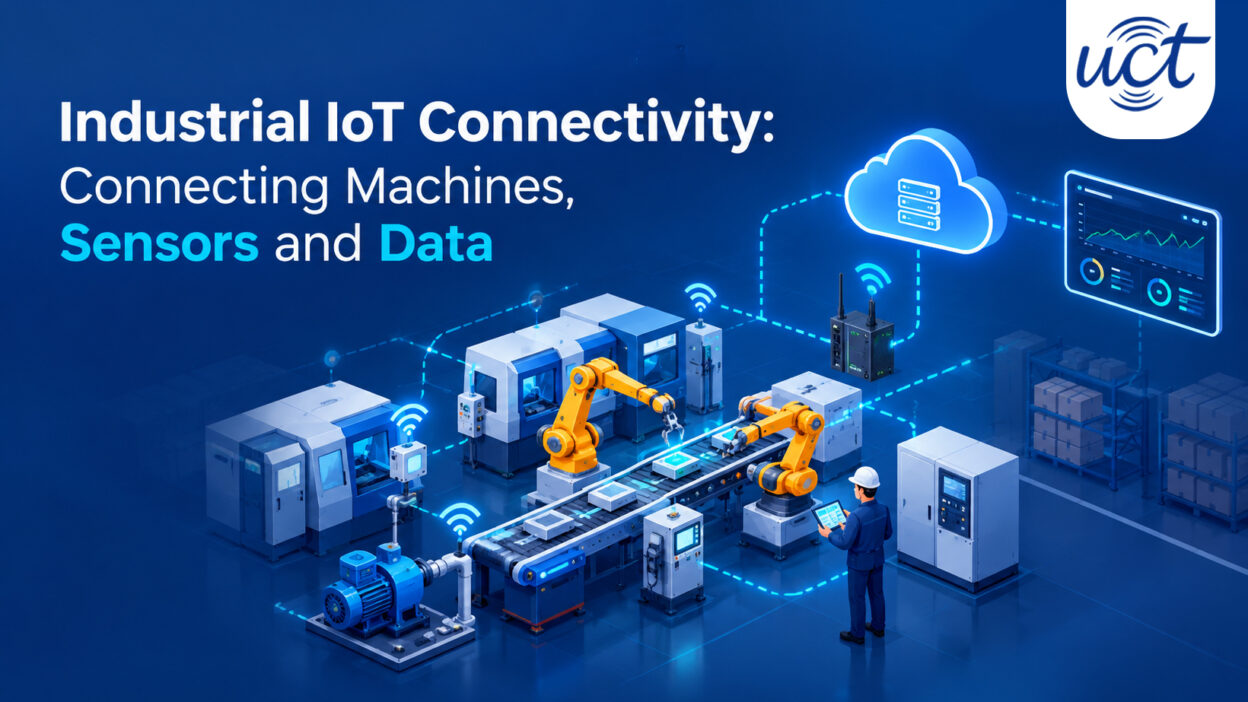

| Modern industrial facilities generate enormous amounts of data every day. Machines, sensors, meters, controllers and other field devices continuously produce information about temperature, energy consumption, equipment status, production processes and operating conditions. But collecting this data is only the first step. The real challenge is connecting industrial devices reliably and getting their data to the systems where it can be monitored, analyzed and acted upon. This is where Industrial IoT connectivity becomes important. Industrial IoT connectivity provides the communication layer between machines, sensors, field devices, gateways, networks and cloud platforms. With the right connectivity infrastructure, businesses can move from isolated equipment and manual monitoring toward a more connected and data-driven industrial environment. |
What Is Industrial IoT Connectivity?
ndustrial IoT connectivity refers to the technologies and communication methods used to connect industrial machines, sensors and devices so that they can exchange data with monitoring systems, gateways, cloud platforms and other applications.
A typical Industrial IoT system can be represented as:
Machines & Sensors → Connectivity Layer → Gateway/Network → Cloud/Platform → Dashboard & Analytics
Each layer has a specific role.
Sensors and machines generate data. The connectivity layer transports that data. Gateways collect and process device information and may convert between communication protocols. Networks transfer the information to the required platform, where businesses can visualize and analyze it.
Without reliable connectivity, even advanced sensors and analytics platforms cannot deliver their full value.
Why Connectivity Is a Challenge in Industrial Environments
Industrial facilities are very different from typical office environments.
A factory may contain hundreds or thousands of devices distributed across production areas, utility rooms, warehouses and outdoor installations. Many of these devices may use different communication protocols and may have been installed years apart.
Common challenges include:
1. Long Cable Runs
Traditional industrial devices often use wired communication such as RS485.
While RS485 is reliable and widely used for industrial communication, connecting devices over long distances can require extensive cabling, conduits, installation work and maintenance.
As the number of devices increases, wiring can become increasingly difficult and expensive.
2. Multiple Communication Protocols
Industrial equipment does not always use the same communication technology.
A facility may have:
- RS485 devices
- Modbus RTU equipment
- Analog sensors
- Digital inputs and outputs
- Energy meters
- PLCs
- Industrial controllers
Bringing information from these different devices into one monitoring environment requires an appropriate connectivity architecture.
3. Difficult-to-Reach Devices
Some sensors and meters are installed in locations where running new communication cables is impractical.
Examples include:
- Utility areas
- Large warehouses
- Remote equipment rooms
- Outdoor installations
- Water treatment facilities
- Energy monitoring locations
Wireless connectivity can make these installations easier to scale.
4. Legacy Equipment
Industrial digital transformation does not necessarily mean replacing existing machines.
Many facilities already have working equipment that communicates through established industrial interfaces such as RS485 and Modbus.
The challenge is to connect this existing infrastructure to modern IoT systems without unnecessarily replacing the equipment.
How Industrial IoT Connectivity Works
An Industrial IoT connectivity architecture generally consists of several connected layers.
1. Machines and Sensors
The process begins with field devices.
These can include:
- Temperature sensors
- Pressure sensors
- Flow meters
- Energy meters
- Vibration sensors
- Industrial machines
- PLCs
- Controllers
- Environmental sensors
These devices generate the information required for monitoring and automation.
2. Connectivity Layer
The connectivity layer determines how device data moves from the field to the next stage.
Depending on the application, this can include wired technologies such as RS485 and Ethernet, or wireless technologies such as LoRaWAN, Wi-Fi and cellular connectivity.
The appropriate technology depends on factors such as distance, power availability, environment, data volume, infrastructure and deployment requirements.
3. Gateway
A gateway acts as an important bridge between field devices and the wider network.
For example, a gateway can collect data from industrial devices and forward it through a suitable network to a cloud or application platform.
In an industrial LoRaWAN deployment, gateways receive LoRaWAN messages from connected nodes and forward them to the network server.
4. Network and Cloud Platform
Once data reaches the network infrastructure, it can be transferred to an IoT platform or cloud environment.
The platform can then organize, store and process the incoming information.
5. Dashboard and Applications
The final layer is where data becomes useful to people.
Dashboards can provide information such as:
- Energy consumption
- Equipment status
- Temperature trends
- Water usage
- Production parameters
- Alerts and abnormal conditions
- Historical data
Instead of manually collecting information from individual devices, teams can monitor important parameters from a centralized interface.
The Role of RS485 in Industrial IoT
RS485 remains widely used in industrial environments because of its robust communication characteristics and suitability for industrial equipment.
Many energy meters, sensors, controllers and automation devices use RS485 with Modbus RTU.
However, traditional RS485 installations require physical communication wiring.
This creates a challenge when devices are distributed across large facilities or when new monitoring points need to be added.
This is where RS485-to-LoRaWAN connectivity can provide an alternative approach.
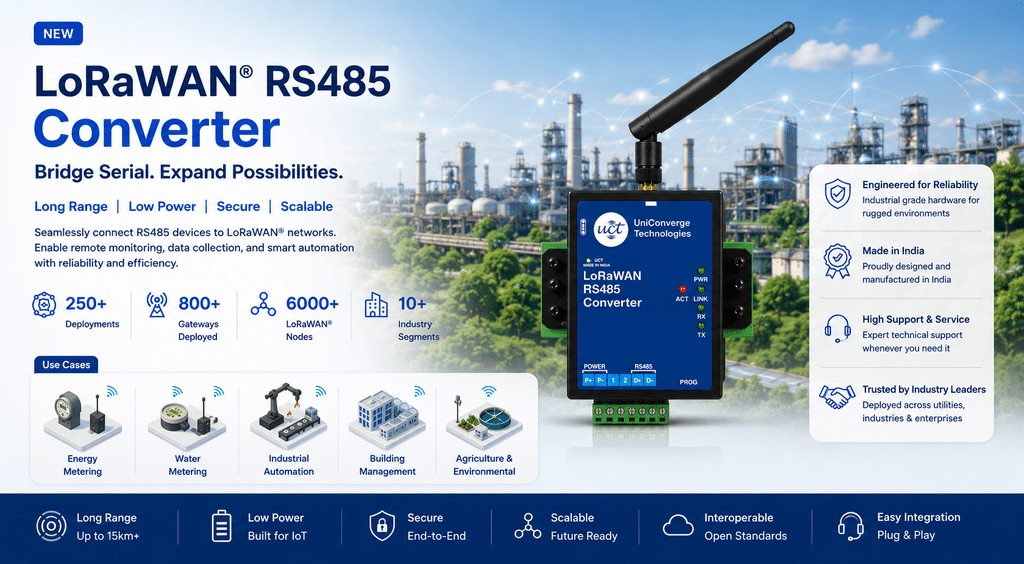
An RS485-to-LoRaWAN converter can collect data from compatible RS485/Modbus devices and transmit that information over a LoRaWAN network.
This allows existing industrial devices to become part of a wireless IoT architecture without necessarily replacing the original equipment.
Why LoRaWAN Is Useful for Industrial IoT
LoRaWAN (Long Range Wide Area Network) is a wireless communication technology designed for long-range, low-power IoT applications.
For industrial applications, LoRaWAN can be useful where devices are geographically distributed and do not need to continuously transmit large volumes of data.
Potential advantages include:
- Long-range wireless communication
- Low power consumption
- Support for large numbers of devices
- Reduced dependence on extensive communication cabling
- Suitable for remote monitoring applications
- Secure device communication
- Flexible deployment across large facilities
For example, a facility could use LoRaWAN-connected devices to monitor energy meters, water meters, environmental conditions or equipment parameters across different areas.
Wired vs Wireless Industrial IoT Connectivity
here is no single connectivity technology that is ideal for every industrial application.
Wired Connectivity
Wired communication can be suitable when:
- Devices are permanently installed
- Reliable physical infrastructure already exists
- High-speed communication is required
- Devices are located close to existing network infrastructure
However, installing new cables can become challenging when devices are spread across large areas.
Wireless Connectivity
Wireless connectivity can be useful when:
- Devices are geographically distributed
- New cabling is difficult
- Remote monitoring is required
- Deployment flexibility is important
- Additional monitoring points need to be added
The important point is not that wireless connectivity replaces wired communication everywhere.
Instead, modern Industrial IoT architectures can combine wired and wireless technologies depending on the application.
Connecting Existing Industrial Infrastructure
One of the biggest advantages of Industrial IoT is the ability to modernize existing infrastructure.
Businesses do not always need to replace their existing meters, machines or controllers to begin collecting data.
A connectivity device can act as a bridge between existing industrial interfaces and modern IoT networks.
For example:
Existing RS485 Device → RS485-to-LoRaWAN Converter → LoRaWAN Gateway → Network Server → IoT Platform → Dashboard
This approach can help organizations extend the usefulness of existing equipment while gradually introducing IoT capabilities.
Industrial Applications of IoT Connectivity
Industrial IoT connectivity can support a wide range of applications.
Energy Monitoring
Connected energy meters can provide real-time information about electricity consumption across machines, production lines or facilities.
This can help teams identify consumption patterns and investigate unusual usage.
Water Monitoring
Connected flow meters can transmit water consumption data for centralized monitoring.
This can support applications such as water usage tracking, leak monitoring and utility management.
Equipment Monitoring
Sensors can collect parameters such as temperature, vibration or operating status.
The resulting data can be used to monitor equipment conditions and identify unusual changes.
Smart Manufacturing
Connected machines and sensors can provide production teams with greater visibility into manufacturing processes.
Data from different equipment can be brought into centralized monitoring systems for analysis.
Remote Monitoring
Industrial assets located across large facilities or remote locations can be monitored without requiring personnel to physically inspect every device at regular intervals.
What Businesses Should Consider When Choosing Industrial IoT Connectivity
Selecting an IoT connectivity technology should begin with the application rather than the technology itself.
Businesses should consider:
Distance
How far are the devices from the gateway or network infrastructure?
Data Requirements
How frequently does the device need to transmit information, and how much data is being transmitted?
Power Availability
Are the devices connected to a continuous power source, or do they need to operate on batteries?
Existing Infrastructure
Can existing communication interfaces such as RS485 or Modbus be integrated?
Environment
Will the equipment operate inside a factory, outdoors, underground or in another challenging industrial environment?
Scalability
Can the connectivity architecture support additional devices as the deployment grows?
Security
Does the solution provide appropriate authentication, encryption and secure communication mechanisms?
Answering these questions helps businesses select a connectivity architecture that matches their actual operational requirements.
Building a Connected Industrial Ecosystem
ndustrial IoT connectivity is not simply about putting sensors on machines.
The bigger objective is to create a connected ecosystem where information can move reliably from the physical environment to the systems where it can create operational value.
A typical architecture may look like:
Sensors & Machines
↓
Industrial Interfaces / IoT Nodes
↓
LoRaWAN / Wired Connectivity
↓
Gateway & Network
↓
Cloud / IoT Platform
↓
Dashboard & Analytics
↓
Operational Decisions
When these layers work together, organizations can gain greater visibility into their industrial operations.
How UniConverge Technologies Supports Industrial IoT Connectivity
UniConverge Technologies provides industrial IoT connectivity solutions designed to connect field devices with modern wireless and IoT networks.
Its solutions include technologies for applications such as LoRaWAN connectivity, energy monitoring, industrial device communication and remote monitoring.
For existing RS485-based equipment, an RS485-to-LoRaWAN converter can help bridge traditional Modbus RTU devices with a LoRaWAN network.
This enables businesses to build wireless monitoring solutions around existing industrial equipment while reducing the need for extensive new communication cabling in suitable applications.
The approach can be particularly relevant for industries looking to gradually modernize their infrastructure rather than replace their existing equipment.
The Future of Industrial IoT Connectivity
Industrial IoT is moving toward increasingly connected and data-driven operations.
As more machines, meters and sensors become connected, the connectivity layer will become even more important.
Future industrial environments are likely to combine multiple technologies rather than depend on a single communication method.
RS485, Ethernet, LoRaWAN, cellular and other connectivity technologies can each have a role depending on the application.
The objective is simple:
Connect the right devices, using the right connectivity technology, and make their data available where it can be used.
Industrial IoT connectivity provides the foundation for doing exactly that.
Conclusion
Industrial IoT connectivity connects the physical world of machines and sensors with the digital systems used to monitor and manage industrial operations.
From traditional RS485 devices to wireless LoRaWAN sensors and gateways, businesses can combine different technologies to build connected industrial environments.
The key is not simply collecting more data. It is creating a reliable path for that data to move from machine → network → platform → people.
With the right connectivity architecture, organizations can gradually transform existing industrial infrastructure into a more connected, visible and data-driven operation.
Looking to connect your industrial devices with a modern IoT network?
Explore UniConverge Technologies’ industrial IoT and LoRaWAN solutions to find connectivity options for your application.
Website: https://www.uniconvergetech.in/
Email: sales@uniconvergetech.in
Phone: +91 92057 03472
Location: Sector 62, Noida, Uttar Pradesh, India